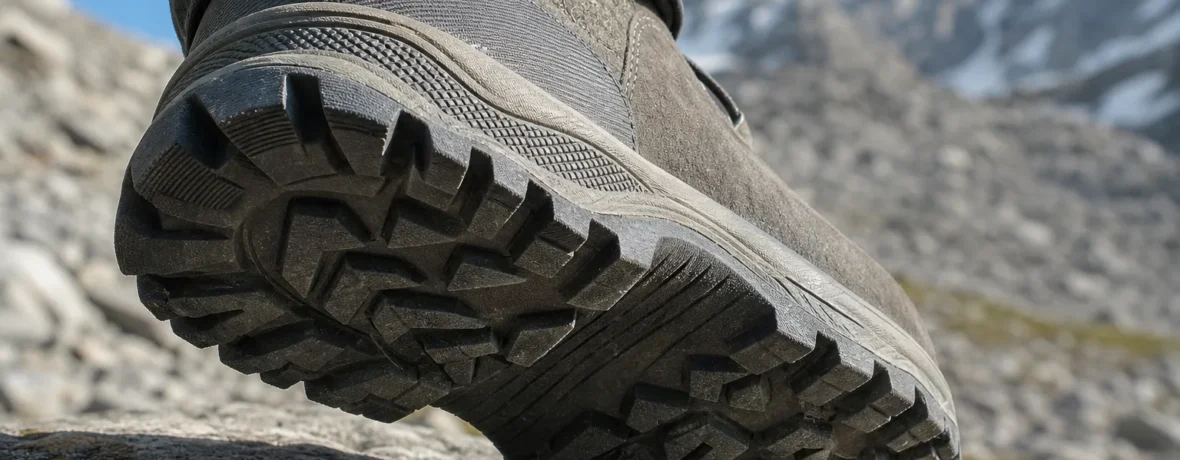
A Vibram sole is a branded rubber outsole used on hiking boots, trail shoes, work boots, and climbing footwear. If you’re asking “what is a Vibram sole,” the short answer is: yes, it can improve grip and durability, but only when the lug pattern, rubber compound, and shoe fit match your trail conditions.
What is Vibram sole and how does it work?
A Vibram sole works by pairing a rubber compound with a lug pattern built for traction, braking, and wear resistance.
Vibram is not one single sole. It is a company that makes many outsole designs for different footwear brands. The brand traces its mountain-boot roots to 1937, when Vitale Bramani developed the Carrarmato rubber lug sole for mountaineering; Vibram’s own history describes that early design as a mix of rubber material and a “tank” tread pattern. You can read the brand background on Vibram’s official history page.
On your boot, the Vibram part is usually the black or colored outsole that touches the ground. It may be glued, cemented, stitched, or molded to the midsole depending on the shoe. The midsole handles cushioning and support. The outsole handles contact with dirt, rock, mud, roots, and pavement.
Look for the yellow Vibram octagon on the bottom or side of the shoe. That logo tells you Vibram made the outsole, but it does not tell you the sole is automatically perfect for your hike. A stiff backpacking boot and a flexible trail runner can both use Vibram rubber and feel completely different underfoot.
Are Vibram soles good for hiking?
Yes, Vibram soles are often good for hiking when the tread matches the terrain.
That last part matters. A deep, widely spaced lug sheds mud better than a flat approach-shoe sole. A sticky rubber compound grips rock better than a hard, long-wearing compound, but it may wear faster on pavement. A winter-focused sole can help on cold, slick surfaces, while a lightweight sole saves weight for faster hiking.
Here is the simple trail logic:
- Loose dirt and gravel: Choose pronounced lugs with braking edges under the heel.
- Wet roots and rock: Choose stickier rubber and more surface contact.
- Mud: Choose deeper, more open lugs that can clear debris.
- Long backpacking trips: Choose a durable outsole with enough stiffness for load carrying.
- Desert slickrock: Choose lower-profile lugs with sticky rubber and good ground feel.
Vibram lists outdoor technologies such as Megagrip, Litebase, Arctic Grip, XS Trek, and Mont across its official technology pages, each aimed at different performance needs. See Vibram’s overview of sole technologies and compounds for the current lineup.
What are Vibram soles made of?
Vibram soles are made from rubber compounds blended for grip, durability, weight, flexibility, or cold-weather performance.
Rubber is the base idea, but the recipe changes. Think of it like tires. A winter tire and an all-terrain tire are both rubber, but they do not behave the same. Vibram does something similar with footwear outsoles.
Some compounds are tuned for sticky traction. Some are tuned for abrasion resistance. Some are designed to stay useful in cold weather. Some shave weight from the sole without changing the overall lug shape. The outsole also includes a tread design: lug height, lug spacing, channels, heel brakes, toe climbing zones, and flex grooves.
| Vibram feature | What it does | Best use |
|---|---|---|
| Deep lugs | Bite into soft ground | Mud, forest duff, loose trail |
| Sticky compound | Increases friction on hard surfaces | Wet rock, slabs, scrambling |
| Firm compound | Resists wear longer | Backpacking, rocky trails, mixed use |
| Lightweight construction | Reduces outsole weight | Fast hiking, trail running, long days |
Is Vibram better than regular rubber?
Sometimes, yes—but “Vibram” alone does not guarantee better performance.
A well-designed Vibram outsole usually signals that the footwear brand paid attention to traction. That is good. But the complete shoe still matters. A sloppy fit can make a grippy outsole feel unstable. A soft midsole can roll on sidehills. A shallow tread can clog in peanut-butter mud. A stiff boot can feel clumsy if you wanted trail-runner flex.
Regular rubber can be excellent too. Some footwear brands make strong proprietary outsoles. Others use Vibram because Vibram has long experience in outsole design and a recognizable reputation in the outdoor world. The real question is not “Vibram or non-Vibram?” The better question is: “Does this outsole match where I hike?”
Use this quick comparison:
| Choice | Strength | Watch out for |
|---|---|---|
| Vibram hiking outsole | Proven designs, many terrain-specific compounds | Performance varies by model |
| Brand-owned outsole | Can be tuned tightly to one shoe | Quality varies widely |
| Cheap generic outsole | Lower cost | May wear faster or grip poorly on wet rock |
Do Vibram soles last longer?
They can last longer than softer outsoles, but wear depends on rubber hardness, terrain, gait, pack weight, and how much pavement you walk.
Rocky trails chew up rubber. Pavement can sand down lugs quickly. A heavy pack adds force to each step. Dragging your heels wears the rear lugs first. Sticky rubber often trades some lifespan for grip, while harder rubber may last longer but feel less secure on wet slabs.
Signs your outsole is wearing out:
- Lugs are rounded instead of squared off.
- The heel brake no longer has a defined edge.
- The forefoot feels slick on dry rock where it used to hold.
- One side of the outsole is collapsing or wearing unevenly.
- You can see separation between the outsole and midsole.
If the upper and midsole are still in good shape, resoling may be possible. Vibram promotes repair and resoling through its Repair If You Care program, though whether your exact shoe can be resoled depends on its construction and a cobbler’s assessment.
How do you choose the right Vibram sole for hiking?
Choose the sole by terrain first, then by shoe fit, support, and weight.
Do not buy by logo alone. Flip the shoe over. Study the outsole like you study a map before a storm rolls in.
- Match the lug depth to the ground. Deep lugs for mud and loose soil; lower-profile lugs for rock and hardpack.
- Check lug spacing. Wide spacing clears mud better. Tight spacing feels smoother on rock and packed trails.
- Look at the heel. A defined heel brake helps on steep descents, especially with a pack.
- Flex the shoe. A flexible sole feels nimble. A stiffer sole gives more support under load.
- Think about weather. Cold, wet, and icy trails demand a different outsole than dry summer singletrack.
- Try it on with hiking socks. Grip does not help if your heel lifts or your toes slam the front on descents.
For mountain terrain, Vibram’s Mont compound is commonly associated with mountaineering and trekking footwear, while Megagrip is widely used for wet and dry grip in trail shoes and hiking footwear. For icy urban paths and cold mixed conditions, Vibram describes Arctic Grip as a technology aimed at grip on wet ice; check the specific footwear model because not every winter boot uses the same version.
Are Vibram soles slip-proof?
No outsole is slip-proof.
Vibram soles can improve traction, but slick algae, wet wood, ice, loose ball-bearing gravel, and polished rock can still put you on the ground. Traction is a system: outsole, tread, foot placement, body position, pack weight, and speed.
Use these habits on sketchy footing:
- Shorten your stride on wet rock and roots.
- Place your whole foot when crossing slabs.
- Slow down before steep, loose descents.
- Use trekking poles when carrying a heavy pack.
- Do not trust any outsole on smooth ice without traction devices.
For ice, microspikes or crampons may be the safer tool, depending on the route. Rubber helps. Metal teeth bite.
Can Vibram soles be resoled?
Some Vibram-soled footwear can be resoled, but not all of it.
Traditional leather hiking boots are often the best candidates. Many lightweight trail runners and cemented hiking shoes are harder to resole because the midsole, upper, and outsole may not be built for repeated repair. A cobbler needs enough structure to remove the old outsole and bond a new one without wrecking the shoe.
Resoling makes the most sense when:
- The upper is still strong.
- The midsole is not crushed or dead.
- The boot fits perfectly and is worth saving.
- The repair cost is reasonable compared with replacement.
- A qualified cobbler says the construction can handle it.
How do you care for Vibram soles?
Clean them, dry them away from high heat, and inspect them before big trips.
Trail grit works into lug channels. Mud can hide cuts. Pine sap and road oil can make rubber feel slick. After a dirty hike, knock off the debris, rinse the outsole with water, and use a soft brush in the tread. Let the shoes dry at room temperature. Do not bake them beside a fire or blast them with a heater; heat can damage adhesives and materials.
Before a trip, check for outsole separation, worn heel edges, missing lugs, and exposed midsole foam. If the sole is peeling, deal with it before you are 6 mi [9.7 km] from the trailhead with weather moving in.
Related reading
- How to Use a Compass for Hiking
- How to Waterproof a Tent: Seams, Rainfly and Floor
- How to Choose a Sleeping Bag: Temperature Ratings, Fill and Shape
- What Is Merino Wool and Why Hikers Swear By It
FAQ
What does Vibram mean on shoes?
Vibram means the outsole was made by Vibram, a company known for rubber lug soles used in outdoor, work, lifestyle, and repair footwear. The yellow octagon logo identifies the brand, not one universal tread pattern.
Are Vibram soles waterproof?
No, the sole itself does not make a shoe waterproof. Waterproofing depends on the upper materials, membrane, tongue design, seams, and overall construction.
Are Vibram soles good on wet rocks?
Some Vibram soles are very good on wet rock, especially stickier compounds such as Megagrip. Still, wet algae, polished stone, and steep slabs can overwhelm any rubber outsole.
Why do some Vibram soles feel hard?
They may use a firmer compound for durability, edging support, or load carrying. Harder rubber can last longer, but it may feel less sticky than softer rubber on smooth rock.
Is Vibram worth it for day hiking?
Yes, it can be worth it if the shoe fits well and the tread suits your local trails. For easy dirt paths, you may not need an aggressive Vibram outsole; for rocky, wet, or steep terrain, better traction earns its keep fast.