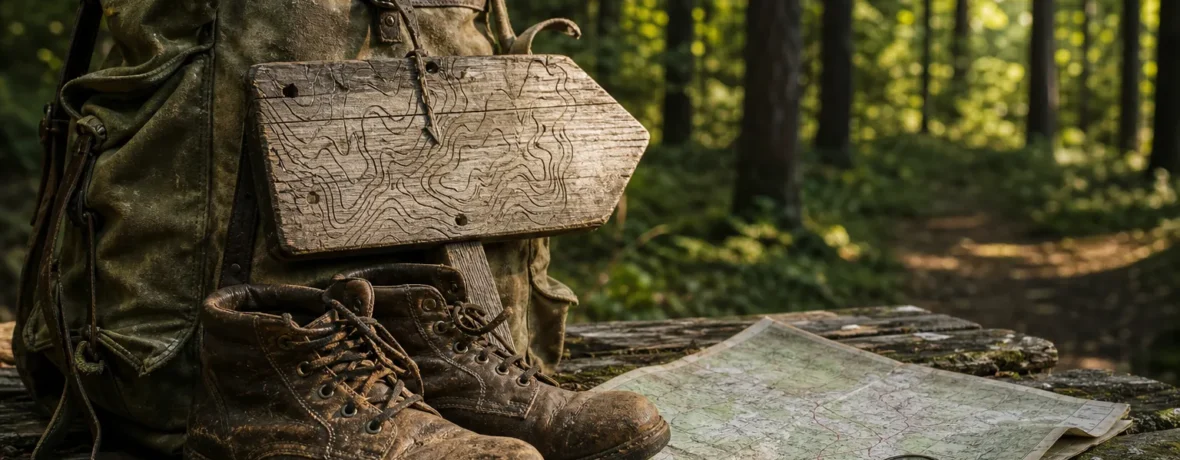
The history of hiking is not the story of humans learning to walk; it is the story of walking becoming a chosen outdoor pursuit. Modern hiking took shape in the 1800s, grew through clubs, parks, and trail rights, then exploded with long-distance trails in the 1900s.
What is the history of hiking in one short version?
Hiking began when practical foot travel turned into voluntary recreation.
For most of human history, walking across land was work. You walked to hunt, trade, migrate, farm, fight, visit, or survive. Trails were not “hiking trails.” They were routes to water, passes through mountains, paths between villages, Indigenous travel corridors, trade roads, pilgrimage ways, and animal tracks made useful by people.
The change came when people started walking into rough country because they wanted to be there. That shift gathered speed in Europe and North America during the 1800s, when industrial cities grew, railroads carried people closer to mountain regions, and writers and artists made wild landscapes feel spiritually and culturally valuable. The old practical footpath became a weekend plan.
Here is the position: hiking is often sold as personal escape, but its real history is collective. The trail under your boots exists because communities fought for access, built clubs, mapped routes, cut tread, protected land, and argued that ordinary people deserve wild places.
When did hiking become a popular leisure activity?
Hiking became a popular leisure activity in the 1800s.
That does not mean nobody walked for pleasure before then. Pilgrims, poets, naturalists, hunters, shepherds, and wanderers all moved through landscapes with motives beyond simple transportation. But the 1800s gave recreational walking a wider public identity. City life made the countryside feel like medicine. Railroads made it reachable. Guidebooks and maps made it repeatable.
In Britain, “rambling” became the common word for walking in the countryside. Access mattered from the start. Much of the best open land was privately controlled, so walking for pleasure quickly became political. The official Ramblers history points to the 1932 Kinder Scout mass trespass, involving 400 walkers from Manchester and Sheffield, as a key moment in the long fight for public access.
That matters because the same tension still shows up today. You may call it hiking, rambling, tramping, hillwalking, or trekking. The argument behind it stays familiar: who gets to walk, where, and on what terms?
Who made hiking popular in America?
No single person made hiking popular in America.
American hiking grew through a mix of Indigenous routes, European settler paths, scientific exploration, conservation politics, outdoor clubs, guidebooks, and later federal land protection. If you want a marker, look to the late 1800s. The Appalachian Mountain Club was founded in Boston in 1876, tying recreation to exploration, science, trail work, and conservation in the Northeast.
Then came the western conservation movement. John Muir did not invent hiking, but his writing and advocacy helped sell Americans on the idea that wild country had value beyond timber, grazing, and mining. The National Park Service says Muir arrived in the Sierra Nevada in 1868 and later helped found the Sierra Club in 1892 to preserve Yosemite and other wild places in the Sierra Nevada Mountains, according to its history of nineteenth-century conservation.
Here is the blunt version: American hiking became popular when walking met land protection. Clubs made routes. Conservationists made a moral case. Parks made destinations. Volunteers made it usable.
How did national parks change hiking?
National parks turned scenic walking into a public promise.
Yellowstone became the first U.S. national park in 1872, and the National Park Service was established in 1916, according to the Library of Congress brief history of national parks. Those two dates changed outdoor recreation because they tied public enjoyment to preservation.
That bargain is messy. Roads brought crowds. Hotels followed. So did concessionaires, postcards, parking lots, and the eternal restroom problem. Still, parks gave millions of people legal, mapped, maintained access to landscapes that could easily have been fenced, logged, mined, or sold off piece by piece.
For hikers, the park idea created a new expectation: a trail could be public infrastructure. Not a leftover track. Not a private favor. A maintained footpath with signs, maps, crews, bridges, switchbacks, and a reason to exist.
How did long-distance hiking begin?
Long-distance hiking began when trails became planned regional systems.
The Appalachian Trail is the cleanest American example. The National Park Service says Benton MacKaye conceived the trail in 1921 as a wilderness retreat from urban life and a way to preserve the Appalachian ridgeline; with volunteer, federal, state, and Civilian Conservation Corps help, the trail first opened in 1937, according to this NPS history of Appalachian Trail partnerships.
That was a leap. A path was no longer just a way to reach one summit. It could connect states, communities, shelters, clubs, ridgelines, and an entire hiking culture.
| Era | What changed | Why it matters to you |
|---|---|---|
| Ancient and premodern routes | Footpaths served trade, migration, hunting, pilgrimage, and local travel. | Many trails began as useful corridors, not recreation projects. |
| 1800s leisure walking | Urban people began seeking countryside and mountains for pleasure. | Hiking became a chosen activity, not only a necessity. |
| Late 1800s to early 1900s clubs | Outdoor groups mapped routes, built shelters, published guides, and pushed conservation. | The volunteer trail culture you depend on took root. |
| 1900s long trails | Regional footpaths became protected, named, and maintained systems. | Thru-hiking and section hiking became realistic goals. |
What role did the National Trails System play?
The National Trails System made long trails federal policy.
In 1968, the National Trails System Act established the Appalachian Trail and Pacific Crest Trail as the first two national scenic trails, according to the National Park Service summary of the act. That move gave long-distance hiking a legal framework, not just a romantic one.
The law also confirmed something hikers had already proved with their feet: trails can cross jurisdictions and still serve one public purpose. A long trail may pass through national parks, national forests, state lands, private easements, road crossings, towns, farms, deserts, and high passes. Without cooperation, it breaks.
That is why long-distance hiking is never only an individual feat. You carry your own pack, yes. But you walk through the work of agencies, clubs, landowners, maintainers, donors, planners, and old stubborn people who refused to let the footpath disappear.
Why does hiking history matter now?
Hiking history matters because access is not permanent.
Trails can close. Easements can fail. Maintenance can fall behind. Wildfire, floods, development, overuse, and bad behavior can change a route faster than nostalgia can save it. If you treat hiking as a consumer product, you miss the point. The trail is not content. It is a public trust with dirt on it.
This is where hikers need to grow up a little. Gear is fun. Trip photos are fun. Big-mile goals are fun. But none of that exists without access and stewardship. The history of hiking says the same thing again and again: people get the trails they are willing to defend.
How can you hike with history in mind?
You hike with history in mind by acting like a beneficiary, not an owner.
- Learn whose land you are on. Read trailhead signs, agency pages, tribal history, and local land acknowledgments when available.
- Respect closures. A closed trail may be protecting nesting wildlife, burned slopes, washed-out tread, private access, or your own neck.
- Support trail groups. Join, donate, volunteer, or at least stop acting shocked that trails need money and labor.
- Use durable surfaces. Cutting switchbacks is not harmless. It turns one lazy choice into erosion everyone else has to walk through.
- Make room for other hikers. Public access means the trail is not tailored to your pace, playlist, dog, drone, or summit schedule.
- Carry out trash, including food scraps.
- Stay on established tread where trails are signed and maintained.
- Read current land manager guidance before big trips.
- Give trail crews space to work.
- Teach new hikers the ethic, not just the route.
Related reading
- A Short History of the Appalachian Trail
- How National Parks Began
- Type 2 Fun: Why Hard Hikes Feel Good Later
- The Seven Summits Explained
FAQ
When did hiking start?
Hiking as recreation took recognizable shape in the 1800s. Walking routes are ancient, but the modern idea of heading into hills, forests, and mountains for pleasure grew with cities, railroads, outdoor clubs, guidebooks, and conservation movements.
Who invented hiking?
No one invented hiking. People have always walked, but modern hiking came from many sources: Indigenous travel routes, European rambling traditions, mountaineering clubs, American conservationists, park planners, and volunteer trail builders.
What is the difference between walking and hiking?
Walking is the broad act of traveling on foot. Hiking usually means walking outdoors on trails or rougher natural terrain, often for recreation, fitness, scenery, solitude, or a destination such as a viewpoint, lake, pass, or summit.
Why is the Appalachian Trail so important in hiking history?
The Appalachian Trail showed that a footpath could be planned across a vast region and maintained by partnerships. Proposed in 1921 and first opened in 1937, it helped define the American dream of long-distance hiking.
Is hiking still political?
Yes, hiking is still political whenever access, funding, conservation, private land, public land, or trail damage enters the picture. Every open trail reflects decisions about who gets to use land and who takes care of it.