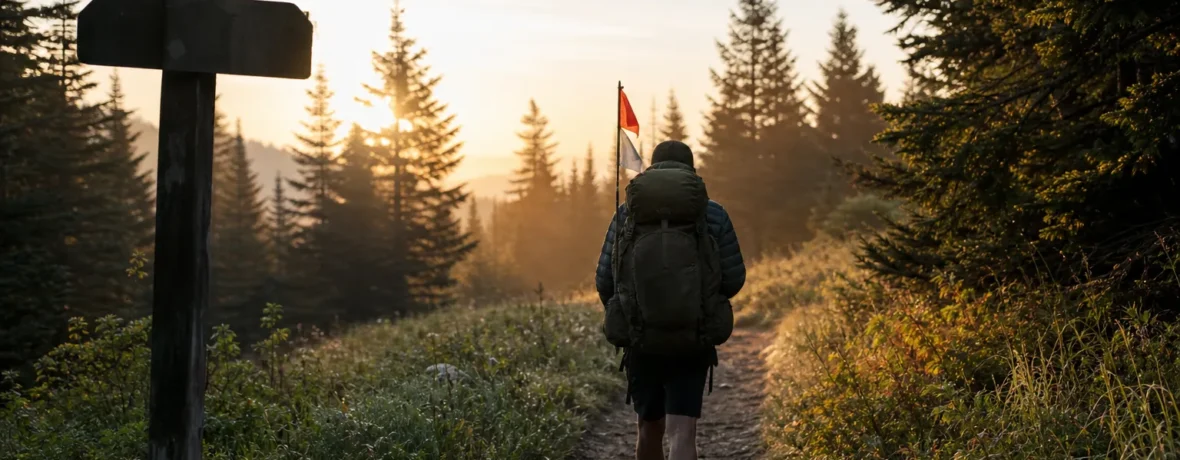
NOBO means “northbound.” On a thru-hike, a NOBO hiker travels from the southern end of a trail toward the northern end. SOBO means southbound. A zero means 0 trail miles in a day; a nero means nearly zero miles, often just enough to reach town or camp.
Here’s the straight take: thru-hiker slang is useful when it makes trail life clearer, faster, and friendlier. It turns clunky explanations into quick shorthand. But the second it becomes a secret handshake used to make new hikers feel dumb, it’s trash. Trail language should open the door, not guard it.
If you’re planning your first long trail, you don’t need to memorize every oddball phrase before your first step. Learn the words that affect direction, pacing, resupply, safety, and etiquette. The rest will rub off on you somewhere between damp socks, gas-station pizza, and the third person who asks if you’ve got a trail name yet.
What does NOBO mean in hiking?
NOBO means northbound.
If you ask, “what does nobo mean,” that’s the answer: a NOBO hiker is traveling toward the northern terminus of a trail. On the Appalachian Trail, for example, a NOBO thru-hike starts at the southern end and heads north, while the Appalachian Trail Conservancy’s thru-hiking resources use NOBO, SOBO, and flip-flop to describe common thru-hike directions.
NOBO is pronounced “no-bo,” not spelled out letter by letter. You’ll see it written as NOBO, NoBo, or nobo. Same meaning. Trail people are not strict copy editors, and thank goodness for that.
Why does the word matter? Because direction shapes the whole hike:
- Weather windows: Northbound and southbound hikers hit mountains, deserts, snow, heat, and seasonal closures at different times.
- Crowds: A popular NOBO season can create a “bubble” of hikers moving in the same direction.
- Resupply: Town stops, mail drops, and hostel traffic can feel different depending on which way most hikers are moving.
- Morale: Hiking with or against the main flow changes how often you see familiar faces.
NOBO is not a badge of superiority. It is not “the real way.” It is just a direction. A clean, useful word. Let’s keep it that way.
What does SOBO mean on a trail?
SOBO means southbound.
A SOBO hiker starts at the northern end of a trail and heads south. On the Appalachian Trail, the ATC describes a SOBO thru-hike as beginning at Katahdin in Maine and ending at Springer Mountain in Georgia.
SOBO hikes can feel quieter because they often move against the larger NOBO crowd. That can be magic if you like space. It can also be harder if you count on a big rolling community to pull you through rough days.
Neither direction is automatically tougher. That argument eats itself. A SOBO hiker may start with harder terrain, colder mornings, or fewer companions. A NOBO hiker may deal with crowding, heat, or a race against late-season conditions. Different does not mean better. It means different.
| Term | Meaning | Plain-English use |
|---|---|---|
| NOBO | Northbound | “I’m hiking NOBO from the southern terminus.” |
| SOBO | Southbound | “She started up north and is hiking SOBO.” |
| Flip-flop | A thru-hike split into non-linear sections | “He hiked north, then flipped and hiked south to finish.” |
| LASH | Long-a– section hike | “They’re doing a LASH, not the whole trail in one season.” |
What is a zero day in thru-hiker slang?
A zero day is a day with 0 trail miles.
You may walk to the grocery store. You may shuffle across a motel parking lot in Crocs. You may climb three flights of stairs to a laundry room and feel personally attacked. None of that counts. A zero means no forward progress on the trail.
Zeros are not failures. They are maintenance. Your body needs food, sleep, dry socks, wound care, and a few hours where every decision is not filtered through mileage. Your gear needs attention too. Shoes blow out. Quilt baffles shift. Water filters clog. Power banks die. A zero gives you room to fix small problems before they turn into hike-ending problems.
The mistake is treating a zero like a vacation from consequences. One zero can restore you. Three unplanned zeros in an expensive town can wreck a budget and momentum. Use them. Don’t let them use you.
What is a nero day, and is it different from a zero?
A nero is a near-zero mileage day.
Think of a nero as the compromise day. You hike a short distance, then spend the rest of the day doing town chores, eating, washing clothes, charging electronics, sorting food, and pretending you’ll leave early tomorrow.
A nero might mean hiking 2 miles [3.2 km] into town in the morning. It might mean leaving town late and walking 6 miles [9.7 km] to the next legal campsite. There is no universal mileage law. The point is that you made a little forward progress while still giving yourself most of the benefits of a rest day.
Here’s the column opinion: neros are underrated. For many hikers, a smart nero beats a full zero. You keep rhythm. You reduce lodging costs. You avoid that heavy-legged feeling that can show up after a full day of doing nothing. But if you are sick, injured, depleted, or mentally cooked, don’t cosplay toughness. Take the zero.
What hiking slang should beginners know before a thru-hike?
Learn the hiking slang that helps you move, communicate, and stay out of trouble.
You do not need a full trail dictionary. You need the working vocabulary. The rest is seasoning.
- Thru-hiker: Someone attempting to hike an entire long-distance trail in one continuous trip or season, depending on the trail’s convention.
- Section hiker: Someone hiking a long trail in separate pieces over time.
- Trail name: A nickname used on trail, often earned, gifted, or chosen.
- Trail magic: Unexpected kindness given to hikers, often food, drinks, rides, or help.
- Trail angel: A person who provides trail magic or support.
- Hiker box: A box at a hostel, outfitter, or resupply stop where hikers leave unwanted food or gear for others.
- Resupply: Getting more food, fuel, toiletries, or other consumables.
- Shakedown: A review of your gear to cut weight or fix poor choices.
- Base weight: Pack weight without consumables like food, water, and fuel.
- Blue blaze: An alternate side trail or route, especially common language around the Appalachian Trail.
- Yellow blaze: Skipping trail miles by road travel. Often used as a jab, sometimes fairly, often not.
- Leave No Trace: Outdoor ethics built around reducing your impact; start with the Leave No Trace 7 Principles.
That last one matters more than sounding fluent. Nobody cares if you forget the word “nero.” People care if you leave orange peels in a fire ring, camp on fragile vegetation, or blast music at a shelter.
How do you use thru-hiker slang without sounding like a poser?
Use slang when it makes your meaning clearer.
That’s the rule. Not cooler. Clearer.
If you are new, say the plain thing first. Then use the trail word once you understand it. You don’t have to perform belonging. A hiker who asks good questions, respects the land, and treats people well fits in faster than someone spraying jargon like bug repellent.
- Start with the practical terms. Learn NOBO, SOBO, zero, nero, resupply, shelter, privy, shuttle, and water carry.
- Listen before copying. Trail language varies by region and trail. Let local usage teach you.
- Ask when you don’t know. “What does that mean?” is a normal question, not a confession of weakness.
- Don’t weaponize words. Mocking someone for not knowing a term is lazy trail-gatekeeping.
- Use plain English for safety. If the issue is weather, injury, water, fire, route-finding, or a missing person, skip the cute phrasing.
The best trail slang has a job. It compresses meaning. “I’m taking a nero into town” tells another hiker your plan in six words. Good. Efficient. But if slang turns into fog, drop it.
When should you ignore trail slang and ask a plain question?
Ignore slang when the stakes are higher than sounding trail-savvy.
Ask plainly about water, distance, exposure, permits, closures, weather, injury, fires, stream crossings, and transportation. If someone says, “The next stretch is dry,” ask how many miles to the next reliable water. If someone says, “The pass is sketchy,” ask what made it sketchy: snow, ice, wind, lightning, loose rock, or route confusion.
This matters because trail slang can hide missing details. “Gnarly” is not a forecast. “Cruisy” is not a map. “Sendy” is not a safety plan.
For official trail planning, use official sources before gossip. The Pacific Crest Trail Association’s trail information and the National Trails System overview from the National Park Service are better starting points than a stranger’s three-year-old comment thread.
Why does thru-hiker slang matter at all?
Trail slang matters because it builds fast trust, but it should never replace good judgment.
Language is part of trail culture. Shared words make a scattered line of dirty, tired walkers feel like a temporary village. NOBO, SOBO, zero, nero, trail angel, hiker box—these words carry whole routines inside them. They help you plan a day, compare notes, and understand what other hikers are doing without a 10-minute explanation.
But here’s the line: culture is not the same as cliquishness. A welcoming trail culture explains itself. A weak one sneers at beginners. Every experienced hiker was once the person who didn’t know what a privy was, packed too much food, or thought a “zero” sounded like an insult.
So learn the language. Use it. Enjoy it. Laugh at the weirdness of it. Just don’t let vocabulary become your identity. The trail does not care how fluent you sound. It cares where you put your feet, how you treat the place, and whether you can get yourself to the next water source before dark.
Related reading
- Trail Blazes: What the Colors and Marks Mean
- Type 2 Fun: Why Hard Hikes Feel Good Later
- The Seven Summits Explained
- What Is Geocaching?
FAQ
Does NOBO always mean north on every trail?
Yes, NOBO means northbound. It describes direction of travel, not a specific trail, pace, or style.
Is NOBO better than SOBO?
No, NOBO is not automatically better than SOBO. NOBO often has a larger social bubble on popular trails, while SOBO can feel quieter and more independent.
How many miles is a nero?
A nero has no fixed mileage. In normal trail use, it means a very short hiking day—often just enough miles to get into town, leave town, or reach a nearby campsite.
Can you take a zero in a tent?
Yes, a zero can happen anywhere if you hike 0 trail miles that day. Many hikers take zeros in towns, but a campsite zero still counts if you make no forward trail progress.
What is a flip-flop thru-hike?
A flip-flop is a thru-hike completed in non-linear sections. For example, a hiker may start in the middle, hike north, then return to the middle and hike south.
Do I need a trail name to be a thru-hiker?
No, you do not need a trail name. Trail names are a tradition, not a requirement, and using your regular name is completely fine.