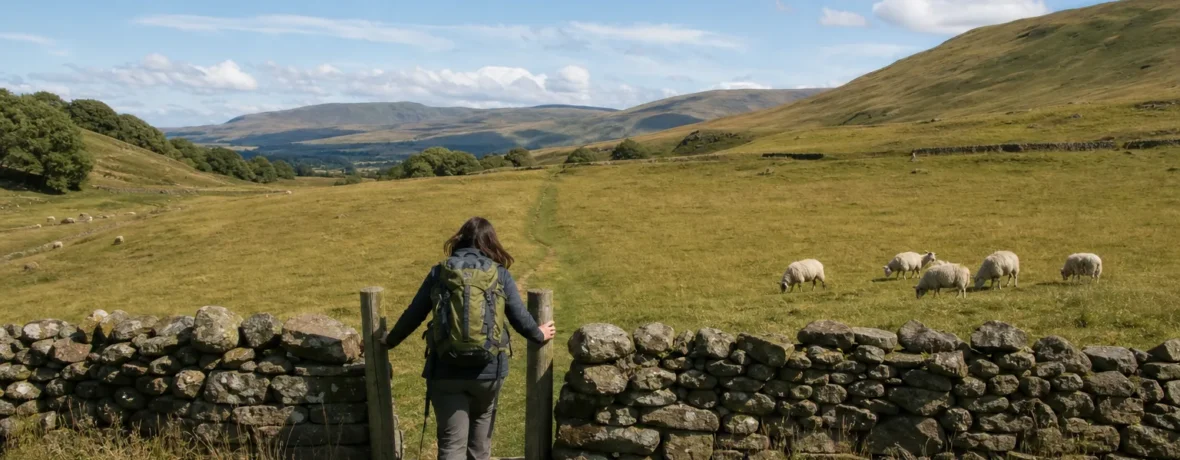
The right to roam lets you walk across certain private or public land without asking first, but only where the law allows it and only if you act responsibly. In 2026, Scotland and Nordic countries offer the broadest access; the United States does not have a nationwide right.
What does the right to roam mean?
It means access comes with duties, not a blank check.
A real right to roam gives you legal permission to cross land for quiet recreation: walking, hiking, running, birding, and in some places paddling or camping. The exact rights change by country. The common thread is simple: you may pass through, but you may not damage crops, disturb livestock, invade a home’s privacy, light fires where they are unsafe, or treat someone else’s land like a free campground.
That last part matters. The best access systems are not anti-landowner. They are pro-public and pro-responsibility. They say: yes, the hills, woods, shores, and moors are part of public life. They also say: don’t be a jerk.
That is the model hikers should want. Not chaos. Not trespass dressed up as virtue. A clear, legal, teachable access right with teeth for bad behavior and trust for everyone else.
Which countries have freedom to roam?
Scotland, Sweden, Norway, Finland, Iceland, and parts of the United Kingdom are the names hikers see most.
Scotland is the gold standard for many walkers. Under the Scottish access system, you can go onto most land and inland water for recreation if you behave responsibly. The official Scottish Outdoor Access Code says access rights do not usually apply to houses and gardens, farmyards, growing crops, quarries, railways, airfields, schools, or places where public access would be unreasonable, as of November 2026.
England and Wales are tighter. The official GOV.UK right to roam guidance says open access land includes mapped mountains, moors, heaths, downs, registered common land, and some land around the King Charles III England Coast Path, as of November 2026. That is useful. It is not the same as wandering across any field you like.
Sweden’s allemansrätten is another strong model. The Swedish Environmental Protection Agency describes it as a right to enjoy nature with responsibility: you can walk, cycle, ski, paddle, and sometimes camp, but you must not disturb or destroy. That phrase should be tattooed on every trailhead sign: do not disturb, do not destroy.
| Place | What you can generally do | What still limits you |
|---|---|---|
| Scotland | Walk across most land and inland water responsibly | Homes, gardens, crops, farmyards, schools, railways, unsafe worksites |
| England and Wales | Use mapped open access land and public rights of way | Most private fields, closures, livestock rules, local restrictions |
| Sweden | Walk, ski, paddle, forage, and sometimes camp responsibly | Private homes, crops, protected areas, hunting and fishing rules |
| United States | Use public land, easements, beaches, and trails where access is legal | No national roaming right across private land |
Does the right to roam exist in the United States?
No, not as a nationwide right.
The American default is permission. If land is private, you usually need permission unless a trail easement, public right-of-way, water-access rule, state-specific custom, or posted public access program says otherwise. Some New England states have long traditions of unposted land access for hunting or other outdoor uses, but those rules are local, limited, and easy to misunderstand.
On federal public land, you have far more room. Bureau of Land Management areas, national forests, national parks, wildlife refuges, state parks, and county lands can all offer legal access. But they are not one giant open door. Each agency has its own rules. Gates, seasonal closures, wildlife protections, fire bans, restoration areas, tribal lands, military lands, mining claims, and private inholdings can all change the answer on the ground.
The Bureau of Land Management camping guidance says most BLM lands allow dispersed camping unless an area is posted closed or has specific restrictions, as of November 2026. The U.S. Forest Service gives similar public-land access through national forests, but local forest orders and motor vehicle use maps control the details. Translation: public land is generous, but you still need to read the signs.
Here is the hard truth: the U.S. has millions of acres where you can hike freely, yet many Americans still live near land they cannot legally cross. A ridge may be visible from town and functionally unreachable. A river may be public, but every dry access point may be private. A national forest may sit behind a checkerboard of ranch parcels. That is not freedom. That is a map that teases you.
Can you camp under the right to roam?
Sometimes, but walking rights and camping rights are not the same thing.
Scotland generally allows lightweight, responsible wild camping as part of access rights, but not in places where camping causes damage, blocks work, crowds residents, or violates local controls. England’s open access land does not automatically give you a right to wild camp. Sweden often allows short, low-impact camping away from homes and sensitive areas, but protected land can have separate rules.
In the U.S., camping depends on the managing agency. Some BLM and national forest lands allow dispersed camping. National parks usually restrict camping to designated sites or permit zones. State lands vary wildly. Private land requires permission unless a specific legal arrangement says otherwise.
The rule for hikers is simple: assume walking, sleeping, fires, dogs, bikes, horses, drones, hunting, fishing, and foraging are separate permissions until you confirm otherwise.
How do you use the right to roam responsibly?
You earn public access by behaving like someone who deserves it.
Here is the practical field code:
- Leave gates exactly as you found them.
- Give livestock a wide berth, especially cattle with calves.
- Keep dogs under close control, and leash them when animals, nesting birds, or posted rules require it.
- Walk around field edges when crops are growing.
- Stay out of gardens, yards, farmyards, barns, and work areas.
- Pack out every scrap, including fruit peels and dog waste bags.
- Do not block driveways, gates, ranch roads, boat ramps, or emergency access.
- Skip fires unless they are clearly legal, safe, and low-impact.
- Use toilets before you start; if you must go outside, bury waste properly and stay far from water.
- Back off when wildlife changes behavior because of you.
Bad access behavior spreads faster than a good trail report. One trashed pullout, one dog chasing sheep, one campfire scar on dry grass, and the next landowner hears the story before breakfast. Then gates close. Signs go up. Everyone loses.
How can hikers check where they can legally walk?
Check the land status before your boots hit dirt.
Do not rely on vibes. A faint path through grass is not always a public trail. A gap in a fence is not an invitation. A line on a phone app can be wrong, old, or missing an access restriction.
- Find the land manager: national forest, BLM field office, state park, county open space, land trust, private owner, or tribe.
- Check the official map first, then compare it with your hiking app.
- Read current alerts for closures, fire restrictions, wildlife nesting zones, storm damage, and parking limits.
- Look for easements and public rights-of-way, not just nearby public land.
- Call the ranger district, field office, or land trust when the map is unclear.
- At the trailhead, obey posted signs even if your app says the route continues.
If that sounds less romantic than wandering over a hill at sunrise, fine. It is also how you avoid trespassing, fines, angry confrontations, and damaged access for the hikers behind you.
Should the U.S. adopt a broader right to roam?
Yes, but it should be local, phased, and tied to strict responsibility.
A national copy-paste of Scotland would crash into American property law, liability fears, hunting seasons, wildfire risk, tribal sovereignty, ranching, and the ugly reality that some public-land visitors already treat trailheads like dumpsters. Pretending otherwise helps nobody.
But the current system is too stingy. Too much walkable land is locked behind old assumptions. Too many towns have nearby woods children cannot legally enter. Too many rivers are public only if you own a boat or know someone with a gate key. That is a public-health problem, a conservation problem, and a civic problem.
The better path is a responsible access bargain:
- Expand state-level access laws for uncultivated land where risk is low.
- Create stronger recreational liability protection for landowners who allow free passage.
- Fund trail easements across private parcels that block public land.
- Pay land trusts and willing landowners for permanent public footpaths.
- Teach access ethics in schools, scouting groups, outdoor clubs, and permit systems.
- Penalize the real problems: littering, vandalism, gate blocking, livestock harassment, illegal fires, and off-road damage.
That is the column’s line in the dirt: hikers should fight for more access, but never for consequence-free access. The right to roam works only when the public can be trusted to walk lightly. If we want more open gates, we need to be the people landowners do not regret letting through.
Related reading
- Who Has the Right of Way on a Hiking Trail?
- Type 2 Fun: Why Hard Hikes Feel Good Later
- The Seven Summits Explained
- What Is Geocaching?
FAQ
What is the right to roam in simple terms?
The right to roam is legal permission to walk across certain land without asking the owner first. It usually applies to quiet recreation and comes with duties to avoid damage, disturbance, and invasion of privacy.
Is freedom to roam the same everywhere?
No. Each country writes its own access rules. Scotland, Sweden, and Norway are broader; England and Wales are more limited; the United States has no nationwide version.
Can I walk across private land in the United States?
Usually no, unless you have permission or a legal access right exists. Look for public trails, easements, open-space agreements, state-specific rules, or public land boundaries before you cross.
Does a public-land map mean I can drive or hike anywhere on it?
No. Public land can still have closed roads, private inholdings, seasonal closures, wildlife areas, burn zones, and permit requirements. Use official agency maps and obey posted signs on-site.
Why should hikers care about right-to-roam laws?
Access shapes who gets to experience nature. Better roaming laws can connect communities to nearby woods, hills, rivers, and coasts, but only if hikers prove that open access and respect can live together.