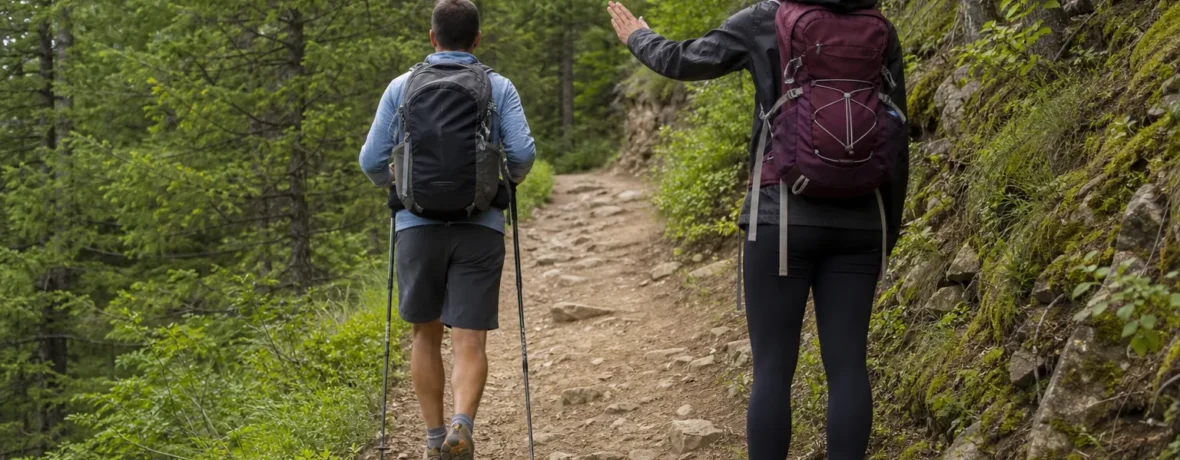
Use this 3-part rule: downhill hikers yield to uphill hikers, hikers yield to horses and pack stock, and bikes yield to hikers and horses. Yes, local signs can override the usual rule. When space is tight, stop, communicate, and pass slowly.
What is the hiking right of way rule?
The short rule is: yield early, communicate clearly, and follow the sign in front of you. As of November 2026, the National Park Service hiking etiquette guidance says trail signs may vary by park, but its general guidance is that uphill hikers have right of way, bicyclists yield to hikers and horses, and hikers yield to horses and other pack stock. (home.nps.gov)
Think of right of way as a safety tool, not a trophy. You are not “winning” by forcing someone else into brush, poison ivy, loose rock, or the outside edge of a cliffy trail. The clean move is to make eye contact, speak up, and create a calm pass before the meeting gets awkward.
| Trail meeting | Who usually yields? | What you do |
|---|---|---|
| Downhill hiker meets uphill hiker | Downhill hiker | Step aside and let the climber keep rhythm. |
| Hiker meets horse or pack stock | Hiker | Stop, speak calmly, and move to the safe side. |
| Bike meets hiker | Bike | Slow, stop if needed, and pass only when acknowledged. |
| Dog hiker meets other users | Dog hiker | Shorten the leash and give space. |
Do uphill hikers right of way rules mean downhill hikers always yield?
Usually, yes. The uphill hikers right of way rule exists because climbing hikers are working harder, moving slower, and may be locked into a steady breathing-and-footwork rhythm.
As of November 2026, both the National Park Service and the Bureau of Land Management say downhill hikers should yield to hikers traveling uphill on shared trails. The BLM hiking right-of-way page states that the downhill hiker must yield to the uphill hiker when two hikers meet. (edit.blm.gov)
Still, use your eyes. If the uphill hiker has already stopped in a wide, durable spot and waves you through, go. If you are descending with a heavy overnight pack and the uphill hiker is standing safely on a rock slab, a quick “Thanks, coming past on your left” keeps the whole thing smooth.
Who yields to horses and pack stock on a trail?
You yield to horses, mules, llamas, and other pack stock. Large animals can spook fast, and a startled horse on a narrow trail is not a small problem.
As of November 2026, NPS general guidance says hikers yield to horses and other pack stock by stepping slowly and calmly off the trail, preferably to the downhill side, and avoiding sudden movement or loud noise. (home.nps.gov) Sequoia and Kings Canyon National Parks give a concrete spacing cue: step off the trail to the downhill side by 2 to 3 feet [0.6 to 0.9 m] when you can do so safely. (nps.gov)
One big exception: follow local instructions where they differ. At Grand Canyon National Park, as of November 2026, hikers encountering mules are told to follow the wrangler’s directions, step to the uphill side away from the edge, remain quiet and still, and wait until the last mule is 50 feet [15 m] past before returning to the trail. That is a park-specific rule for canyon trails, not a free pass to ignore signs elsewhere. (nps.gov)
Do hikers or mountain bikes have the right of way?
Hikers usually have right of way over bikes on shared-use trails. As of November 2026, NPS guidance says bicyclists yield to hikers and horses or other pack stock, and the U.S. Forest Service shared-trails guide says mountain bikes yield to runners, hikers, and horses. (home.nps.gov)
If you are hiking, do not drift across the whole tread just because a bike is supposed to yield. Hold a predictable line. If the rider slows and asks to pass, answer clearly: “Pass on my left,” or “Give me a second at the next wide spot.”
If you are the faster trail user, your job is simple:
- Slow down before you reach people.
- Announce yourself in a normal voice, not a bark.
- Wait for a response.
- Pass at walking speed when the space is safe.
- Say thanks and keep moving.
Who has right of way when hikers meet dogs, runners, or groups?
The person who can make the safer move should make it first. On public land, dog rules vary by trail, but as of November 2026 the BLM says hikers with dogs should yield to all other trail users and keep dogs close and under control when passing children, horses, or other dogs. (edit.blm.gov)
Trail runners are usually treated like fast hikers. If you are running, slow down before passing and speak early. If you are hiking and a runner is climbing hard, giving a little space is good trail manners even when no sign spells it out.
Groups need to shrink themselves. On narrow trails, walk single file. Do not make solo hikers, stock users, or uphill travelers step around a wall of people. If your group stops for snacks, photos, or layers, move fully off the tread where the surface can handle it.
How do you yield on a narrow trail without wrecking the trail?
Stop where you can step aside safely. Do not crush fragile plants, widen a switchback, or perch on loose outside gravel just to be polite.
Use this trail-yield checklist:
- Pick a durable spot: rock, gravel, dry dirt, or an already wide section.
- Face the trail while the other user passes.
- Keep poles, elbows, and packs out of the lane.
- Shorten leashes before the pass, not during it.
- Keep earbuds low enough to hear bells, hooves, and voices.
- Step back onto the trail only after the other user has fully passed.
When horses are involved, calm beats clever. The Forest Service shared-trails guide tells trail users to speak to riders and horses in a friendly, relaxed tone and, when approaching horses from behind, stop, call ahead, and ask whether it is OK to pass. (fs.usda.gov)
What if posted signs disagree with the usual hiking right of way?
Follow the sign. Agency-wide etiquette is the baseline; the sign at the trailhead or junction is the rule for that trail.
Some trails are hiker-only. Some are shared with bikes, horses, or motorized users. Some parks use one-way traffic, seasonal closures, or special stock instructions because the terrain is steep, crowded, icy, exposed, or under restoration. As of November 2026, NPS tells hikers to check trail signage and follow the correct right-of-way yields because signs may vary from park to park. (home.nps.gov)
That means your best habit starts before the first step: read the trailhead board. Look for allowed uses, closures, leash rules, bike direction, stock warnings, and restoration notices. Then take a photo if the sign is detailed. Memory gets fuzzy 4 miles [6.4 km] later.
Related reading
- Right to Roam: Where You Can Walk Freely
- America the Beautiful Pass: Price, Coverage and Where to Buy
- Machu Picchu Tickets: Circuits and Entry Rules
- How Many National Parks Are There in the US?
FAQ
Do uphill hikers always have the right of way?
Usually, yes. As of November 2026, NPS and BLM guidance both give uphill hikers right of way over downhill hikers, but the uphill hiker can choose to stop and wave you through. (home.nps.gov)
Why do downhill hikers yield to uphill hikers?
Because uphill hikers are working harder and may be holding a steady pace, breath, and balance. Stopping a climb can be harder than pausing a descent, especially on steep or loose trail.
Do hikers yield to horses?
Yes. As of November 2026, NPS and BLM guidance says hikers yield to horses and pack stock, move calmly, and avoid sudden noise or movement. (home.nps.gov)
Do bikes yield to hikers?
Yes, on typical shared-use trails. As of November 2026, NPS guidance says bicyclists yield to hikers and horses, while Forest Service shared-trail guidance says mountain bikes yield to runners, hikers, and horses. (home.nps.gov)
Which side should you step to when yielding?
Step to the safest durable side of the trail. Around horses, general NPS guidance favors the downhill side where safe, but Grand Canyon mule guidance tells hikers to step uphill away from the edge, so local instructions win. (home.nps.gov)
What should you say when passing another hiker?
Say what you are doing in a calm, short sentence. “Passing on your left,” “Mind if I come by?” or “Take your time—I’ll wait here” works far better than silence from 3 feet [0.9 m] behind someone.