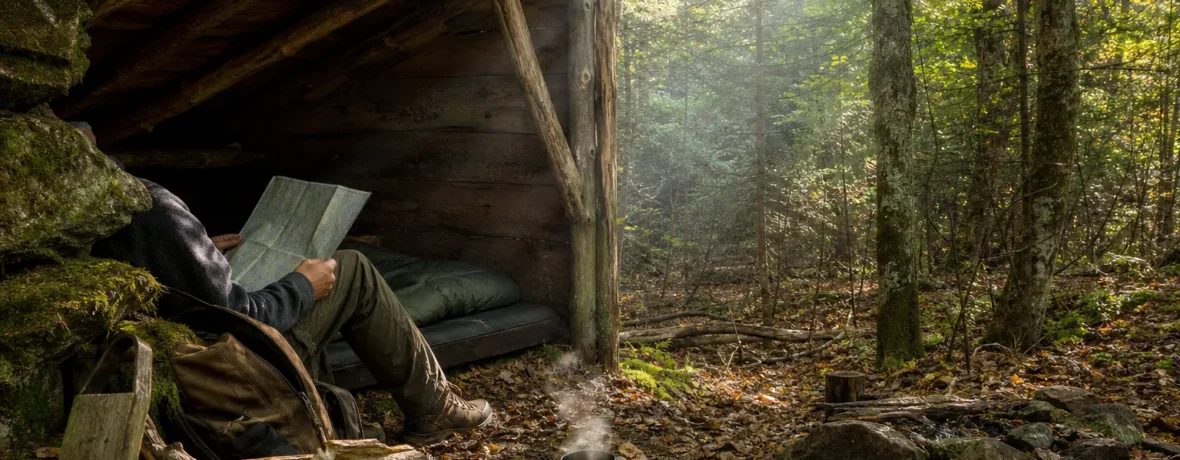
A lean-to is a fixed, three-sided backcountry shelter with a roof, raised or packed floor, and one open side. It usually sleeps 4 to 12 hikers, offers basic rain and wind protection, and should not replace your own shelter unless local rules and conditions clearly allow it.
A lean-to is not a cabin. It is not a hostel. It is not a magic dry box in the woods. It is a simple shelter, usually built from logs or lumber, meant to give hikers a shared place to sleep out of the worst weather. The open front faces away from prevailing wind when the builders did their job well. The floor may be wood, dirt, gravel, or packed earth. Sometimes there is a nearby privy, water source, food-storage cable, bear box, or fire ring. Sometimes there is none of that.
Here is the position: lean-tos are one of the best pieces of trail infrastructure in American hiking, but you should treat them as a bonus, not a plan. Count on your own gear first. Use the lean-to if it is open, legal, uncrowded, and in good shape. That mindset keeps you dry, keeps you flexible, and keeps you from becoming the hiker who arrives at dusk with no backup and a big problem.
What is a lean to shelter used for?
A lean-to shelter is used for simple overnight protection in the backcountry.
On hiking trails, lean-tos give backpackers a shared sleeping space that reduces tent impact around fragile campsites. Instead of ten tents spreading across roots, moss, and muddy clearings, several hikers can sleep under one roof. That is the real win. A lean-to concentrates use in a hardened spot.
You will see them most often in the Northeast, along parts of the Appalachian Trail, in state forests, and in older backcountry camping networks. The Appalachian Trail Conservancy’s shelter guidance describes shelters and surrounding campsites as one of the main overnight options on the A.T. New York’s Department of Environmental Conservation also describes primitive camping as including camping in a tent or lean-to deep in the woods, away from developed campgrounds, in its primitive camping guidance.
What you get is basic cover. A roof over your sleeping bag. A flatter place to roll out a pad. A social hub if other hikers are there. What you do not get is privacy, guaranteed space, bug protection, heat, or silence.
How is a lean-to different from a tent?
A lean-to is fixed and shared; a tent is portable and private.
That sounds obvious, but it changes your whole trip. A tent goes where camping is legal and terrain allows. A lean-to exists only where someone built it and maintains it. If your map says there is one at mile 14, your day bends around mile 14. If it is full, closed, damaged, or surrounded by standing water, your “shelter plan” falls apart fast.
| Feature | Lean-to | Tent |
|---|---|---|
| Protection | Good roof cover, open front | Full enclosure when pitched well |
| Privacy | Low to none | High for one or two hikers |
| Bug control | Poor unless you bring netting | Good with intact mesh |
| Reliability | Depends on location, space, and condition | Depends on your gear and site choice |
The blunt advice: carry a tent, tarp, bivy, or hammock setup unless you have verified that every night of your route has legal, available shelter space and the land manager allows your plan. Even then, a lightweight backup tarp can save the trip.
Can you sleep in a lean-to without a tent?
Yes, you can sleep in a lean-to without a tent if the shelter is open, legal to use, and has space.
That is the classic lean-to setup: sleeping pad on the floor, sleeping bag or quilt on the pad, pack nearby, headlamp within reach. Simple. Fast. Dry enough in many conditions.
But “can” and “should rely on it” are different. A lean-to has one missing wall. Wind can blow rain or snow across the floor. Mosquitoes, blackflies, mice, porcupines, and bold chipmunks do not care that you planned a peaceful night. If the shelter is full when you arrive, you do not get to claim a spot because your spreadsheet said so.
Some parks and trail corridors also have site-specific rules. As of November 2026, the National Park Service page for backcountry camping at Delaware Water Gap National Recreation Area describes restrictions on where and when backcountry camping is permitted along its stretch of the Appalachian Trail. Rules like that are exactly why you check the official land manager before you go, not a random forum post from six years ago.
What should you pack for a lean-to shelter?
You should pack as if the lean-to might be full or unusable.
That does not mean packing heavy. It means packing honestly. A 10 oz [283 g] tarp, a small bug bivy, or a compact tent can be the difference between a minor adjustment and a miserable night. Your sleeping system still needs to match the low temperature. The shelter roof does not warm the air.
- Backup shelter: tent, tarp, bivy, or hammock system with straps where hammocks are allowed.
- Sleeping pad: a full-length or torso-length pad for insulation from wood or ground.
- Bug protection: head net, bug bivy, or inner net in mosquito and blackfly season.
- Ground cloth: useful on damp floors, rough planks, or packed dirt.
- Food storage: bear canister, approved bear bag system, or use provided storage when present and legal.
- Earplugs: tiny weight, huge payoff in a shared shelter.
- Headlamp: keep it close, not buried under your quilt.
- Repair tape: for pads, tarps, and the little failures that show up at 10 p.m.
Food storage deserves special attention. The Appalachian Trail Conservancy’s bear and food storage guidance recommends strong food-storage habits around shelters because food-conditioned wildlife can become dangerous and can cause closures or animal deaths. Never leave snacks, toothpaste, trash, or cookware loose in a lean-to overnight.
How do you use a lean-to without being that hiker?
You use a lean-to well by treating it as shared public space.
A shelter is not your bedroom. It is more like a bunkroom with no staff, no lock, and no cleaning crew coming in the morning. Your manners matter.
- Arrive with a backup plan. If the shelter is full, pitch your shelter in a legal campsite instead of crowding people.
- Make room. Keep your pack tight to your sleeping area. Do not sprawl across 6 ft [1.8 m] of floor.
- Cook away from sleeping bags. Food odors in the shelter invite mice and larger problems.
- Store food properly. Use the provided bear box, cable, pole, or your own approved system.
- Keep lights low. A headlamp blast to the face at midnight is never charming.
- Control noise. Talk softly after dark. Pack up quietly before sunrise.
- Do not carve, nail, burn, or “improve” the shelter. Leave maintenance to the crews.
- Pack out trash. All of it. Foil corners, wrappers, orange peels, dental floss, everything.
If there is a shelter register, use it briefly. Registers can help maintainers track use and spot problems, but they are not the place for threats, rants, or fake emergency notes. Keep it useful.
Are lean-to shelters safe in bad weather?
Lean-tos are safer than open ground in some weather, but they are not stormproof.
A good lean-to sheds vertical rain and gives you a dry place to sleep. That is enough on many nights. The trouble comes with sideways rain, drifting snow, high wind, falling limbs, and cold air pooling in valleys. The open front is the weak point. If the weather shifts, your dry floor can turn into a spray zone.
Look at the shelter before you commit. Check the roof for obvious holes. Look for dead limbs overhead. Watch where water flows around the site. If the floor is damp before the storm starts, it will not improve after midnight.
Also, fire is not your safety plan. A fire ring near a shelter does not mean you should build a smoky blaze under the roofline or scorch the front beams. Follow posted rules and current fire restrictions. If you cannot stay warm without a fire, your sleep system is underbuilt for the trip.
Should you plan a backpacking trip around lean-tos?
You can plan around lean-tos, but you should not depend on them as your only shelter.
This is where smart trip planning gets practical. Lean-tos make excellent targets for lunch, storms, and overnight camps. They also make poor guarantees. A shelter can be full of a youth group. A roof can be damaged. A spring can run dry. A local closure can change your route. None of that is dramatic if you packed a backup.
Use this simple planning method:
- Map the official shelter locations. Use the land manager, trail club, or current guidebook.
- Check current rules. Look for permits, group-size limits, closure notices, bear-storage rules, and fire restrictions.
- Identify legal overflow options. Mark nearby designated tent sites or areas where dispersed camping is allowed.
- Carry your own shelter. Choose the lightest backup that fits the season and regulations.
- Arrive before dark. Early arrival gives you choices; late arrival gives you whatever is left.
The best lean-to users are not the ones who need the lean-to. They are the ones who can use it gratefully, share it easily, and walk away if the situation is wrong.
Related reading
- Type 2 Fun: Why Hard Hikes Feel Good Later
- The Seven Summits Explained
- What Is Geocaching?
- What Is Hiking, Really? A Definition Worth Arguing About
FAQ
Here are straight answers to common lean-to questions.
Is a lean-to the same as a shelter?
Yes, in hiking language, a lean-to is one type of backcountry shelter. It usually has three sides, a roof, and an open front, while “shelter” can also mean huts, cabins, or enclosed structures depending on the trail system.
Do lean-tos have doors?
No, most trail lean-tos do not have doors. The open side is part of the design, which is why wind direction, rain angle, and bug pressure matter.
How many people fit in a lean-to?
Most lean-tos fit a small group, often somewhere in the range of 4 to 12 hikers depending on floor size. Do not assume space will be available; carry your own shelter and be ready to camp legally nearby.
Can you set up a tent inside a lean-to?
Usually no, and it is poor etiquette unless local rules clearly allow it and the shelter is empty. A tent inside a lean-to wastes shared floor space; use a bug bivy or head net instead.
Are lean-tos first come, first served?
Many are first come, first served, but not all shelter systems work the same way. Some areas use permits, reservations, or site-specific rules, so check the official land manager before your trip.
Should beginners use lean-to shelters?
Yes, beginners can use lean-tos if they understand the limits. Bring a backup shelter, store food correctly, share space politely, and treat the lean-to as a helpful option rather than a guaranteed bed.