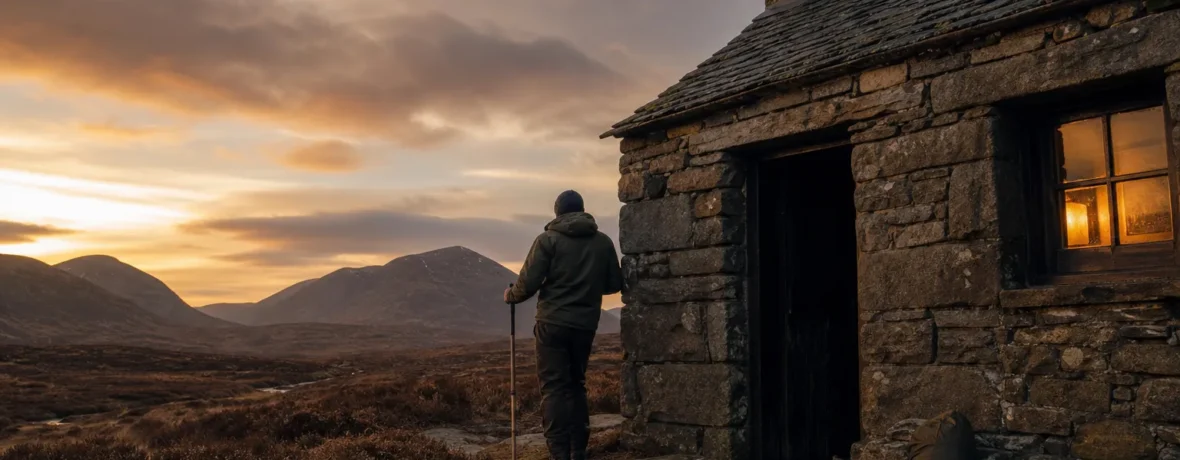
What is a bothy? A bothy is a basic, unlocked shelter in remote country, usually free to use and shared by whoever arrives. Expect four walls and a roof, not beds, lights, running water, toilets, heat, privacy, or a booking. You still need full camping gear, minus the tent.
What is a bothy in hiking?
A bothy is a rough backcountry shelter, not a hut vacation.
That distinction matters. The best way to understand a bothy is this: it is camping with a sturdier shell around you. The Mountain Bothies Association describes bothying as closer to camping without a tent than staying in a holiday home, and that is the right mental model.
Most bothies are old cottages, estate buildings, or farm shelters that now give walkers, climbers, bikepackers, and paddlers a dry place to sleep. They are simple by design. Some have a fireplace or stove. Some have a sleeping platform. Some have nothing but a floor, damp stone walls, a door that shuts, and a view that makes you forgive the rest.
Here is the position: if you treat a bothy like free lodging, you are doing it wrong. A bothy survives because visitors behave like temporary caretakers. You arrive self-sufficient. You share the space. You leave it cleaner than you found it. That is the deal.
Are bothies free to use?
Yes, most Mountain Bothies Association bothies are free to use, but free does not mean consequence-free.
As of November 2026, the Mountain Bothies Association says it maintains about 100 shelters in remote parts of Great Britain, mostly in Scotland, with others in England and Wales. The MBA also states that no charges are made for using any bothy in its care. That is rare in outdoor recreation now. It deserves respect.
You do not book a space. You do not get a bunk assignment. You do not have a claim on a room because you arrived first. If another wet, tired party opens the door at 10 p.m., you make room. That is bothy culture in one sentence.
This is why large groups are a problem. As of November 2026, the Bothy Code says groups of 6 or more should not use a bothy because of crowding and lack of facilities, and commercial groups are not allowed. Good. A remote shelter should not become a private clubhouse with muddy boots.
What facilities does a bothy have?
A bothy usually has fewer facilities than you hope and fewer comforts than a shelter in the US.
Plan for no tap, no sink, no electricity, no beds, no lights, no trash service, and no guaranteed firewood. Water may come from a stream or spring nearby, or it may be awkward to find. A fireplace is not a promise of heat. A sleeping platform is not a mattress. A roof is not an excuse to pack casually.
| Feature | Bothy | Backcountry hut | Tent camp |
|---|---|---|---|
| Booking | Usually no booking | Often reservation-based | No building to book |
| Cost | Often free for MBA bothies | Often paid | Depends on land rules |
| Facilities | Very basic | May have bunks, toilets, heat | Only what you carry |
| Privacy | Shared with whoever arrives | Shared or assigned | Mostly your own space |
That table is the whole argument. A bothy is not the cushy middle ground between a hotel and a tent. It is a communal safety valve for wild places. You should be grateful for it, not comfortable enough to get lazy.
How do you use a bothy responsibly?
You use a bothy responsibly by acting like the next person matters.
The Bothy Code is short, practical, and built on one idea: respect. Respect the shelter. Respect other users. Respect the surrounding land. Respect the agreement with the estate or owner. Respect limits on numbers.
- Check the current bothy page before you go, because closures and restrictions can change.
- Carry full overnight gear, including a sleeping bag, pad, stove, headlamp, food, water treatment, and emergency backup.
- Arrive ready to share. A bothy is not yours, even if you got there first.
- Keep noise down. Nobody hiked into remote country to listen to your speaker.
- Use fires carefully, only where appropriate, and make sure the fire is out before you leave.
- Pack out all trash. If you can carry full cans in, you can carry empty cans out.
- Close doors and windows before leaving so weather and animals stay outside.
As of November 2026, MBA guidance says bothies are for short stays only, and you need the owner’s permission for an extended stay. That is fair. Lingering too long turns a shared refuge into somebody’s unpaid rental.
What should you pack for a bothy?
Pack like you are camping, then add a few bothy-specific items.
The common rookie mistake is leaving too much at home because a building appears on the map. Do not do that. The building may be full. It may be closed. It may be colder inside than your tent. It may be a long, wet walk from the nearest road, and your backup plan should not depend on luck.
- Sleeping bag warm enough for the season
- Sleeping pad for a wooden, concrete, or stone floor
- Headlamp plus spare power
- Stove and fuel for cooking
- Water treatment and containers
- Map, compass, and offline navigation
- Food that does not create messy waste
- Trash bag for every scrap you bring in
- Toilet kit, including trowel if needed, toilet paper, and hand sanitizer
- Dry layers, gloves, hat, and shell
- Earplugs, because shared shelter means shared snoring
Candles or a lantern can be useful where allowed, but fire safety comes first. Do not burn live wood. Do not tear apart fences, furniture, or nearby structures for fuel. That is not resourcefulness. That is vandalism with a backpack.
Do bothies have toilets and water?
Usually, no: expect no toilet and no treated water.
Some bothies may have a spade. Many have no toilet facilities at all. As of November 2026, MBA advice says that if there is no toilet, you should go at least 660 feet [200 meters] from the bothy and 200 feet [60 meters] from the water supply before burying human waste. Use judgment, avoid watercourses, and keep the area around the shelter clean.
For US hikers, the best comparison is Leave No Trace with stone walls. Pack out trash. Keep water sources clean. Do not leave food that attracts rodents. Do not assume someone else will deal with the mess. The romance of bothying dies fast when the doorway smells like a badly managed campsite.
Where are bothies found?
Bothies are mainly found in Scotland, with some in England and Wales.
They sit in hill country, glens, islands, moorland, and other remote places where a simple shelter can change a hard night into a manageable one. Many are several hours from a public road. That distance is part of the filter. Bothies are not built for drive-up convenience.
In Scotland, access rights are broad, but they come with responsibilities. As of November 2026, the Scottish Outdoor Access Code says Scotland’s access legislation allows camping wherever access rights apply, while also stressing obligations to respect others and the environment. If you are visiting from the US, read that before you go. Scotland is generous with access, but generosity is not permission to be clueless.
Are there bothies in the United States?
No, not in the same traditional sense.
The US has trail shelters, fire lookouts, cabins, yurts, and backcountry huts, but the classic bothy system is a British and especially Scottish thing. An Appalachian Trail shelter may feel similar because it is simple, shared, and first-come in spirit, but the culture, ownership, rules, and access context are different.
So do not use “bothy” as a fancy word for any hut. A bothy is a particular kind of shelter with a particular ethic: unlocked, basic, communal, remote, and dependent on restraint. That ethic is the point.
Related reading
- Type 2 Fun: Why Hard Hikes Feel Good Later
- The Seven Summits Explained
- What Is Geocaching?
- What Is Hiking, Really? A Definition Worth Arguing About
FAQ
Can you sleep in a bothy?
Yes, you can sleep in a bothy if it is open and available. Bring a sleeping bag and pad because you may be sleeping on a wooden, concrete, or stone floor.
Do you have to book a bothy?
No, MBA bothies generally cannot be booked. You turn up, share space with others, and make room for later arrivals if they need shelter.
Are bothies heated?
Not reliably. Some have fireplaces or stoves, but you should not count on fuel, warmth, or even a working fire setup.
Can dogs stay in bothies?
Sometimes, but only if they are under control and not bothering other users, livestock, or wildlife. If your dog cannot settle quietly in a crowded room, a bothy is the wrong plan.
Is a bothy only for emergencies?
No, bothies are often used for planned nights out, but you should treat them with emergency-level humility. Carry your own gear and have a backup plan in case the shelter is full, closed, or unsuitable.