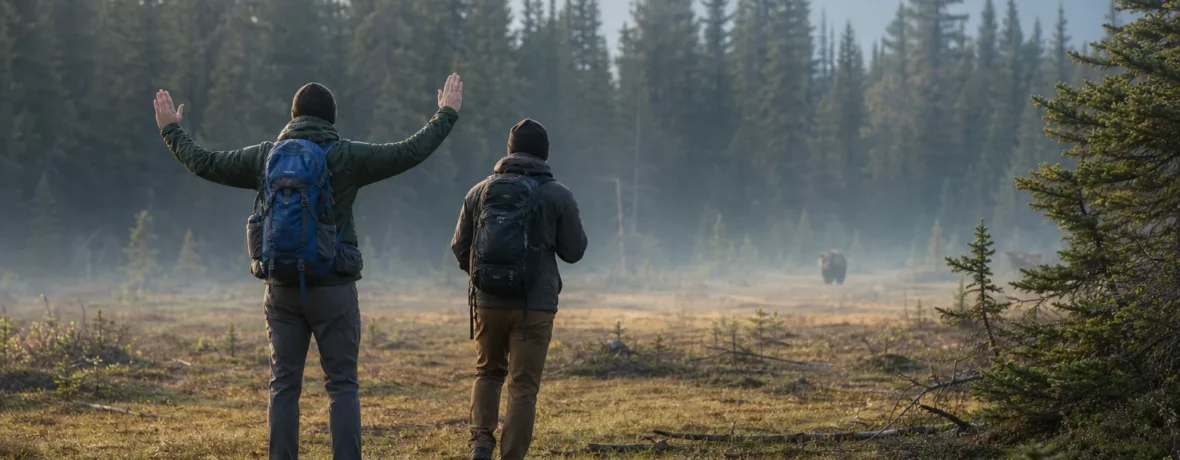
Stop, stay calm, speak in a low voice, and back away slowly. Do not run. Give the bear at least 100 yards [91 m] when possible. If it approaches, stand your ground, ready bear spray, and leave without turning your back.
What should you do first if you see a bear on a hike?
Stop moving and give the bear space.
A bear sighting can spike your heart rate fast. That jolt is normal. Your job is to avoid feeding the bear more alarm. Most bear encounters end without injury, especially when hikers stay calm, avoid sudden movement, and don’t crowd the animal. The National Park Service bear safety guidance says to talk calmly, stand your ground, and slowly wave your arms so the bear can identify you as a human.
Here’s your first move-by-move plan:
- Stop. Freeze where you are. Don’t step closer for a photo. Don’t hurry past.
- Check the bear’s behavior. Is it feeding, walking away, watching you, with cubs, or coming closer?
- Talk in a calm, firm voice. Say something simple like, “Hey bear, I’m leaving.” You’re not trying to scare it. You’re identifying yourself.
- Back away slowly. Move diagonally if you can, keeping the bear in view without staring it down.
- Group up. If you’re with others, stand close together so you look larger.
- Get bear spray ready. Remove the safety clip if the bear is close or approaching, but don’t spray unless it is within range and moving toward you.
- Leave the area. Once you have distance, change plans if needed. A bear owns that section of trail for the moment.
Do not run. Bears can sprint far faster than humans, and running may trigger a chase response. Do not climb a tree, either. Black bears climb extremely well, and grizzlies can climb when they need to.
How far away should you stay from a bear?
Stay at least 100 yards [91 m] from bears whenever terrain allows.
Think of 100 yards [91 m] as a football field, including both end zones. That distance gives the bear room to keep feeding, traveling, or moving its cubs without feeling squeezed. In brush, timber, bends in the trail, or noisy water, you may not get that luxury. If you surprise a bear at close range, focus less on measuring distance and more on lowering tension: stop, talk calmly, back away, and avoid sudden movement.
If the bear has not noticed you, don’t announce yourself with a shout from close range. Quietly retreat the way you came. If the bear has noticed you, speak calmly so it understands you are human. Then give ground slowly.
- Good distance: the bear keeps doing bear things and is not focused on you.
- Too close: the bear stops feeding, stares, pops its jaws, huffs, swats the ground, or moves toward you.
- Danger zone: the bear is closing distance, following, circling, or blocking your retreat.
Should you make noise when hiking in bear country?
Yes, make steady human noise in places where a bear could be surprised.
Bears usually want to avoid people, but they need a fair warning. Make noise before blind corners, in thick brush, near berry patches, beside loud creeks, and when hiking into the wind. A normal human voice works better than random shrieking. Call out, talk with your group, clap a few times, or say “Hey bear” before you round a corner.
Bear bells are not a magic shield. They make a small sound that may disappear under wind, rain, or moving water. Your voice carries meaning. It says: human, coming through, no surprise intended.
Also keep your earbuds out, or use only one at very low volume. If you can’t hear snapping branches, huffing, cub sounds, or another hiker’s warning, you’re hiking with a handicap you gave yourself.
What should you do if a bear is on the trail?
Do not try to pass it; wait, backtrack, or reroute.
A bear standing or feeding on the trail is not an obstacle to squeeze around. It is a wild animal with personal space, sharp senses, and a short fuse if surprised. Stop at a safe distance. Speak calmly. Let the bear leave first. If it keeps feeding or walking the trail, turn around and give it the corridor.
This is where hikers get tempted to make bad choices: “The parking lot is only half a mile away,” “It doesn’t look aggressive,” or “We can sneak around.” Don’t bargain with a bear. The fastest way out may not be the safest way out.
If the bear moves off trail, wait until it is well away before continuing. If you cannot see where it went, make more noise than usual and proceed only if you have enough visibility and an escape route. In dense brush, turning around is often the cleaner call.
What if the bear stands up, huffs, or charges?
A standing bear is usually trying to understand you, not automatically preparing to attack.
Bears stand on their hind legs to see and smell better. That posture can look terrifying, but it is not always aggressive. Keep your voice low. Don’t scream. Don’t throw food. Don’t make direct, hard eye contact like you’re challenging it.
A bluff charge is different. The bear may rush toward you, slam its feet, huff, woof, or veer away at the last second. Your body will want to run. Don’t. Stand your ground, keep speaking, and have bear spray ready. The National Park Service guidance on bear spray describes bear spray as an effective deterrent when you know how to use it and keep it accessible.
Use this quick read:
| Bear behavior | What it may mean | Your move |
|---|---|---|
| Feeds, walks, ignores you | Bear is not focused on you | Back away and leave space |
| Stands up, sniffs, watches | Bear is identifying you | Talk calmly, wave arms slowly, retreat |
| Huffs, jaw-pops, swats ground | Bear feels stressed or defensive | Stop advancing, back away, ready spray |
| Runs toward you | May be bluffing or attacking | Stand your ground, deploy bear spray if close |
How do you use bear spray on a hike?
Carry bear spray on your body and spray when the bear is close and approaching.
Bear spray buried in your pack is close to useless. Keep it in a chest holster, belt holster, or side pocket you can reach with either hand. Practice removing the safety clip before your trip. Do not test-fire it near your tent, car, food, or hiking partner.
Basic bear spray steps:
- Carry it where your hand can reach it fast. Not inside your pack.
- Remove the safety clip only when needed. Keep your finger off the trigger until you intend to spray.
- Aim slightly downward. You want a cloud between you and the bear, not a narrow stream over its head.
- Spray in short bursts. Build a barrier the bear has to run through.
- Move away after spraying. Don’t stand there admiring your work.
Bear spray is a deterrent, not bug spray. Don’t spray your gear, clothes, campsite, or tent. It can leave residue that irritates skin, eyes, and lungs, and it does not create a protective force field around you.
What should you do if a bear attacks?
Your response depends on the bear and the type of attack.
This is the part nobody wants to think about on a sunny trail. Think about it anyway. You won’t have time to research it while a bear is closing distance.
If a grizzly or brown bear attacks defensively, the usual guidance is to play dead after contact: lie flat on your stomach, clasp your hands behind your neck, spread your legs so the bear can’t flip you easily, and keep your pack on for protection. Stay still until the bear leaves the area.
If a black bear attacks, fight back. Be loud, be aggressive, and use anything you have: trekking poles, rocks, fists, boots, a hard water bottle. Aim for the face and muzzle. If any bear stalks you, follows you, attacks in your tent, or treats you like prey, fight back.
That difference matters, but trail reality can be messy. If you cannot identify the bear or its behavior, use bear spray first if you can. If the bear makes contact during what looks like a defensive grizzly encounter, play dead. If the attack continues or seems predatory, fight like your life depends on it.
What is the difference between black bears and grizzly bears?
Grizzlies and black bears can overlap in color, so don’t identify them by color alone.
A black bear can be cinnamon, brown, blond, or black. A grizzly can be dark brown, light brown, or almost blond. Look at body shape, shoulder hump, face profile, and claws when you have enough time and distance to do so safely.
| Feature | Black bear | Grizzly/brown bear |
|---|---|---|
| Shoulders | No large shoulder hump | Prominent shoulder hump |
| Face | Straighter face profile | Dished face profile |
| Ears | Taller, more pointed ears | Shorter, rounder ears |
| Claws | Shorter, curved claws | Longer, straighter claws |
Don’t let identification distract you from the big rule: create distance. A calm black bear at 80 yards [73 m] is safer than a surprised grizzly at 20 feet [6 m], but both deserve space.
How can you prevent a bear encounter before it starts?
Stay alert, make noise, manage food, and hike like a bear may be around the next bend.
Most smart bear safety happens before the bear appears. The National Park Service hiking-in-bear-country guidance recommends checking local bear information, hiking in groups, watching for signs of bear activity, and avoiding surprise encounters.
Use this trail checklist:
- Check current bear advisories at the park, forest, or trailhead before you go.
- Carry bear spray where you can reach it instantly.
- Hike in a group when you can, especially in grizzly country.
- Make noise near blind corners, thick brush, berry patches, and loud water.
- Watch for scat, tracks, torn logs, diggings, carcasses, and fresh claw marks.
- Keep dogs leashed where dogs are allowed. An unleashed dog can run toward a bear, then bring the bear back to you.
- Never feed wildlife. Not once. Not for a photo. Not by accident.
- Pack out every wrapper, fruit peel, crumb bag, and scented item.
Food discipline matters even on day hikes. Bears that learn backpacks mean snacks can become bold around people. That can get hikers hurt and bears killed.
What should you do if you see a bear cub?
Leave immediately and assume the mother is nearby.
A cub is not a photo opportunity. It is a warning sign with fur. Mother bears can defend cubs fast, and you may not see her until she is already moving. Do not move closer. Do not stand between a cub and thick cover. Do not try to “help” a cub that appears alone.
Back away the same way you came if possible. Speak calmly. Keep your group together. If the cub moves toward you, keep backing away and do not touch it. Report the sighting to a ranger, land manager, or local wildlife agency when you are safe.
What should you do after a close bear encounter?
Get out of the area, warn other hikers, and report the encounter if it was close, aggressive, or involved food.
Once you’re clear, take a minute. Breathe. Count heads. Check for injuries. Make sure nobody dropped food, gear, or a dog leash in the scramble.
Then think outward. Other hikers may be walking straight into the same bear. Calmly warn people coming up the trail. Give simple facts: location, time, direction the bear moved, whether cubs were present, and whether it approached or charged.
Report the incident to the land manager if the bear charged, followed you, touched gear, entered camp, got food, appeared injured, or stayed near a busy trail. For national parks, use a visitor center, ranger station, or posted emergency contact. For national forests, contact the local ranger district. Don’t post vague panic online before telling the people who can actually manage the trail.
When to see a doctor
See a doctor promptly after any bear bite, claw wound, deep puncture, crushed tissue, heavy bleeding, or possible saliva exposure.
A bear injury is not a “walk it off” problem. Animal bites can damage tendons, nerves, joints, and deeper tissue, and they can become infected. The Mayo Clinic animal-bite first aid guidance says to seek prompt medical care for deep punctures, badly torn or crushed skin, severe bleeding, possible broken bones, signs of infection, or bites from wild animals.
For field care, control bleeding first, then clean the wound if you can do so safely. The CDC rabies post-exposure guidance says immediate gentle irrigation with water or a dilute povidone-iodine solution can reduce infection risk, and rabies-related care depends on the exposure and medical assessment. The Wilderness Medical Society wound-management guideline treats animal bites as higher-risk wounds that need proper cleaning and medical follow-up.
Get urgent help if any of these apply:
- Bleeding does not stop with firm pressure.
- The wound is deep, gaping, crushed, or over a joint.
- You cannot move a finger, hand, arm, foot, or leg normally.
- You have numbness, weakness, severe pain, or visible fat, tendon, muscle, or bone.
- The bite or scratch is on the face, neck, hand, genitals, or near a joint.
- You may have had saliva in a wound, eyes, mouth, or broken skin.
- Redness, warmth, swelling, pus, fever, red streaking, or worsening pain develops later.
Do not close a deep animal bite with tape, glue, or stitches in the field. Cover it with a clean dressing, keep it as clean as you can, and get medical care. A clinician can assess infection risk, tetanus status, rabies risk, tissue damage, and whether antibiotics or other treatment are needed.
Related reading
- What to Do If You Encounter a Mountain Lion
- Can You See Giardia in Stool?
- What Is Bear Spray and How Effective Is It?
- Where to Buy Bear Spray and How Much It Costs
FAQ
Should you run if you see a bear?
No. Running can trigger a chase response, and a bear can outrun you on open ground, uphill, and downhill. Stop, speak calmly, back away slowly, and keep the bear in sight without staring it down.
Should you look a bear in the eyes?
No, avoid a hard, direct stare. Watch the bear’s body and movement, but don’t lock eyes like you’re challenging it. Use a calm voice and slowly increase distance.
Do bear bells work?
Bear bells may make some noise, but your voice is more useful in most trail situations. Call out before blind corners, in thick brush, and near loud water where a bear may not hear you coming.
Is bear spray better than a gun?
For most hikers, bear spray is the better safety tool because it creates a defensive cloud and does not require lethal accuracy under stress. Carry it where you can reach it fast, and learn how to use it before your hike.
What should you do if a bear comes into camp?
Do not approach it or feed it. Get people together, make yourself known from a safe position, and leave the area if you can do so safely. If the bear gets food or acts aggressively, report it to rangers or the local land manager.
What should you do if your dog sees a bear?
Keep your dog leashed and under control. Do not let it bark at, chase, or approach the bear. Back away slowly with your dog close, because a loose dog can provoke a bear and lead it back to you.