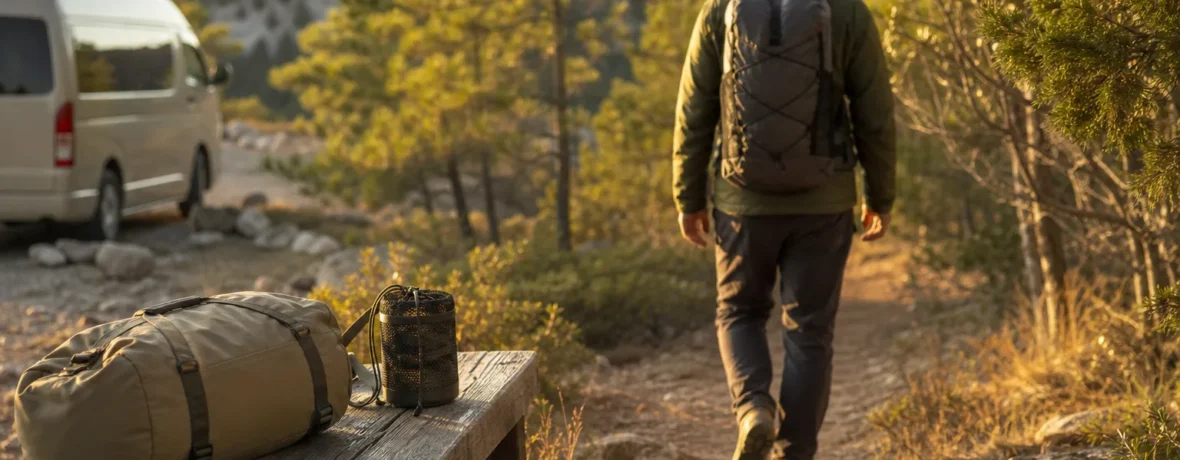
What is slackpacking? Slackpacking is hiking a section of trail with only a daypack while your overnight gear is moved ahead, stored, or left elsewhere. No, it is not cheating if you still walk the miles yourself, follow trail rules, and describe the hike honestly. It is support, not teleportation.
What is slackpacking in hiking?
Slackpacking means carrying less than a full backpack on a long-distance hike.
In plain trail language, you hike with water, food, layers, rain gear, a headlamp, and emergency basics while your tent, sleeping bag, stove, and extra food take a ride. That ride might be with a hostel shuttle, a friend, a trail angel, a luggage-transfer service, or your own car if you are section hiking.
American Trails defines slackpacking as hiking a section of a long-distance trail without a backpack by leaving it somewhere safe or having someone shuttle it ahead. That is the cleanest definition. You still hike. You just are not hauling the full load.
On a typical backpacking day, a loaded pack might weigh 25 to 40 pounds [11 to 18 kg], depending on season, food carry, water availability, and gear choices. On a slackpacking day, you might carry 8 to 15 pounds [4 to 7 kg]. Your legs know the difference by mile 2. Your shoulders know by mile 0.2.
Is slackpacking cheating?
No, slackpacking is not cheating unless you lie about what you did.
Here is the straight answer: hiking miles with a daypack still counts as hiking miles. Your shoes touch the same dirt. Your knees take the same descents. You still climb the climb, sweat through the humidity, dodge the weather, and make the miles happen under your own power.
The only thing slackpacking changes is the load.
Where people get prickly is the word “thru-hike.” Some hikers use “unsupported,” “self-supported,” “supported,” “continuous footpath,” or “assisted” with serious precision. Fair enough. If you slackpack 400 miles [644 km] of a 2,190-mile [3,524 km] trail, do not call it unsupported. If you yellow-blaze around road walks or skip hard sections, do not pretend you walked every mile. But if you walked the trail and used a shuttle for your pack, say that. Done.
The trail does not need more gatekeeping. It needs more honesty.
How does slackpacking work?
You arrange for your heavy gear to meet you at the end of the day.
The logistics are simple on paper and occasionally messy in real life. Cell service fails. Shuttles run late. Trailheads get confusing. Weather eats your schedule. Plan like a competent adult, not like a raccoon with trekking poles.
- Pick a section with road access. Slackpacking works best when the trail crosses roads, towns, hostels, campgrounds, or legal parking areas.
- Confirm the shuttle or gear drop. Get the pickup point, drop-off point, time, driver name, and backup contact before you start walking.
- Carry real day-hiking essentials. Do not strip your kit down to a granola bar and optimism.
- Protect your overnight gear. Use a labeled duffel, dry bag, or pack liner. Rain, dust, and pickup-bed grime are real.
- Keep permits and required items with you. If a ranger asks for a permit, it does not help if the permit is riding in a van 18 miles [29 km] away.
- Have a bailout plan. Know the side trails, road crossings, water sources, and places where you can stop early.
On the Appalachian Trail, slackpacking is common around trail towns and hostels. Rules still apply. As of November 2026, the Appalachian Trail Conservancy says permits are required in three places on the A.T.: Great Smoky Mountains National Park, Shenandoah National Park, and Baxter State Park. Check the current agency page before you go, because your daypack does not exempt you from land-manager rules.
What should you carry when slackpacking?
Carry enough to handle a bad day, not just the day you hope to have.
The trap is thinking “light pack” means “no pack.” Bad idea. A slackpacking day can still include lightning, heat, wrong turns, water gaps, closed roads, rolled ankles, or an unplanned night out. Your overnight kit may be elsewhere, but your brain should not be.
- Water and a way to treat more
- Food plus one extra snack you do not plan to eat
- Rain jacket or wind shell
- Warm layer, even in shoulder season sun
- Map, downloaded route, and backup navigation
- Headlamp with charged battery
- Small first-aid kit
- Emergency blanket or bivy
- Phone, power bank, and charging cable
- Permit, ID, cash or card
- Sun protection and insect protection when conditions call for it
Follow the Leave No Trace 7 Principles the same way you would with a full pack. Slackpacking does not make trash lighter, excuse shortcutting switchbacks, or turn a crowded overlook into your private lunchroom.
What is the difference between slackpacking and backpacking?
Backpacking is carrying your overnight system; slackpacking separates the walking from the hauling.
| Style | What you carry | Best for |
|---|---|---|
| Backpacking | Shelter, sleep system, food, stove, layers, safety gear | Remote routes, self-reliance, flexible camping |
| Slackpacking | Day-hiking essentials and emergency basics | Big-mile days, injury management, town-to-town sections |
| Supported hiking | Varies by trip; may include guides, vehicles, or lodging | Organized treks, fixed itineraries, mixed abilities |
Neither style is morally superior. Backpacking builds a certain kind of competence because you live with every choice you packed. Slackpacking lets you move faster, reduce strain, and enjoy a hard section when a full pack would make it miserable or risky.
The honest position is this: backpacking is the more self-contained craft; slackpacking is a valid hiking tactic. Confusing those two is where the arguments start.
When does slackpacking make sense?
Slackpacking makes sense when a lighter load helps you hike safely, legally, and honestly.
It is especially useful for long road-accessible sections, rough climbs, heat waves, recovery days, and hikers managing old injuries. It can also keep a group together when one person is strong on miles but not with a heavy load. That is not weakness. That is logistics.
Good reasons to slackpack include:
- Reducing joint strain. Less pack weight usually means less pounding on knees, hips, ankles, and feet.
- Covering exposed terrain faster. A lighter load can help you clear ridgelines before afternoon storms.
- Making a hard section possible. Some climbs are simply better without a week of food on your back.
- Helping mixed-pace groups. One hiker’s comfortable load can be another hiker’s trip-ending misery.
- Keeping morale alive. Sometimes a light day saves the whole hike.
Bad reasons to slackpack? To claim a style you did not hike. To dodge permit systems. To pressure a shuttle driver into illegal road access. To dump gear somewhere that creates a problem for rangers, locals, or other hikers.
When to see a doctor
See a doctor when pain, illness, or injury changes how you walk or does not improve with rest.
Slackpacking can reduce load, but it is not medical treatment. If you have chest pain, shortness of breath, fainting, confusion, signs of heat illness, a suspected fracture, severe swelling, numbness, or pain that forces you to limp, stop hiking and get medical help. For heat-related warning signs, the CDC’s heat and health guidance is a solid place to start before your trip.
If you are returning from injury, surgery, or a chronic condition, get personal advice from a qualified clinician. A lighter pack may help you participate, but the trail is a poor place to test a problem you have been ignoring.
How do you slackpack without being that hiker?
Be clear, be prepared, and do not make your convenience someone else’s mess.
Trail culture runs on trust. Slackpacking works when hikers, hostels, shuttle drivers, maintainers, and land managers are all treated with respect. It fails when people treat support as entitlement.
- Pay shuttle drivers fairly and tip when service is good.
- Do not leave packs blocking trailheads, privies, shelters, or road access.
- Use legal parking and legal pickup points.
- Keep smellable items secured where required by local rules.
- Tell the truth when people ask how you hiked a section.
- Do not mock backpackers for carrying full loads.
- Do not mock slackpackers for choosing a lighter day.
In national parks and other managed areas, check current rules before assuming a shuttle, food storage plan, campsite, or road pickup is allowed. For example, Great Smoky Mountains National Park’s backcountry camping page explains its backcountry permit and reservation requirements as of November 2026. Different trail, different rulebook.
So, should you try slackpacking?
Yes, try slackpacking if it helps you hike better and you are honest about it.
The best argument for slackpacking is not that it makes hiking easy. It does not. A 20-mile [32 km] day is still a 20-mile day. The climb still climbs. The rocks still roll under your feet. The rain still finds your sleeves.
The best argument is that hiking is not a purity contest. If the goal is to move through wild places with care, follow the rules, protect the trail, and come home in one piece, slackpacking belongs in the toolkit.
Use it when it makes sense. Say what you did. Keep your standards high. That is not cheating. That is walking smarter.
Related reading
- Type 2 Fun: Why Hard Hikes Feel Good Later
- The Seven Summits Explained
- What Is Geocaching?
- What Is Hiking, Really? A Definition Worth Arguing About
FAQ
Does slackpacking count as thru-hiking?
Yes, it can count if you walk the full trail corridor required by the route’s accepted standard. But it is a supported thru-hike, not an unsupported one, so describe it that way.
Can you slackpack the Appalachian Trail?
Yes, many hikers slackpack parts of the Appalachian Trail where road crossings, hostels, and shuttles make it practical. You still need to follow all land-manager rules, including permits where required.
Is slackpacking safer than backpacking?
Sometimes, because a lighter load can reduce fatigue and strain. It can also create risk if you carry too little emergency gear or depend on a pickup that falls through.
What pack size is best for slackpacking?
A daypack in the 15- to 30-liter range usually works for most slackpacking days. Choose enough space for water, food, layers, rain gear, navigation, and emergency items.
Is slackpacking only for beginners?
No, experienced hikers slackpack too. It is a strategy, not a skill ranking, and it can be useful for big-mile days, rough terrain, heat, or recovery.