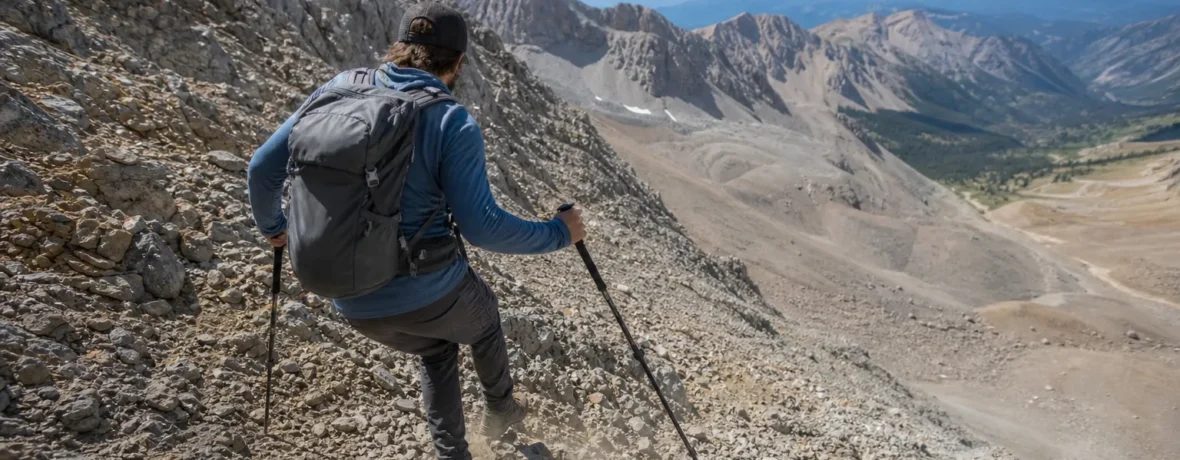
What is scree? Scree is a slope or patch of loose, broken rock, commonly gravel to fist-size, that shifts underfoot. No, it is not the same as talus when the rocks are larger or clearly piled below a cliff. Expect 30–40° on steep accumulations.
What is scree on a hiking trail?
Scree is loose, broken rock small enough to move when you step on it. On a trail, that can mean pea gravel, ankle-rolling chips, or fist-size chunks scattered across a slope.
The cleanest hiking definition is this: scree is the stuff that slides. It is not bedrock. It is not a tidy gravel path. It is rock debris that has broken off higher ground, weathered out of a slope, or collected in a chute. When your boot lands, the surface rearranges itself. Sometimes it purrs downhill. Sometimes it dumps you on your hip.
The position here is simple: hikers should treat scree as terrain, not as bad trail. It demands technique. Blaming the rocks does not help. Reading them does.
What is talus, and how is it different from scree?
Talus is larger loose rock, often piled below a cliff or steep rock face. The USGS defines talus as an outward-sloping heap or mass of rock fragments, usually coarse and angular, formed chiefly by falling, rolling, or sliding from a cliff or very steep slope.
The split is not perfectly clean. Land managers and guidebook writers use the words differently. The National Park Service describes talus slopes as accumulations of large rocks and boulders and contrasts them with scree fields made of much smaller rocks. That is the distinction hikers can actually use.
| Feature | Scree | Talus |
|---|---|---|
| Typical rock size | Gravel to fist-size pieces | Football-size rocks to boulders |
| How it feels | Slides, skitters, and flows | Shifts, teeters, and traps feet |
| Main hiking risk | Losing traction and sliding | Ankle injury, falls between blocks, rock movement |
| Best movement style | Short, balanced steps | Slow, deliberate rock-to-rock steps |
Why does loose rock collect on steep slopes?
Loose rock collects because gravity keeps collecting the bill. Freeze-thaw cycles, heat, water, plant roots, and plain old weathering pry rock from cliffs and ridges, then gravity moves the pieces downhill.
Once rock fragments pile up, they tend to settle near their angle of repose: the steepest angle where loose material can sit without continuously sliding. The NRCS National Soil Survey Handbook gives talus cones as steep, cone-shaped landforms at the base of cliffs, commonly 30–40°. On the ground, that feels steep enough to make every step count.
Here is the key hiking takeaway: loose rock is not random chaos. Fine pieces often sit higher or in chutes. Larger blocks often roll farther down. Fresh rock can be sharp, clean, and unstable. Older rock may be weathered, lichen-covered, and more settled. Your boots should be reading those clues.
Is scree dangerous to hike on?
Yes, scree can be dangerous when the slope is steep, exposed, wet, icy, or crowded. The hazard is not just slipping; it is also knocking rocks onto people below you.
Loose rock punishes sloppy spacing. If you are hiking in a group, do not stack directly above and below each other on a fall line. Spread out laterally when the terrain allows it. If a rock moves, yell “Rock!” once, loud and sharp. Do not add a speech. The person below needs sound, not a paragraph.
Scree also magnifies fatigue. A normal 1-mile [1.6 km] climb can feel much longer when each step slides back half a step. That is where bad decisions start: rushing, standing upright like a fence post, grabbing unstable rocks, and cutting switchbacks. Bad form becomes bad luck.
How do you hike across scree and talus safely?
Move slowly, stay balanced, and test before you trust. Loose rock rewards quiet feet and punishes drama.
- Shorten your stride. Long steps shift your weight too far from your center. Short steps let you recover fast when rock moves.
- Keep your weight over your feet. Leaning back feels safe, but it makes your feet shoot forward. Stay athletic: knees soft, hips over boots.
- Test each landing. Press before committing full weight, especially on talus blocks that may pivot.
- Use poles carefully. Poles help with balance on scree, but do not spear them between talus blocks where they can jam and snap.
- Step on embedded rock when you can. A partly buried rock is usually better than a clean loose one sitting on top.
- Face the slope when needed. On very steep loose sections, turning slightly into the hill can give you better control.
- Protect people below. Cross one at a time in narrow gullies, and never kick rocks “for fun.” That is not fun. That is lazy trail behavior.
Should you go up scree or down scree?
Going up scree is usually harder; going down scree is usually faster but riskier. Uphill, you lose energy to sliding. Downhill, you gain speed you may not be able to stop.
On ascent, aim for firmer edges, ribs, or patches with bigger embedded stones. Avoid the deepest loose chute unless it is clearly the intended route. On descent, do not run unless the slope is open, soft, and free of people below you. The classic “scree ski” looks smooth when it works and ugly when it does not.
The better rule: descend with control, not style. Heel placement can help on fine scree, but stomping sends rocks downhill. On talus, never hop blindly. A boulder that looks solid may be balanced on two hidden points with a boot-eating gap beside it.
What gear helps on loose rock?
Good footwear helps, but technique matters more than gear. A stiff, grippy outsole gives you an edge; it does not give you permission to switch off your brain.
- Footwear: Choose shoes or boots with torsional support and a lugged outsole.
- Trekking poles: Helpful on scree, less trustworthy in blocky talus.
- Helmet: Smart in steep gullies, below cliffs, or anywhere rockfall is likely.
- Gloves: Useful if you may need hands for balance on sharp rock.
- Gaiters: Helpful for keeping gravel out of shoes on long scree descents.
Gear cannot fix poor spacing, poor route choice, or poor timing. If the slope is icy, storm-soaked, or sitting under active rockfall, the strongest move may be turning around.
When to see a doctor
Get medical help after a loose-rock fall if you cannot bear weight, have severe swelling, have deformity, or symptoms do not improve. For ankle injuries, Mayo Clinic advises contacting a healthcare professional when pain and swelling suggest a sprain and you need to know whether an exam is needed.
Seek emergency care after a head hit if you have worsening headache, repeated vomiting, seizure, unusual behavior, slurred speech, weakness, numbness, poor coordination, unequal pupils, or loss of consciousness. The CDC lists these as concussion danger signs after a bump, blow, or jolt to the head.
Related reading
- Type 2 Fun: Why Hard Hikes Feel Good Later
- The Seven Summits Explained
- What Is Geocaching?
- What Is Hiking, Really? A Definition Worth Arguing About
FAQ
Is scree the same as gravel?
No. Gravel describes rock size; scree describes loose rock on a slope or mountain surface. Scree may include gravel-sized pieces, but it behaves differently because it sits on steep, unstable terrain.
Is talus harder to hike than scree?
Often, yes. Talus is slower because each large rock may tilt, roll, or hide gaps. Scree is more slippery, but talus is more likely to twist an ankle if you rush.
Can scree cause rockfall?
Yes. Your steps can knock loose stones downhill, especially in gullies and on steep slopes. Space out, avoid traveling directly above others, and call “Rock!” immediately if something goes.
Are trekking poles good on scree?
Yes, on fine to medium scree. Poles add balance and rhythm, but they are not anchors. On talus, plant them lightly so they do not wedge between rocks.
What is the best way to descend loose rock?
Descend slowly with short steps and your weight centered. Use firmer ribs or embedded stones when possible, and never charge down if hikers are below you.