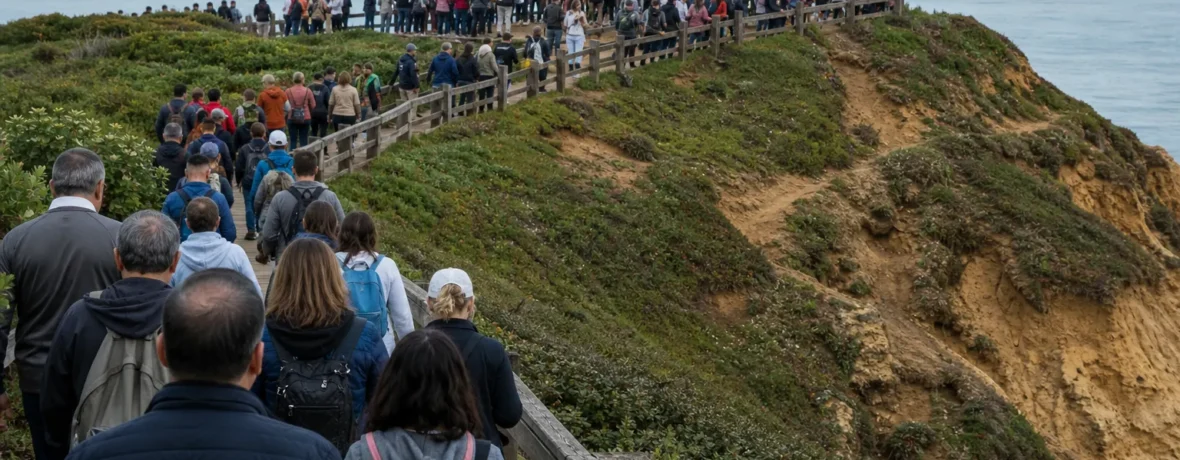
What is overtourism? It is when visitor pressure exceeds what a trail, park, community, or season can handle without damage to land, wildlife, staff, or the visitor experience. The National Park Service recorded 323 million recreation visits in 2025; crowding becomes overtourism when impacts, not head counts alone, cross the line, according to NPS visitation data.
Are national parks too crowded?
Yes, some national parks are too crowded in specific places at specific times.
That answer matters because the lazy version is, “Parks are ruined.” They are not. Most of the damage happens in narrow bands: the famous overlook at sunset, the waterfall trail on a holiday weekend, the alpine lake that blew up on social media, the entrance road between breakfast and lunch.
The backcountry can still be quiet. The shoulder season can still feel roomy. A lesser-known trail 4 miles [6.4 km] from the same parking lot can feel like a different planet. But the pressure is real where everyone piles into the same few corridors.
Here is the position: national parks should stay public, affordable, and welcoming, but access cannot mean a free-for-all at the exact same trailhead at the exact same hour. If we refuse timed entry, shuttle systems, campsite limits, and trail permits where they are needed, we are not defending freedom. We are choosing traffic jams, eroded switchbacks, wildlife harassment, overflowing toilets, and burned-out rangers.
What is overtourism in national parks?
Overtourism in national parks is crowding that creates unacceptable impacts.
That can mean trampled vegetation beside a trail, braided paths around mud, packed parking lots spilling onto road shoulders, long rescue delays, noise at campsites, illegal parking, human waste near water, and animals losing their fear of people because someone wanted a close photo.
UNESCO describes overtourism as excessive visitor numbers that can cause overcrowding and harm resident well-being; in parks, the “residents” include gateway communities, rangers, wildlife, soil, water, and the next hiker who came for silence and got a line instead. See UNESCO’s overview of travel and overtourism impacts.
Head count alone is a blunt tool. A million careful visitors spread across 12 months and 200 miles [322 km] of trail is one thing. A thousand people pushing onto one fragile alpine path during thaw is another. The land feels the difference.
| Heavy use | Overtourism | What it looks like on trail |
|---|---|---|
| Many people visit, but systems hold. | Visitor pressure overwhelms the place. | Full trailhead, but hikers stay on durable surfaces. |
| Rangers, toilets, signs, and trails keep pace. | Staff and infrastructure fall behind. | Trash, illegal parking, closed restrooms, preventable rescues. |
| The experience is busy but functional. | The experience degrades for people and nature. | Wildlife crowding, cut switchbacks, noise, resource damage. |
Why do trails suddenly feel more crowded?
Trails feel crowded because attention has become concentrated.
Maps are better. Phones make planning easier. A single short video can turn a quiet basin into a bucket-list stop by Friday. Remote work changed weekday patterns. More people discovered local trails during the pandemic and kept hiking. None of that is bad by itself.
The problem is copycat recreation. Same photo. Same rock. Same lake. Same weekend. Same 10 a.m. start.
Trail systems were not built for everyone to arrive in one wave. A narrow tread can handle steady use. It suffers when hikers step around each other, widen corners, dodge puddles, park on vegetation, and build social trails to get a cleaner angle for a photo.
This is where hikers need to stop pretending we are only victims of crowds. We are the crowd. Every boot counts. Every “just this once” shortcut teaches the next person where to step.
How should national parks manage overtourism?
Parks should manage demand before damage becomes permanent.
The National Park Service already uses visitor use management to match public access with resource protection, and its policy direction says visitor activities should not cause unacceptable impacts on park resources or values. See the NPS page on use of parks and visitor management.
That sounds dry. On the ground, it means something simple: if a place is getting loved to death, managers need tools with teeth.
- Set capacity by place, not by vibes. A boardwalk, desert cryptobiotic soil, alpine meadow, and river canyon do not tolerate the same pressure.
- Use timed entry where roads are the choke point. If the entrance line is wrecking the day before hikers reach the trail, spread arrivals out.
- Permit fragile trails before they fail. A permit is less painful than a closure.
- Build shuttles that actually work. A shuttle that runs often can beat a parking lot arms race.
- Close and restore damaged areas fast. Waiting until a meadow becomes dirt is not management. It is surrender.
- Tell visitors the truth. “Come early” is not enough when everyone reads the same advice. Parks need real-time congestion notices, alternate trail suggestions, and clear consequences for bad behavior.
Yes, permits can be annoying. Yes, timed entry can punish spontaneous trips. But unmanaged crowding is also a restriction. It restricts wildlife, damages the trail, slows emergency response, and turns a public park into a public mess.
What can hikers do about overtourism?
Hikers can reduce overtourism by changing where, when, and how they show up.
You do not have to quit popular parks. You do have to stop treating them like theme parks with prettier rocks. Your choices ripple.
- Start before peak crowd windows or go later in the day when it is safe.
- Choose shoulder seasons instead of holiday weekends.
- Pick one less-famous trail for every famous one.
- Have a backup trail before you leave home.
- Turn around if the parking area is full instead of inventing a parking spot.
- Stay on the trail, even when it is muddy.
- Keep groups small and quiet.
- Pack out trash, food scraps, toilet paper, and pet waste.
- Give wildlife space and skip the close-up photo.
- Spend money in gateway towns without treating locals like scenery.
The NPS Leave No Trace guidance says to plan ahead, use durable surfaces, pack out waste, leave what you find, minimize fire impacts, respect wildlife, and be considerate of others. That is not a cute poster. It is the operating manual for crowded public land.
Should hikers avoid posting trail locations online?
Sometimes, yes.
This is where people get touchy. Nobody owns a view. Public land is public. Gatekeeping can slide into snobbery fast.
But there is a difference between helping someone hike responsibly and blasting a fragile spot to strangers with no context. If a place has limited parking, no toilet, sensitive vegetation, sketchy route-finding, or a history of rescues, think before you tag the exact location.
Post the story. Share the lesson. Talk about the region. Encourage preparation. But maybe do not hand a GPS pin to thousands of people for a place that cannot absorb the surge.
The outdoors does not need secrecy as much as it needs restraint. Big difference.
Is limiting access fair?
Limiting access is fair when the alternative is damage, danger, or exclusion by chaos.
A packed trailhead already limits access. It favors people with flexible schedules, aggressive driving habits, expensive lodging nearby, and the patience to circle a parking lot for an hour. That is not equal access. That is a lottery without rules.
Good systems should protect first-time visitors, locals, families, disabled hikers, lower-income travelers, and spontaneous users as much as possible. That means some permits should be reservable ahead, some should be released closer to the date, and some access should remain available without a complicated planning spreadsheet.
Bad management says, “Figure it out.” Good management says, “Here are the limits, here is why they exist, and here are realistic alternatives.”
The hard truth: not every person can stand on every summit on the same Saturday. Pretending otherwise is how trails get wrecked.
What does a better hiking culture look like?
A better hiking culture values judgment over conquest.
It treats turning around as normal. It treats a quiet forest walk as worthy, even without a famous arch or turquoise lake at the end. It understands that a trail is not just a backdrop. It is habitat, watershed, labor, history, and public trust packed into dirt.
That culture also stops blaming “tourists” as if hikers with better gear are a separate species. The day you visit a place you do not live, you are a tourist too. So be a better one.
Do not sneer at new hikers. Teach them. Do not hoard knowledge. Share the right kind: how to check conditions, how to poop outside responsibly, how far 8 miles [12.9 km] with 2,000 feet [610 m] of gain really feels, why shortcuts scar slopes, why feeding wildlife is never harmless.
Overtourism is not solved by shame. It is solved by limits, design, education, enforcement, and hikers who can handle hearing “not today.”
Related reading
- Type 2 Fun: Why Hard Hikes Feel Good Later
- The Seven Summits Explained
- What Is Geocaching?
- What Is Hiking, Really? A Definition Worth Arguing About
FAQ
What is overtourism in simple terms?
Overtourism is too much visitor pressure for a place to handle without harm. On trails, that harm can show up as erosion, trash, wildlife stress, unsafe parking, crowding, and a worse experience for everyone.
Are national parks too crowded every day?
No. Crowding is usually worst at famous sites, peak seasons, weekends, holidays, and mid-morning arrival windows. Many parks still have quieter trails if you change the season, start time, or destination.
Do timed entry and permits actually help?
Yes, when they target the real bottleneck. Timed entry can spread out vehicle arrivals, while trail permits can protect fragile routes from too many boots at once.
Is overtourism the fault of new hikers?
No. New hikers are not the problem by default. Poor planning, weak management, social media pile-ons, bad trail behavior, and underbuilt infrastructure all contribute.
How can I avoid adding to crowded trails?
Go outside peak times, choose backup hikes, stay on durable surfaces, keep your group small, and leave if the parking lot is full. The cleanest move is often simple: pick a less-famous trail and have a better day.