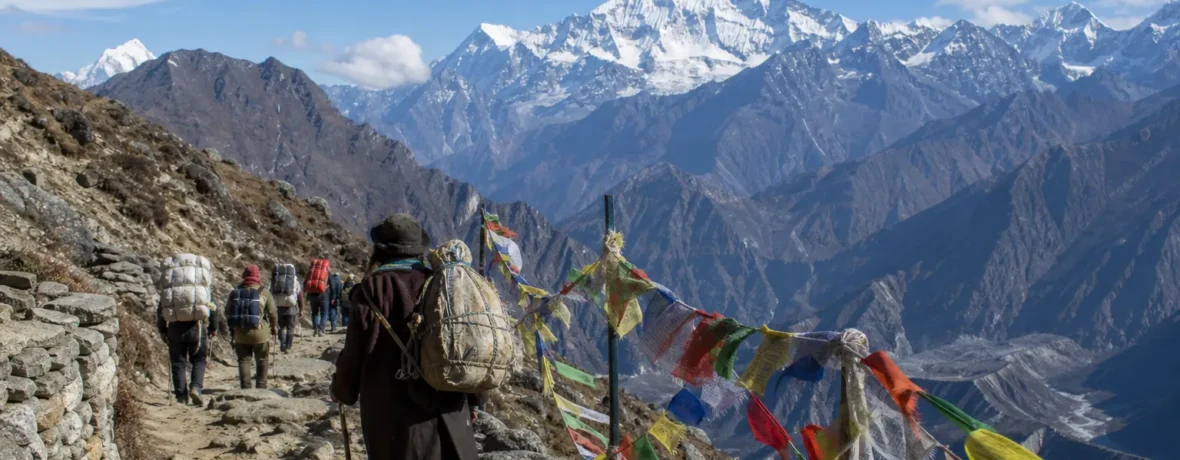
What is a Sherpa guide? A Sherpa guide is usually a highly skilled Nepali mountain worker from, or associated with, the Sherpa community who supports trekkers and climbers in the Himalaya by guiding routes, carrying loads, managing camps, fixing ropes, handling oxygen, and making safety calls at extreme altitude.
Who are the Sherpa people?
The Sherpa are an ethnic group from the high Himalayan regions of Nepal, especially Solu-Khumbu near Mount Everest.
The word “Sherpa” is often said to come from Tibetan roots meaning “people from the east.” That points to the group’s historic migration from eastern Tibet into Himalayan valleys of Nepal centuries ago. Today, Sherpa communities also live in other parts of Nepal, India, Bhutan, and the Tibetan region of China, but the name is most closely tied to Khumbu: the gateway to Everest. For a concise background, see Britannica’s overview of the Sherpa people.
Here’s the key thing: “Sherpa” is not just a job title. It is a people, a culture, a language, and a set of mountain communities with Buddhist traditions, family networks, village life, farms, yak herding, trade history, and deep ties to the high Himalaya.
Western climbing culture flattened that into a job label. That’s why you’ll hear people say “my Sherpa” when they mean “my high-altitude guide” or “porter.” It happens often. But it misses the point.
A better habit: use “Sherpa” for the ethnic group, and use the person’s actual job when you know it: guide, climbing guide, high-altitude worker, porter, cook, sirdar, rope-fixing team member, or expedition leader.
What is a Sherpa guide?
A Sherpa guide is a professional mountain guide or high-altitude worker, often from the Sherpa community, who helps clients move through Himalayan terrain safely and efficiently.
On trekking routes, that may mean leading hikers through villages, checking pace, reading weather, booking teahouses, translating, and helping with logistics. On big peaks, the work gets much more technical. A guide may climb through icefalls, set camps, carry oxygen bottles, manage fixed lines, scout hazards, and support summit attempts above 26,247 feet [8,000 m], the zone climbers call the death zone.
Some Sherpa guides have formal certifications. Nepal’s professional guide body, the Nepal National Mountain Guide Association, represents Nepal within the international IFMGA/UIAGM mountain guide system. Other expedition workers may have decades of practical experience but no international guide credential. Both training and experience matter, and the best operators are clear about who is guiding, who is carrying, and who is making safety decisions.
| Term | What it usually means | Common work |
|---|---|---|
| Sherpa | Ethnic identity | May or may not work in tourism or climbing |
| Sherpa guide | Guide from the Sherpa community, or a local Himalayan guide called “Sherpa” by clients | Route guidance, client support, safety calls |
| Porter | Load carrier | Carries duffels, supplies, and expedition loads |
| High-altitude worker | Specialized expedition worker | Fixes ropes, stocks camps, carries oxygen, supports summit pushes |
What does a Sherpa do on an expedition?
A Sherpa guide or high-altitude worker keeps the expedition moving while reducing risk for clients.
The exact job depends on the trip. A teahouse trek to Everest Base Camp is not the same as a guided Everest summit climb. One is a hard high-altitude hike. The other is a major mountaineering expedition with crevasses, ladders, fixed ropes, oxygen systems, camps, storms, and long exposure above 20,000 feet [6,096 m].
On a big Himalayan climb, the work can include:
- Carrying group gear, tents, fuel, food, and oxygen bottles
- Establishing and stocking higher camps
- Fixing ropes on steep snow, ice, and rock
- Helping clients clip into fixed lines and move through technical sections
- Checking oxygen regulators, masks, and cylinders
- Reading snow, wind, crowds, timing, and turnaround pressure
- Supporting rescues or emergency descents when things go wrong
- Working with the sirdar, expedition leader, cooks, porters, and base camp staff
That list sounds practical because the job is practical. No romance needed. Himalayan expeditions run on labor, skill, judgment, and repeated carries through dangerous ground. Clients may get the summit photo, but the scaffolding underneath that success is often built by Nepali workers.
What is a Sherpa Mount Everest guide?
A Sherpa Mount Everest guide is a high-altitude climbing professional who supports an Everest expedition on the Nepal or Tibet side of the mountain.
On Everest, Sherpa guides and high-altitude workers are central to the commercial climbing model. They help prepare the route, carry loads to Camps I, II, III, and IV, manage oxygen, guide clients on summit day, and help climbers descend when they are tired, cold, slow, or scared.
The Everest story most people know began on May 29, 1953, when Tenzing Norgay and Edmund Hillary became the first confirmed climbers to stand on the summit. Tenzing was a Sherpa mountaineer, not a side character. New Zealand History’s account of Hillary and Tenzing reaching Everest’s summit gives the basic timeline.
Modern Everest data is tracked by the Himalayan Database, a major archive of Himalayan expeditions. The names and records change season by season, but one thing stays clear: Everest is not a solo fantasy for most guided clients. It is a large team effort.
Why are Sherpa climbers so strong at altitude?
Sherpa climbers are strong at altitude because of culture, lifelong exposure, training, work experience, and inherited high-altitude adaptation.
Don’t reduce it to genetics. That’s lazy. Many Sherpa people do not climb mountains for work. Many Nepali guides from other ethnic groups are also excellent at altitude. And nobody, Sherpa or not, is immune to cold, falls, avalanches, exhaustion, or altitude illness.
Still, Sherpa communities from high valleys have produced extraordinary climbers. Children may grow up walking steep trails at elevations that would leave sea-level hikers gasping. Families may have generations of mountain work behind them. Young workers often start as porters or kitchen staff, then move into higher roles after seasons of learning the route, the weather, the clients, and the mountain.
Training has become more formal, too. The Khumbu Climbing Center was founded to improve safety for Nepali climbers and high-altitude workers through technical climbing education. That matters. Skill is learned. Judgment is earned.
Is every Himalayan guide a Sherpa?
No, every Himalayan guide is not Sherpa.
Nepal is home to many ethnic groups, and Himalayan trekking and climbing teams include Rai, Tamang, Gurung, Magar, Thakali, Newar, Brahmin, Chhetri, and others. Some work as trekking guides. Some are porters. Some are cooks. Some are IFMGA-trained mountain guides. Some own expedition companies.
Calling every Nepali mountain worker “a Sherpa” may sound harmless, but it erases people’s real identities. If you don’t know, say “guide,” “porter,” or “high-altitude worker.” If a person is Sherpa, use the word with respect, not as shorthand for “the person carrying my stuff.”
How do Sherpa guides support trekkers, not just climbers?
On trekking trips, Sherpa guides help you move through remote mountain country with better pacing, logistics, and cultural awareness.
Think Everest Base Camp, Gokyo Lakes, Three Passes, or a lodge-based trek in Khumbu. These are not technical climbs, but they are still high, cold, and physically demanding. A good guide watches how you’re walking, how you’re eating, how you’re sleeping, and how fast the group is gaining elevation.
For trekkers, a guide may help with:
- Pacing: keeping the day slow enough that you do not burn yourself early.
- Route finding: choosing the right trail through villages, bridges, moraine, snow patches, or poor visibility.
- Local logistics: arranging rooms, meals, porters, permits through the operator, and transport links.
- Communication: translating with lodge owners, yak drivers, porters, and local officials.
- Risk management: changing the plan when weather, illness, trail damage, or timing makes the original plan a bad idea.
That last one is the big one. The mountain does not care about your itinerary. A strong guide helps you accept that before the lesson gets expensive.
How should you choose and respect a Sherpa guide?
Choose a guide through a reputable operator, ask direct questions, and treat the guiding team as professionals.
Price matters, but the cheapest expedition can push risk down onto workers. If a trip cost looks too low, ask what corners are being cut. Wages? Insurance? Load limits? Training? Oxygen? Rescue plans? Weather support? Staff gear?
Use this checklist before booking:
- Ask who your lead guide is and what experience they have on the route.
- Ask whether climbing guides have formal training or certification.
- Ask how many clients each guide supports above high camp.
- Ask what loads porters and high-altitude workers are expected to carry.
- Ask whether staff have proper boots, clothing, tents, food, and insurance.
- Ask who has authority to turn the group around.
- Learn names. Use them. Tip fairly through a transparent system.
Respect is not complicated. Don’t bark orders. Don’t assume your summit dream outranks someone else’s life. Don’t call grown professionals “boys.” Don’t treat cultural ceremonies as photo props. And if a guide says conditions are bad, listen.
Related reading
- Can You Climb Everest Without a Sherpa?
- How to Become a Mountain Guide
- How to Become a Hiking Guide: Certifications and Work
- How to Become a Backpacking Guide
FAQ
Is Sherpa a race, job, or last name?
Sherpa is an ethnic identity, and it is also commonly used as a surname. In tourism, people often use “Sherpa” as a job label, but that usage is imprecise unless the worker is actually Sherpa.
Are Sherpa guides only found on Mount Everest?
No, Sherpa guides work across the Himalaya and beyond. Many guide treks and climbs on peaks such as Ama Dablam, Lhotse, Manaslu, Cho Oyu, Island Peak, and Lobuche East.
Do Sherpa guides carry everything for climbers?
No, not everything. On commercial expeditions, high-altitude workers often carry shared loads, oxygen, tents, and supplies, but responsible clients still carry personal gear and manage their own movement.
Can you trek in Nepal without a Sherpa guide?
Sometimes, depending on the route, local rules, and operator requirements. Even where independent trekking is possible, many hikers hire local guides for safety, logistics, language help, and better support for the local economy.
What is the difference between a Sherpa guide and a porter?
A guide leads, manages decisions, and supports safety; a porter primarily carries loads. On expeditions, roles can overlap, but they should still be clearly defined and fairly paid.
Why do people say “Sherpa” when they mean guide?
Because Sherpa climbers became famous through Himalayan mountaineering, especially on Everest. The habit stuck, but the more respectful choice is to use the person’s real role and identity whenever you can.