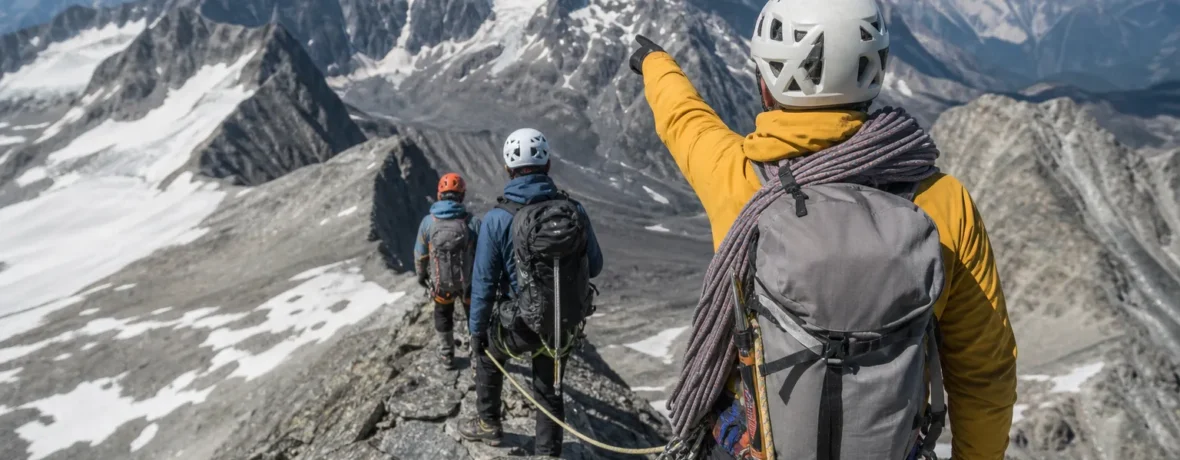
To become a mountain guide, build years of personal mountain experience, get wilderness medical training, take avalanche education if you work on snow, apprentice under qualified guides, and pursue AMGA certification. Yes, you can guide without full IFMGA status, but serious alpine guiding requires formal training, judgment, and logged days.
How to become a mountain guide step by step?
Start by becoming solid in the mountains before you try to lead paying clients there.
- Build a deep personal resume. Climb, hike, ski, scramble, camp, and travel in bad weather. Get comfortable when the trail disappears and the day gets longer than planned.
- Pick your guiding lane. Hiking guide, backpacking guide, rock guide, alpine guide, ski guide, and international mountain guide are not the same job.
- Take wilderness medicine. A Wilderness First Responder course is the common baseline for many outdoor professionals; NOLS describes its WFR course as training for people who work or travel in remote areas with limited medical access.
- Learn risk systems. That means weather, terrain, group management, emergency plans, communication, and decision-making under pressure.
- Get avalanche training if you work in winter or glaciated terrain. As of November 2026, AIARE says aspiring professionals need AIARE 1 and Avalanche Rescue before Pro 1.
- Work entry-level outdoor jobs. Carrying group gear, teaching knots, cooking in rain, and managing nervous beginners all count.
- Find mentors and apprentice. Watch how professional guides pace the day, brief hazards, coach movement, and turn around without drama.
- Pursue AMGA training and certification if you want to guide technical rock, alpine, or ski terrain in the United States. The AMGA runs separate Rock, Alpine, and Ski programs.
- Keep a clean logbook. Record routes, dates, grades, conditions, partners, leadership role, client days, and lessons learned.
- Stay employable. Be fit, punctual, humble, organized, and easy to trust. Technical skill opens the door. Professional behavior keeps it open.
What does a mountain guide actually do?
A mountain guide helps people move through mountain terrain safely, efficiently, and with better judgment than they would have alone.
The job is not just being the strongest person on the rope. You plan the route, study weather, check permits when they apply, inspect equipment, assess the group, teach movement skills, manage fear, and make go/no-go calls. Some days are full-value alpine climbs. Some days are gentle instructional hikes with clients who have never worn crampons.
A good guide reads people as closely as terrain. You notice the client who says they are fine but has stopped eating. You spot the person tying in wrong because they are cold. You know when a group needs a snack, a layer, a short rope, a new plan, or a hard turnaround.
| Guide type | Typical terrain | Common training path |
|---|---|---|
| Hiking or backpacking guide | Trails, off-trail travel, camps, non-technical peaks | Wilderness medicine, navigation, outdoor leadership, local permits |
| Rock guide | Single-pitch and multi-pitch rock climbs | AMGA Single Pitch Instructor, Rock Guide training, rescue skills |
| Alpine guide | Snow, ice, rock, glaciers, exposed mountain routes | AMGA Alpine Guide Program, avalanche training, glacier travel |
| Ski guide | Backcountry ski tours, avalanche terrain, ski mountaineering | Avalanche professional training, AMGA Ski Guide track |
What certifications do you need to be a mountain guide?
You need the certifications that match your terrain, employer, and client risk.
In the United States, the key name to know is the American Mountain Guides Association. As of November 2026, the AMGA’s mountain guide programs are split into three major disciplines: Rock, Alpine, and Ski. The AMGA Alpine Guide Program is designed for guides working on alpine snow, ice, and rock routes, including glaciated and non-glaciated peaks.
For the highest international credential, guides work toward IFMGA status. As of November 2026, the AMGA says its American Mountain Guide/IFMGA credential requires certification in the Alpine, Rock, and Ski disciplines, and the IFMGA training standard includes at least 94 days of training, with at least 84 practical days in alpine terrain.
That does not mean every guide needs IFMGA certification. A front-country hiking guide in the Smokies, a backpacking guide in the Sierra, and a ski mountaineering guide in the Tetons have different scopes of work. Match the credential to the terrain. Do not sell yourself as a technical mountain guide if your training stops at trail leadership.
- For hiking and backpacking: Wilderness First Aid or Wilderness First Responder, map and compass skill, local land-management knowledge, and employer training.
- For rock guiding: AMGA Single Pitch Instructor or Rock Guide progression, rescue systems, anchor building, and client movement coaching.
- For alpine guiding: glacier travel, crevasse rescue, short roping, snow and ice protection, rock movement, and AMGA Alpine training.
- For ski guiding: avalanche education, snowpack assessment, ski movement, winter emergency systems, and AMGA Ski training.
How much climbing experience do you need to become a mountain guide?
You need enough experience that your own movement is no longer the main problem.
That takes time. Not one big summer. Not a handful of summits. You should have a broad logbook across seasons, weather, partners, and terrain types. A guide who has only climbed in perfect conditions has not yet learned the job.
Before guiding technical terrain, you should be able to move competently while still watching clients, rope systems, rockfall, time, weather, and escape options. If you need all your attention for your own footwork, you are not ready to manage someone else’s risk.
Your experience should include:
- Long mountain days that start before sunrise and end after dark.
- Trips where the original plan changed because of weather, fatigue, route conditions, or group ability.
- Navigation in fog, snow, forest, talus, and featureless terrain.
- Rock climbing, snow travel, scrambling, and camping in poor conditions if you want alpine work.
- Leadership days where you made the plan, briefed the group, and carried the decision.
- Rescue practice done repeatedly enough that it does not fall apart under stress.
How long does it take to become a mountain guide?
Expect several years for basic professional competence and longer for full technical certification.
A person with no mountain background should not rush this. You can start working in outdoor programs, camps, trail crews, youth expeditions, or hiking-guide roles while you build your resume. Technical alpine guiding takes a longer runway because you need mileage in rock, snow, ice, weather, rescue, and client care.
The full AMGA/IFMGA path is a major professional commitment. It includes discipline-specific training, exams, prerequisites, mentorship, and logged experience. The time depends on your current skill, access to terrain, money, schedule, fitness, and how often you can work under qualified guides.
Here is a realistic progression:
- Year 1: Learn outdoor leadership basics, take wilderness medicine, build personal hiking and climbing mileage.
- Years 2-3: Work entry-level trips, assist senior staff, take avalanche education if needed, sharpen rescue and rope systems.
- Years 3-5: Enter discipline-specific guide training, guide within your scope, build a stronger logbook.
- Years 5 and beyond: Pursue advanced certification, specialize, mentor newer guides, and keep training current.
What wilderness medical training does a guide need?
Most serious guide jobs expect wilderness medical training, and many prefer Wilderness First Responder.
Guides work where standard emergency care can be delayed by terrain, weather, darkness, distance, or communication gaps. That is why wilderness medicine matters. You are not becoming a doctor. You are learning patient assessment, basic field care, evacuation thinking, and how to communicate clearly when help is not standing next to you.
As of November 2026, NOLS Wilderness First Responder courses are built for people working or traveling in remote settings with limited access to medical care. Many guide services ask for WFR because it is more complete than a short first-aid class.
Keep the card current. More than that, keep the skill alive. Practice scenarios. Know your kit. Know your employer’s emergency plan. A guide who cannot stay calm during a simple ankle injury will struggle when the situation gets noisy.
Do you need avalanche training to become a mountain guide?
Yes, if your work touches avalanche terrain.
If you guide snowshoe trips, ski tours, winter climbs, glacier routes, or spring alpine objectives, avalanche education is part of the job. Snow is not scenery. It is a moving, changing medium with consequences.
As of November 2026, AIARE Level 1 states that aspiring professionals need AIARE 1 and Avalanche Rescue before taking Pro 1. That is the starting point, not the finish line. Professional avalanche work also means weather tracking, snowpack observations, terrain choices, communication, rescue practice, and humility when the forecast does not match the plan in your head.
Good snow guides are conservative without being timid. They know the difference.
What skills make a good mountain guide?
The best guides combine technical competence with calm leadership.
Clients remember summits, sure. They remember how you made them feel even more. Rushed, ignored, embarrassed, unsafe? That is bad guiding. Clear, challenged, respected, protected? That is the standard.
- Judgment: You make decisions before the mountain makes them for you.
- Communication: You explain hazards in plain language and check that people understood.
- Technical systems: Anchors, knots, transitions, rescue, navigation, and terrain movement must be clean.
- Pacing: You move the group at a speed that protects morale and daylight.
- Teaching: You can coach a nervous client without flooding them with jargon.
- Fitness: You have enough reserve to help others when the day gets heavy.
- Humility: You turn around when needed and do not make the client carry your ego.
- Professionalism: You answer emails, show up early, maintain gear, and keep clean records.
How do you get your first mountain guiding job?
Get hired by doing useful work before asking for glamorous work.
New guides often start with hiking trips, youth programs, outdoor schools, summer camps, climbing gyms, trail crews, or assistant guide roles. That is not a step down. It is where you learn group management, pacing, teaching, risk communication, and the art of keeping people fed, warm, and moving.
When you apply, do not just say you love the mountains. Everyone says that. Show a clean resume, a clear logbook, current medical training, references, and a scope you understand. If you are not ready to lead technical terrain, say so. Employers trust honesty more than bravado.
Useful ways to get noticed:
- Volunteer with local climbing, trail, adaptive sports, or search-and-rescue groups if the role is appropriate for your skill.
- Take courses from the guide service you hope to work for and act like a professional student.
- Ask working guides what skills their company needs, then go build those skills.
- Offer availability for less glamorous dates, shoulder seasons, gear days, and instructional programs.
- Keep your online presence clean. Clients and employers can find it.
What gear do you need to become a mountain guide?
You need reliable personal gear first, then discipline-specific professional gear.
Do not buy shiny tools before you know your path. A hiking guide needs different equipment than an alpine or ski guide. Start with durable clothing, footwear that fits, navigation tools, a headlamp, repair items, a communication plan, and a medical kit that matches your training.
For technical guiding, your employer or certification course may specify required gear. Follow that list. Guides are hard on equipment, so choose pieces that are simple, repairable, and easy to inspect. The fanciest item in the shop is not always the best item for client work.
- Personal layers for heat, cold, wind, and rain.
- Footwear suited to the terrain, from trail shoes to mountaineering boots.
- Map, compass, GPS device or app, and the skill to use them when tired.
- Headlamp with backup power.
- First-aid and emergency kit matched to your training and trip type.
- Communication device appropriate for the area.
- Helmet, harness, rope systems, ice axe, crampons, skis, or avalanche gear only when your terrain requires them.
Can you become a mountain guide without being an elite climber?
Yes, but you cannot be sloppy.
Guiding is not a sport-climbing highlight reel. You do not need to be the strongest climber in the valley to guide hiking, backpacking, or moderate alpine terrain. You do need to be steady, safe, teachable, fit, and honest about your limits.
For technical guiding, your movement skills must exceed the terrain you guide. If clients are paying you to manage risk on exposed rock, snow, ice, or avalanche terrain, you need a margin. That margin is what lets you solve problems while everyone else is cold, scared, or tired.
The mountain does not care how badly you want the title. Build the craft. The title follows.
Related reading
- How to Become a Hiking Guide: Certifications and Work
- How to Become a Backpacking Guide
- How to Become a Park Ranger: Education, Steps and Timeline
- How to Become a Forest Ranger
FAQ
Do mountain guides need a license?
Sometimes. Requirements depend on the country, land manager, employer, and terrain. In the United States, permits often apply to guide services on public land, while professional certification comes through groups such as the AMGA.
What is the difference between a hiking guide and a mountain guide?
A hiking guide usually works on trails, backpacking routes, and non-technical terrain. A mountain guide may work on rock, snow, ice, glaciers, ski terrain, and exposed alpine routes that require rope systems and advanced risk management.
Is AMGA certification required to guide in the United States?
Not for every guiding job. Many employers, land managers, and clients value AMGA training, and technical guide services may require it for certain terrain, but entry-level hiking and backpacking jobs can have different requirements.
How fit do you need to be to guide mountains?
You need enough fitness to work all day while carrying group gear and still make good decisions. That means endurance, leg strength, balance, and reserve energy for emergencies, not just fast summit times.
Can guiding be a full-time career?
Yes, but many guides piece together seasonal work at first. Full-time careers usually come from certification, repeat clients, strong employers, broad terrain skills, and the ability to work safely across multiple seasons.
What is the best first course for an aspiring mountain guide?
Start with wilderness medicine and a course that matches your terrain. For many people, that means Wilderness First Responder, then avalanche education, rock instruction, or alpine skills training depending on the guiding path you want.