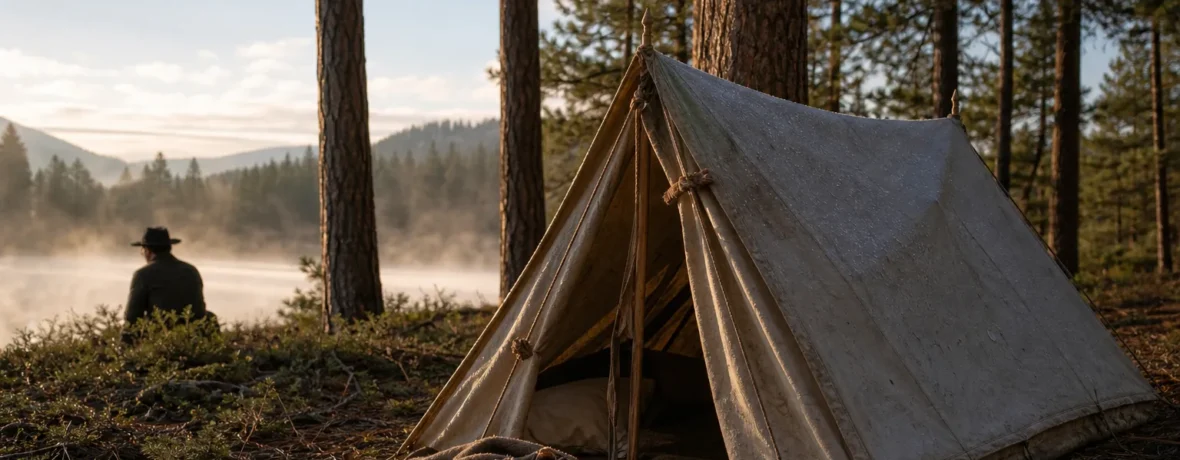
A pup tent is a small, low, usually wedge-shaped tent for one or two people. The classic military version used two shelter halves buttoned together over end poles, with each soldier carrying one half. It works, but for most backpackers today, it is more history lesson than best shelter choice.
What is a pup tent?
A pup tent is a simple A-frame shelter, usually sized for one or two sleepers.
The old-school version is brutally straightforward: two sloping panels, a ridge line, a pole or support at each end, stakes at the edges, and not much else. No standing room. No vestibule worth bragging about. Often no sewn-in floor. In its purest military form, it was made from two “shelter halves” joined together, which is exactly how the U.S. Defense Logistics Agency describes the shelter half: one half of a small tent, with two halves forming a closable tent in its MIL-S-3725 shelter-half specification.
That is the clean answer. But the better answer is this: a pup tent is a design built around sharing weight, not maximizing comfort. It came from soldiers moving on foot, carrying their own kit, and needing something better than sleeping in the open. That origin explains both its charm and its limits.
Why is it called a pup tent?
It is called a pup tent because soldiers compared the low little shelter to a dog kennel.
The name has bite. “Pup” does not sound grand because the tent was not grand. The phrase shows up in American military use during the Civil War era; the Online Etymology Dictionary dates “pup tent,” also called “dog tent,” to 1863 in its entry for “pup”. That timing lines up with the U.S. Army’s shift toward portable shelter tents carried by individual soldiers.
There is a lesson tucked inside the nickname. Nobody called it a palace tent. Nobody called it a comfort tent. They called it something fit for a dog, then crawled inside anyway because dry canvas beats wet wool blankets.
Where did pup tents come from?
Pup tents came from military shelter-half systems, especially the Civil War shelter tent.
During the American Civil War, armies had to move men, food, ammunition, tools, animals, and shelter across bad roads. Big wall tents had their place, but they needed wagon space. A small shelter carried by the soldier solved a real logistics problem.
The U.S. Army Center of Military History describes Civil War shelter tents as two sections buttoned together into what people now often call a pup tent; each enlisted man received one shelter half and joined it with a sleeping mate’s half in its staff ride guide on the Union Army. That is the key move: the shelter was split between two people. Each person carried a burden. Together, they got a roof.
By World War II, the term was common enough to appear in civilian newspaper accounts of wartime manufacturing. A National Park Service lesson on Wichita defense manufacturing quotes a 1940 article explaining that pup tents were made of two shelter halves, with each soldier carrying one and pairing up at night to button them together in the NPS article on Langdon Tent & Awning Company.
That is the short history: soldiers needed portable shelter; the shelter was divided into halves; the low, kennel-like shape earned a nickname; the nickname stuck.
How does a pup tent work?
A pup tent works by tensioning fabric into a ridge shape and staking the edges to the ground.
Think of it as the ancestor of every basic A-frame tarp pitch you have ever seen. The ridge is held up by end poles, trekking poles, sticks, or a suspended line. The sides slope down to the ground. Stakes pull the fabric tight. Gravity sheds rain. Wind resistance depends on pitch quality, site choice, and fabric strength.
A military shelter-half tent had more structure than a random tarp pitch. The U.S. Army technical manual for shelter-half tents describes a two-man shelter made from cotton/rayon duck, with poles at each end and sides secured by pins through footstops. It also lists the shelter-half dimensions as 12 ft 9.5 in [3.90 m] long and 5 ft 1 in [1.55 m] wide in TM 10-8340-221-13.
Here is the plain setup pattern:
- Pick high, level ground with drainage, not a hollow where water will pool.
- Join the two shelter halves, if using the classic military design.
- Lay the tent body where you want the door and foot end to land.
- Set a pole at each end or run a taut ridge line between solid supports.
- Stake the four lower corners first, then tension the side points.
- Tighten the ridge and re-stake until the fabric sheds rain instead of sagging.
Simple? Yes. Forgiving? Not really. A sloppy pitch makes a pup tent sag, flap, leak, and steal sleep.
Is a pup tent the same as an A-frame tent?
A pup tent is a type of A-frame tent, but not every A-frame tent is a pup tent.
The overlap is shape. Both use a triangular profile. The difference is history and use. “A-frame” describes the geometry. “Pup tent” carries the military shelter-half baggage with it.
| Feature | Classic pup tent | Modern backpacking tent |
|---|---|---|
| Shape | Low wedge or A-frame | Dome, tunnel, trekking-pole, or hybrid |
| Floor | Often none in older designs | Usually sewn-in bathtub floor |
| Setup | Stakes, poles, tension, patience | Usually faster and more intuitive |
| Best use | History, reenactment, simple fair-weather camping | Backpacking, storms, bugs, varied terrain |
Are pup tents good for backpacking?
Pup tents are usually not the best choice for modern backpacking.
That is the opinion, and it is not a nostalgic one. A pup tent can shelter you. So can a blue tarp. The question is not whether it works. The question is whether it earns its spot in your pack against better options.
For most hikers, the answer is no. A classic pup tent gives you limited headroom, weak bug protection unless modified, little gear storage, and a fussy pitch compared with modern shelters. Canvas versions also hold water, dry slowly, and feel like punishment on long climbs.
Still, the design has strengths:
- It teaches pitch tension better than many modern pop-up shelters.
- It has fewer failure points than complex pole hubs.
- It can be repaired with basic field skills.
- It shows why site selection matters.
- It splits shelter weight cleanly between two people in the classic military setup.
So here is the fair verdict: use a pup tent if you enjoy old gear, teach outdoor skills, camp in mild conditions, or want a cheap surplus-style shelter for backyard or base-camp use. Do not choose one as your primary long-distance backpacking shelter because it looks rugged in a photo. Rugged is not the same thing as smart.
What should you look for if you buy a pup tent?
Look for sound fabric, complete hardware, and a design that matches your actual camping plans.
Plenty of tents get labeled “pup tent” because the phrase sells nostalgia. Before you buy, separate the useful shelter from the costume piece.
- Fabric condition: Avoid brittle coatings, mildew, pinholes, and torn seams.
- Complete parts: Check for poles, stakes, guy lines, buttons, snaps, and end closures.
- Weather protection: A floorless tent needs a groundsheet and careful pitching.
- Ventilation: Low canvas or nylon shelters can collect condensation fast.
- Packed weight: If you have to ask whether it is too heavy for backpacking, it probably is.
- Purpose: Reenactment, scouts, car camping, and backyard use are different jobs.
The big trap is romance. Old gear has soul. It also has old-gear problems. Buy it for the right reason and you will enjoy it. Buy it to replace a proper three-season backpacking tent, and the first wet night may settle the argument.
What is the real legacy of the pup tent?
The pup tent’s legacy is not comfort; it is portable shared shelter.
That idea still matters. Split the load. Pitch low when weather turns. Carry only what solves the problem. Those are backpacking principles, not museum labels.
But the physical pup tent has mostly done its job and stepped aside. Modern shelters are lighter, roomier, more waterproof, better ventilated, and far better against insects. Good. Progress is allowed. You can respect the pup tent without dragging one over every pass.
The best way to think about it is this: the pup tent is the grandfather of practical backpacking shelters. Tough. Plain. A little cranky. Worth listening to. Not always worth copying.
Related reading
- What Is a Bell Tent?
- How to Waterproof a Tent: Seams, Rainfly and Floor
- How to Set Up a Tent Step by Step (Even Alone)
- How to Clean a Tent (Including Mold and Mildew)
FAQ
What is a pup tent used for?
A pup tent is used as a small sleeping shelter for one or two people. Historically, soldiers used it in the field; today it is more common for simple camping, scouting, reenactments, and outdoor-skills practice.
How many people fit in a pup tent?
Most pup tents fit two people closely, or one person with gear. The classic military version was designed around two shelter halves joined by two soldiers, so comfort was secondary to portability.
Does a pup tent have a floor?
Many traditional pup tents do not have a sewn-in floor. If yours is floorless, use a groundsheet and choose a raised, well-drained site so rain does not run under your sleeping pad.
Is a pup tent waterproof?
A pup tent may shed rain if the fabric is treated, seams are sound, and the pitch is tight. Older canvas or surplus tents can leak if the fabric, coating, snaps, or seams have degraded.
Is a pup tent good for beginners?
A pup tent is good for learning basic pitching skills, but not always best for a beginner’s first backpacking shelter. A modern freestanding or semi-freestanding tent is usually easier, drier, and more comfortable.
What is the difference between a pup tent and a shelter half?
A shelter half is one panel of the classic military system. Two shelter halves join together to make the complete pup tent, which is why each soldier could carry one half and pair up at camp.