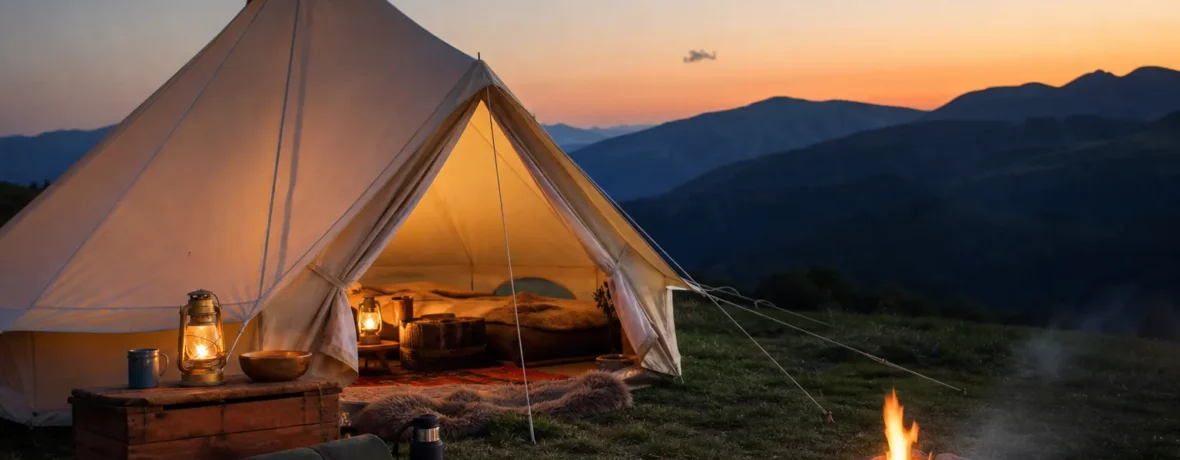
A bell tent is a round canvas shelter with one center pole, a door pole, guy lines, and steep walls. It is usually a car-camping tent, not a backpacking tent: common 13-foot [4 m] models sleep 4-6 people and can weigh 60-80 lb [27-36 kg].
What is a bell tent used for?
A bell tent is best used as a comfortable basecamp shelter. That means car camping, hunting camp, festival camping, family weekends, long campground stays, and “glamping” setups where standing room and livability matter more than packed weight.
Here’s the straight take: a bell tent is excellent when your vehicle does the hauling. It is the wrong tool when your shoulders do the hauling. Canvas, steel poles, heavy stakes, and a large packed bag make sense beside a truck, trailer, or canoe landing. They make no sense on a 9-mile [14.5 km] climb to a lake.
The shape is the point. The round floor gives you a simple living space. The center pole creates a high peak. The low sidewalls give you usable edge space for duffels, dog beds, cots, firewood bags, and the mountain of family gear that somehow appears after one night outside.
How is a bell tent different from a regular camping tent?
A bell tent is heavier, roomier, and simpler than most dome or cabin tents. Most bell tents use canvas or canvas-like fabric, a single center pole, a front A-frame or door pole, and a ring of guy lines to tension the shelter.
A regular synthetic camping tent usually relies on flexible poles, a rainfly, and lighter nylon or polyester fabric. It packs smaller. It dries faster. It is easier to move when you picked a bad site. A bell tent gives you a more pleasant living room, but it asks for more planning and more muscle.
| Tent type | Best use | Main tradeoff |
|---|---|---|
| Bell tent | Car camping, basecamp, glamping, family camp | Very comfortable, very heavy |
| Dome tent | Weekend camping, windier sites, smaller groups | Less standing room, easier handling |
| Backpacking tent | Hiking, thru-hiking, backcountry travel | Light and compact, less living space |
| Cabin tent | Campgrounds and family trips | Roomy, but often weaker in wind than lower shapes |
Are bell tents good for hiking?
No, not for normal hiking trips. A bell tent is a camp shelter, not a trail shelter, unless stock animals, a boat, a sled, or a vehicle is moving the load.
This is where the marketing fluff needs to be called out. A tent you can technically carry is not automatically a hiking tent. A 13-foot [4 m] canvas bell tent can weigh more than an entire lightweight backpacking kit for two people. Some current manufacturer specs put 13-foot models in the 60-80 lb [27-36 kg] range, including poles and hardware; see these 13-foot bell tent specs from White Duck Outdoors and Life inTents’ bell tent size guide.
If your plan is to hike from a parking lot to a walk-in campsite 200 yards [183 m] away, fine. If your plan is to climb switchbacks for hours, leave the bell tent at home and bring a real backpacking shelter.
How many people fit in a bell tent?
A 13-foot [4 m] bell tent usually fits 2 people luxuriously, 4 people comfortably, or 6 people tightly in sleeping bags. The practical number is lower than the advertised number once you add cots, bags, chairs, a dog, wet boots, and one person who packs like they’re fleeing a small empire.
Use this rule: if you want comfort, divide the listed sleeping capacity by two. A 6-person bell tent is a very good 3-person camp palace. It can sleep 6, yes. So can a pickup bed. That does not make it pleasant.
For families, the best setup is usually sleeping pads or cots around the edges with the center pole left clear. Do not stack gear against the walls if rain is coming. Canvas handles weather best when air can move and fabric is not pressed against wet items all night.
Are bell tents waterproof?
Most quality bell tents are water-resistant or waterproof when properly designed, pitched, and maintained. Canvas behaves differently than a coated backpacking tent fly, so care matters.
Cotton canvas can swell when wet, which helps tighten the weave. Treated canvas sheds rain well when the tent is pitched tight and the roof angle is clean. But no canvas tent likes being packed wet, stored dirty, or left sagging in a storm. That is how mildew starts and seams get stressed.
A bell tent also needs space. A 13-foot [4 m] floor does not mean a 13-foot campsite is enough. You need room for guy lines, stakes, door clearance, and drainage. If the campground pad is small, boxed in by shrubs, or covered with sharp gravel, a bell tent becomes a wrestling match.
How do you set up a bell tent?
You set up a bell tent by staking the floor first, raising the center pole, then tensioning the guy lines evenly. The order matters because the round footprint only works when the fabric is centered and balanced.
- Pick a flat, durable site with enough space for the tent body and guy lines.
- Lay out the groundsheet or sewn-in floor and pull it into a clean circle.
- Stake the floor lightly at opposite points, then fill in the remaining stakes.
- Zip the door closed before raising the tent so the shape stays true.
- Insert the center pole vertically and raise the roof.
- Add the door pole or A-frame support.
- Stake and tension the guy lines in pairs, moving around the tent evenly.
- Check the roof for wrinkles, sags, and pooling points before you call it done.
Do not muscle one side tight and ignore the other side. Bell tents reward patience. A good pitch looks boring: straight pole, even roof, firm floor, no loose panels flapping like laundry in a gale.
Can you use a stove in a bell tent?
Yes, only if the tent is built for it and you use the correct stove system. That means a proper stove jack, heat shielding, ventilation, spark control, and strict clearance from fabric, bedding, and gear.
This is not the place to improvise. A canvas bell tent with a stove jack is often sold as a “hot tent,” but that does not make every heater safe. Never run a charcoal grill, camp stove, or fuel-burning cooking setup inside a tent for warmth. The U.S. Consumer Product Safety Commission’s carbon monoxide guidance warns against portable fuel-burning equipment inside tents unless it is specifically designed for enclosed-space use and used exactly as instructed.
Also, cooking inside your sleeping shelter is bad backcountry hygiene. In bear country, it is worse. As of November 2026, the National Park Service tells campers not to store food or scented items in tents; read its bear food-storage guidance before you build camp habits that attract trouble.
What should you check before buying a bell tent?
Buy a bell tent only if you have the vehicle space, campsite space, and patience to care for it. The pretty photos do not show the wet canvas bag in your garage.
- Packed weight: Can one person move it, or do you need two?
- Packed size: Will it fit in your vehicle with coolers, chairs, and sleeping gear?
- Footprint: Does your usual campsite have enough room for guy lines?
- Fabric: Cotton canvas breathes well; synthetic canvas blends may dry faster.
- Floor: A sewn-in floor blocks bugs better; a zip-out floor cleans easier.
- Ventilation: Look for roof vents, mesh doors, and usable windows.
- Stove jack: Skip it unless you will use a compatible hot-tent stove safely.
- Drying plan: If you cannot dry it fully at home, do not buy canvas.
Where should you pitch a bell tent?
Pitch it on durable ground with drainage, space, and low impact. A bell tent’s large footprint can damage fragile vegetation if you squeeze it where it does not belong.
Use established campsites when possible. As of November 2026, Leave No Trace guidance on durable surfaces recommends designated tent pads and already impacted areas as the least damaging places to camp. That advice matters more with a big shelter because your guy lines, stakes, entry mat, chairs, and kitchen sprawl can turn one tent into a whole compound.
A good bell tent site has firm ground, no dead limbs overhead, natural drainage away from the door, and room to walk around the tent without trampling plants. If you cannot stake it properly, pick a different shelter.
Related reading
- What Is a Pup Tent? A Short History
- How to Waterproof a Tent: Seams, Rainfly and Floor
- How to Set Up a Tent Step by Step (Even Alone)
- How to Clean a Tent (Including Mold and Mildew)
FAQ
Is a bell tent worth it?
Yes, if you camp from a vehicle and value comfort over compactness. No, if your trips involve long carries, tight tent pads, or fast one-night stops.
Why are bell tents so heavy?
Bell tents are heavy because they use large fabric panels, strong poles, long guy lines, and sturdy stakes. Canvas models add durability and breathability, but the weight penalty is real.
Can one person set up a bell tent?
Yes, one person can set up many bell tents with practice. The easier path is two people: one manages the fabric and poles while the other stakes and tensions the lines.
Do bell tents handle wind well?
They can handle moderate wind when pitched tight with proper stakes and even guy-line tension. A sloppy pitch turns the tall canvas walls into a sail, so site choice and staking matter.
Can you leave a bell tent up all season?
Some bell tents can stay up for extended periods, but canvas still needs inspection, drying, cleaning, and tension checks. Snow load, mildew, UV exposure, and standing water can shorten the tent’s life fast.
What is the bottom line on bell tents?
A bell tent is a roomy basecamp shelter, not a hiking tent. Buy one for comfort, style, and long camp hangs; skip it when weight, speed, and small campsites matter most.