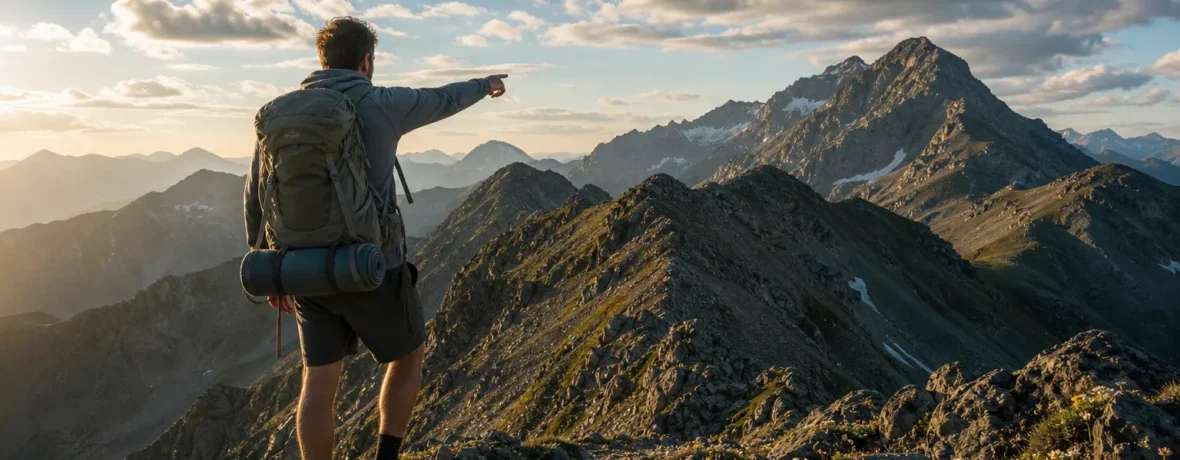
A false summit is a high point that looks like the top of a mountain but is not the true summit. No, you are not done if the trail continues upward beyond it. On steep hikes, one climb can hide another, sometimes several hundred vertical feet [90+ m] above you.
What is a false summit?
A false summit is a visual fake-out.
You climb toward what appears to be the highest point, reach it, and then see more mountain. Maybe the real summit is across a saddle. Maybe it is tucked behind a ridge. Maybe the trail bends and reveals another bump that was hidden from below.
That is the plain answer. But here is the column answer: a false summit is not the mountain being cruel. It is the mountain telling you that your eyes are lousy judges of terrain.
Your brain wants a clean finish line. Hiking rarely gives you one. Terrain rolls, folds, blocks sightlines, and stacks ridges in front of each other. From below, a shoulder can look like the top. From the side, a subpeak can steal the skyline. From inside the effort of a hard climb, wishful thinking does the rest.
If you hike long enough, false summits stop feeling like betrayal and start feeling like data. They tell you where you are, how much you have left, and whether your plan still makes sense.
Why do false summits happen?
False summits happen because you cannot see the whole mountain from one angle.
Mountains are three-dimensional. Trails do not move up them in a clean staircase. A route may climb a shoulder, cross a bench, swing around a rib, drop into a saddle, then climb again. From below, the first high point blocks the higher ground behind it.
Several landforms commonly create the illusion:
- Shoulders: Broad rises on the side of a peak that look final from below.
- Ridges: Long crests that hide higher points farther along the line.
- Subpeaks: Smaller named or unnamed high points near the main summit.
- Rollovers: Convex slopes where the ground curves out of sight.
- Switchbacks: Trail turns that make progress feel higher than it really is.
Fog, snow, tree cover, and darkness make the problem worse. So does fatigue. When your legs are cooked and your snacks are low, every knob starts looking like salvation.
How can you spot a false summit before you reach it?
You spot a false summit by checking the map, not by trusting the skyline.
A topographic map is the best tool here because contour lines show the shape of the land. The U.S. Geological Survey explains that contours represent elevation and terrain shape, which is exactly what you need when the view lies to you. Read more from the USGS topographic map symbol guide.
Look for the pattern. A true summit is usually shown by closed contour lines with no higher closed contour nearby. A false summit often appears as a shoulder, bump, or smaller closed contour before the route continues to higher ground.
| Feature | What it means | What you should do |
|---|---|---|
| Closed contour with higher contours beyond it | Likely false summit or subpeak | Expect more climbing |
| Saddle after a high point | You will lose elevation before gaining again | Save energy for the next climb |
| Trail continues past the high point | The route is not finished | Check distance and elevation remaining |
| Highest labeled point on the map | Likely the true summit | Confirm with GPS, map, or trail sign |
Digital maps help, too, but only if you look at the elevation profile before you are gasping on a ridge. A profile with three distinct rises is not one climb. It is three climbs wearing the same trail name.
What is the difference between a false summit and the true summit?
The true summit is the highest point of the mountain; a false summit only looks like it from your current position.
The true summit is a geographic fact. The false summit is a perception problem. One is measured. The other is felt.
That distinction matters because hikers can make bad decisions when emotion beats information. You may burn too much water getting to the first “top.” You may push past your turnaround time because the real summit looks close. You may skip food because you think you are nearly finished. Bad math starts small.
Here is the clean test: if there is higher terrain connected to the route ahead, you are not on the true summit. You may be on a ridge crest, shoulder, overlook, or subpeak. Nice place. Good view. Not the top.
Why do false summits feel so frustrating?
False summits feel frustrating because they break the deal you made in your head.
You told yourself, “Just get to that top.” Then you did. Then the mountain moved the finish line.
Of course that stings. Hiking is physical, but the hardest parts are often mental. A false summit hits when you have already spent effort, hope, and maybe the last clean sip from your bottle. The view opens, and instead of reward, you get another climb.
This is where hikers split into two camps. One camp gets angry and starts chasing the summit harder. The other camp pauses, recalculates, and keeps control of the day. Be in the second camp.
The point is not to be tough. The point is to be accurate. If the summit is still 0.7 miles [1.1 km] away with 500 feet [152 m] of gain, say that out loud. Numbers cut through drama.
How should you handle a false summit on a hike?
Handle a false summit by stopping, checking your plan, and making a fresh decision.
Do not treat it as a personal insult. Treat it as a checkpoint.
- Stop moving for one minute. Drink, breathe, and get your head out of grind mode.
- Check your map and elevation profile. Confirm how far and how high the true summit is from your position.
- Check daylight. Your return takes time, and downhill miles still count.
- Check weather. If clouds are building or wind is rising, the summit can wait.
- Check the group. The slowest hiker sets the real pace, not the strongest one.
- Decide cleanly. Keep going, shorten the goal, or turn around. Do not drift into a decision.
The National Park Service advises hikers to plan ahead, know conditions, carry essentials, and be willing to change plans. Their Hike Smart guidance is blunt in the right way: your safety is your responsibility.
When should you turn around at a false summit?
Turn around when continuing shrinks your safety margin too much.
This is the unpopular opinion that should not be unpopular: turning around at a false summit is often the smartest move of the day. Summits are optional. Getting back is not.
Use these signals as a hard reset:
- You have reached your planned turnaround time.
- The route ahead is steeper, icier, looser, or more exposed than expected.
- Weather is worsening or visibility is dropping.
- You do not have enough water, food, warm layers, or light for the full return.
- Someone in the group is moving poorly, getting cold, or making sloppy decisions.
- The remaining climb would put you on exposed terrain during thunderstorm risk.
The NPS trip planning guide tells hikers to ask about current conditions and consider turning around when safety concerns affect the activity. That is not weakness. That is mountain sense.
For weather, check the forecast before you go and keep checking conditions with your eyes. NOAA’s outdoor weather safety guidance is a good baseline for understanding how fast weather can change outside.
How do you avoid getting fooled by false summits?
You avoid getting fooled by planning the whole route, not just the summit photo.
Before the hike, study three things: total mileage, total elevation gain, and the shape of the climb. A trail with 3,000 feet [914 m] of gain may climb steadily, or it may climb, dip, climb, dip, and climb again. Those are different days.
Use this quick checklist before you leave the trailhead:
- Look at the full elevation profile, not only the top elevation.
- Mark major ridges, saddles, and subpeaks.
- Identify the final summit approach.
- Set a turnaround time before you start.
- Carry a map source that works without cell service.
- Tell someone your route and expected return window.
On the trail, keep asking one question: “What comes after this high point?” If you cannot answer, check before you spend your legs chasing it.
False summits are not rare mistakes. They are normal mountain features. The hikers who handle them well are not the ones with the most optimism. They are the ones with the clearest picture of the route.
Related reading
- Summit Fever: When to Turn Around
- Type 2 Fun: Why Hard Hikes Feel Good Later
- The Seven Summits Explained
- What Is Geocaching?
FAQ
What does false summit mean in hiking?
A false summit is a point that looks like the summit but is not the highest point. The real summit is still farther along the route or hidden behind the terrain.
Is a false summit dangerous?
A false summit is not dangerous by itself. It becomes dangerous when it tricks you into ignoring time, weather, water, fatigue, or the difficulty of the remaining route.
Can a mountain have more than one false summit?
Yes, a mountain can have several false summits. Long ridges and routes with repeated bumps can create multiple high points before the true summit.
How do maps show a false summit?
Maps may show a false summit as a smaller closed contour, shoulder, or subpeak before the highest contour on the route. The key clue is higher terrain beyond the point you are standing on.
Should I keep hiking after a false summit?
Keep hiking only if you still have enough daylight, energy, gear, water, and stable weather for the summit and return. If any of those are thin, turn around without drama.