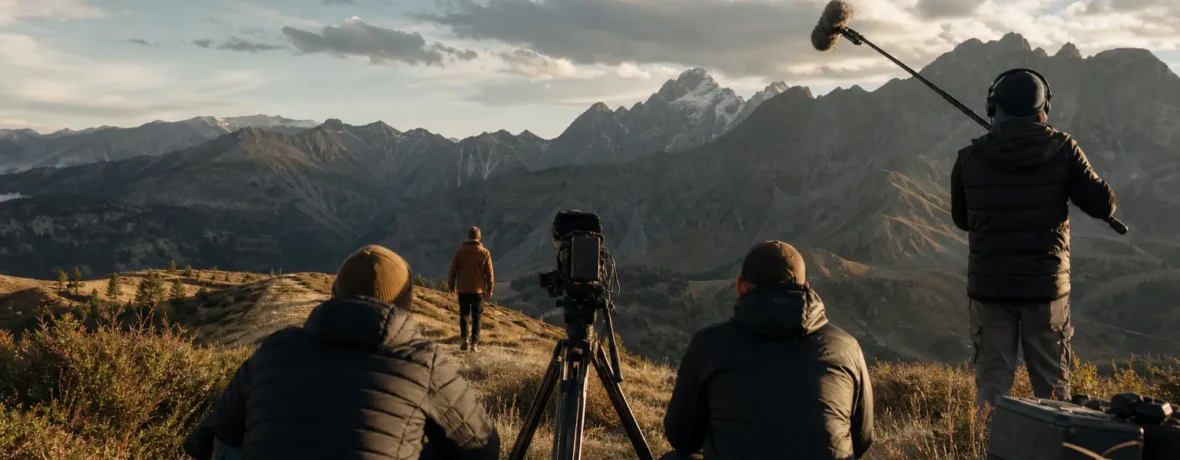
The best hiking documentaries make you want to walk and still make you respect weather, fatigue, terrain, and judgment. Start with 10 films: 4 long-trail stories, 4 alpine-risk films, and 2 conservation/travel films. Yes, watch them for motivation—if you do not mistake cinematic courage for a trip plan.
What are the best hiking documentaries to watch first?
Start with films that show effort, consequence, and place.
Here is the straight position: the best hiking and mountain documentaries are not the ones with the biggest drone shot or the loudest trailer. They are the ones that leave you more curious, more prepared, and less likely to treat the backcountry like a set piece. A good trail film should widen your appetite for wild places without shrinking your respect for them.
That is why this list leans toward documentaries with real foot travel, real mountain judgment, and real stakes. Some are quiet. Some are tense. Some are gorgeous enough to make your living room feel small. Good. That is the job.
-
1. Mile… Mile & A Half
This is the best first pick for hikers who want a trail-forward film.
Mile… Mile & A Half follows five friends on California’s John Muir Trail, a 211-mile [340 km] route through the Sierra Nevada, according to the film’s official page, Mile… Mile & A Half feature film. It works because it does not treat backpacking as punishment. It treats it as repetition, weather, sore feet, shared meals, and the slow build of attention.
This is the antidote to “summit or nothing” storytelling. The trail is the point. The art is the point. So is the daily grind of moving a loaded pack through high country. If you are planning a long walk and need a film that actually feels like walking, start here.
-
2. The Long Start to the Journey
This is one of the better Appalachian Trail documentaries for emotional honesty.
The film follows a thru-hike attempt on the Appalachian Trail and spends more time with the inner trip than the highlight reel. That matters. Long trails are not just ridge views and shelter jokes. They are also doubt, boredom, body management, money pressure, homesickness, weather windows, and the strange math of doing the same hard thing every day.
Watch this if you are drawn to the AT but suspicious of glossy “quit your job and find yourself” packaging. The trail can change you. It can also simply wear you down. A solid documentary admits both.
-
3. The AT Experience
This one is for viewers who want the Appalachian Trail with less polish.
The AT Experience follows Andrew “Reptar” Forestell on an unsupported Appalachian Trail journey. Its strength is the stripped-down perspective. No giant production footprint. No attempt to turn every camp chore into a revelation. Just miles, weather, fatigue, and the odd intimacy that comes from filming a long trail as it happens.
That rougher texture can be more useful than perfection. If you are planning your own thru-hike, you need some beauty, yes, but you also need to see wet socks, repetitive meals, flat moods, and the constant negotiation between ambition and your knees.
-
4. National Parks Adventure
This is the big-screen love letter pick.
National Parks Adventure is not a gritty thru-hiking film. It is a sweeping IMAX-style tour of iconic American landscapes, and the official film site says it includes Yellowstone, Glacier, Yosemite, and Arches among its featured national park settings through immersive large-format cinematography in National Parks Adventure.
Use it as inspiration, not instruction. It is excellent for reminding you why public land matters and why a short hike in a famous park can still be powerful. But do not let the clean editing fool you. Parks are real places, not screensavers. Crowds, heat, altitude, permits, closures, and fragile terrain still apply.
-
5. Free Solo
This is the most famous modern mountain documentary for a reason.
Free Solo follows Alex Honnold as he prepares to climb Yosemite’s 3,000-foot [914 m] El Capitan without a rope, as described by National Geographic Documentary Films. It is beautifully made, brutally tense, and hard to look away from.
Here is the catch: it is not a hiking documentary in the boots-on-trail sense. It is a mountain-risk documentary. That still belongs on this list because hikers need to understand risk culture, too. The film is useful when you watch the preparation, restraint, relationships, and cost around the climb—not when you reduce it to “guy does wild thing.”
-
6. Meru
This is the best film here for obsession, partnership, and consequence.
Meru follows an attempt on the Shark’s Fin route on Meru, a 21,000-foot [6,401 m] peak in India, with Jimmy Chin, Conrad Anker, and Renan Ozturk. The official Meru documentary page frames the mountain as a place where trust is central, and that is the real subject.
The film’s value for hikers is not that you will copy anything in it. You will not. The value is seeing how mountain decisions get shaped by partnership, weather, injury, ego, memory, and unfinished business. That is the stuff that follows every person into the hills, even on a 6-mile [9.7 km] day hike.
-
7. The Alpinist
This is the sharpest warning against confusing purity with safety.
The Alpinist follows Canadian climber Marc-André Leclerc, who climbs alone and away from the spotlight. The official The Alpinist synopsis describes him as publicity shy, nomadic, and reluctant to let a film crew into his world.
The film is moving. It is also uncomfortable. That discomfort is the point. Mountain culture loves purity: pure style, pure commitment, pure solitude. But purity does not care if you come home. Hikers should watch this one with admiration and a raised eyebrow.
-
8. Touching the Void
This is the survival classic.
Touching the Void is a docudrama built around Joe Simpson and Simon Yates in the Peruvian Andes. It remains one of the strongest films ever made about survival, decision-making, and the gap between what looks obvious afterward and what feels possible in the moment.
For hikers, the lesson is simple and hard: emergencies do not arrive as neat moral puzzles. They arrive cold, fast, confusing, and loaded with partial information. A good mountain documentary should make you slower to judge and quicker to prepare.
-
9. 180° South
This is the best pick for the conservation-minded wanderer.
180° South follows Jeff Johnson as he retraces a 1968 journey by Yvon Chouinard and Doug Tompkins toward Patagonia. It mixes surfing, climbing, sailing, road travel, and environmental concern. It is not a pure hiking film, and that is fine.
Its value is in the question behind the scenery: what do you owe the places that shape you? If a documentary only makes you want to take from a landscape—photos, summits, social proof—it has failed. This one pushes harder. It points toward protection.
-
10. The Last Mountain
This is the heaviest film on the list.
The Last Mountain follows the story of British climber Tom Ballard and his family’s relationship with the world’s highest ranges. It is less about triumph than inheritance, grief, identity, and the pull of dangerous places.
Do not put this on for casual motivation while sorting snacks. Give it attention. The mountain documentary genre can get drunk on achievement; this film asks what achievement costs the people left standing at home.
Which hiking documentaries are best for planning a long trail?
Choose the films that show routine, not just revelation.
If you are planning a thru-hike, section hike, or first multi-day backpacking trip, the most useful documentaries are usually the least flashy ones. You want to see how people pack, eat, pace, talk, fall apart, recover, and keep moving. You want rain. You want boredom. You want the camera left on when the magic drains out.
Use this quick comparison before you press play:
| Documentary type | Best for | Watch with this question |
|---|---|---|
| Long-trail films | Backpacking expectations | What repeats every day? |
| National park films | Landscape inspiration | What is missing from the beautiful shot? |
| Alpine films | Risk and judgment | Where did the margin disappear? |
| Conservation films | Outdoor ethics | What does this place need from visitors? |
Here is the column take: if a film makes backpacking look like one long sunrise, it is not helping you. Long trails are built from tiny chores. Water filtering. Foot care. Layer changes. Resupply math. Campsite selection. Being polite when you are hungry. Staying found.
The National Park Service’s Hike Smart safety guidance tells hikers to plan ahead, know their limits, carry essentials, and prepare for changing conditions. That advice is not glamorous, which is exactly why it matters. The dull stuff gets you home.
What mountain documentaries teach hikers the right lessons?
The right lesson is humility.
Mountain documentaries can be dangerous if you watch them like a dare. They can be useful if you watch them like a case study. The difference is your posture. Are you trying to absorb courage, or are you trying to notice decisions?
When you watch films like Free Solo, Meru, The Alpinist, and Touching the Void, look past the hero frame. Watch for the quieter signals:
- How long the preparation took before the “big moment” arrived.
- Who had permission to say no.
- What weather, fatigue, injury, or timing did to the plan.
- Where confidence helped and where it narrowed judgment.
- How much skill sat behind what looked effortless.
This is where hiking documentaries and climbing documentaries overlap. A hiker may never touch a vertical wall, but every hiker makes risk choices. Do you turn around at the pass? Cross the creek? Push to the next campsite? Keep going after the headlamp batteries start looking weak? The scale changes. The habit does not.
Are hiking documentaries realistic?
Some are realistic, but none are complete.
A documentary is still a made object. Someone chose the frame. Someone cut the dull parts. Someone built tension with music. Someone left out the bathroom logistics, the permit stress, the chafing, the dead phone, and the full hour spent staring at a map because the trail junction looked wrong.
That does not make the film fake. It means you should watch it with a hiker’s eye. Ask what the camera could not show. Ask what happened between scenes. Ask who carried the gear, who handled safety, how the crew changed the experience, and what the final edit rewards.
Here is a simple way to watch better:
- Watch once for story. Let the film work. Enjoy the mountains, the people, the tension, the mess.
- Watch again for decisions. Pause at route choices, weather calls, injury moments, and conflict.
- Write down one practical lesson. Not ten. One. Maybe it is “start earlier” or “pack dry gloves.”
- Check that lesson against real guidance. A film is not a field manual.
- Apply it on a modest trip. Do not turn a movie night into a reckless objective.
That last point matters. Inspiration should move you toward better habits, not bigger delusions.
What should you look for in a good hiking documentary?
Look for honesty under the beauty.
A strong hiking documentary does not need perfect cinematography, celebrity athletes, or a tragedy arc. It needs texture. It should give you enough of the ordinary to make the extraordinary believable.
Use this checklist:
- Feet on the ground: You see walking, waiting, cooking, sorting, and recovering.
- Real friction: Weather, fatigue, fear, logistics, or interpersonal strain affect the trip.
- Place awareness: The landscape is treated as more than a backdrop.
- Ethics: The film respects wildlife, other visitors, local communities, and fragile terrain.
- Consequences: Risk is not edited into a harmless thrill ride.
- Aftertaste: You finish wanting to prepare better, not just buy gear.
Outdoor media has a bad habit of turning wild places into personal branding sets. Don’t reward that. The best trail films make the land feel bigger than the protagonist. They leave space for silence. They show restraint. They know that a ridge at sunset does not need a speech over it.
How should hiking documentaries change the way you hike?
They should make you more prepared and less performative.
If a film pushes you outdoors, great. That is a win. But the real test comes later, when you are standing at a trailhead with a weather shift moving in and your plan suddenly looks thinner than it did at home.
Let documentaries change your habits in practical ways:
- Build turnaround time into your day before you start.
- Tell someone your route and return window.
- Carry layers for the weather you could get, not the weather you want.
- Learn basic map reading instead of trusting one blue dot.
- Pack out trash, including the tiny annoying stuff.
- Step off trail for breaks only where the surface can handle it.
- Let a summit, viewpoint, or mileage goal go when conditions turn.
For trail behavior, the Leave No Trace Seven Principles are still the cleanest baseline: plan ahead, travel and camp on durable surfaces, dispose of waste properly, leave what you find, minimize campfire impacts, respect wildlife, and be considerate of others. A film that makes you love a place should also make you behave better in it.
What hiking and mountain documentaries should you skip?
Skip films that sell recklessness as wisdom.
Not every outdoor documentary deserves your evening. Some are just ego with a soundtrack. Some treat local communities as scenery. Some blur the line between courage and carelessness so aggressively that a new hiker could walk away with the wrong lesson.
Be skeptical when a film does these things:
- Frames poor planning as spiritual freedom.
- Treats rescue as a plot device instead of a serious consequence.
- Shows illegal or damaging behavior without context.
- Uses wild places as props for personal mythmaking.
- Mocks caution, training, or slower hikers.
- Turns grief into spectacle.
That does not mean every film needs to lecture you. Please, no. A documentary can be thrilling, funny, strange, rough, and beautiful. But it should not make stupidity look profound. There is enough of that online already.
Related reading
- Type 2 Fun: Why Hard Hikes Feel Good Later
- The Seven Summits Explained
- What Is Geocaching?
- What Is Hiking, Really? A Definition Worth Arguing About
FAQ
What is the best hiking documentary for beginners?
Mile… Mile & A Half is the best beginner-friendly pick. It focuses on trail life, group rhythm, scenery, fatigue, and creativity without burying you in extreme alpine risk.
Are hiking documentaries good for trip planning?
Yes, but only as motivation and context. Use official trail, park, forest, and weather sources for actual planning, because films leave out closures, current conditions, permits, and hazards.
What is the difference between hiking documentaries and mountaineering documentaries?
Hiking documentaries usually focus on foot travel across trails, landscapes, and long-distance routes. Mountaineering documentaries focus more on technical climbing, altitude, exposure, and higher-consequence decisions.
Is Free Solo a hiking documentary?
No, Free Solo is a climbing and mountain-risk documentary. Hikers should still watch it for its lessons about preparation, pressure, judgment, and the cost of extreme objectives.
Should kids watch mountain documentaries?
Some are fine for older kids, but many include death, fear, injury, or intense risk. Preview the film first and talk directly about the difference between trained athletes on extreme objectives and normal hiking choices.
What should I watch after a hiking documentary makes me want to go outside?
Watch the weather, then check the official land manager’s trail information. Pick a modest route, pack the essentials, tell someone your plan, and let the film inspire better preparation—not bigger bravado.