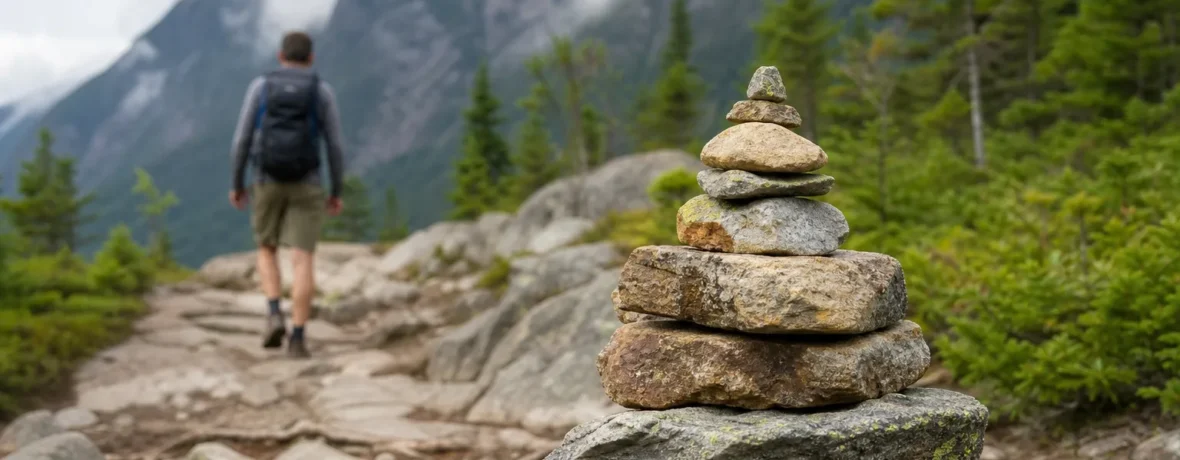
What is a cairn? A cairn is a human-made pile of stones used to mark a route, summit, boundary, burial site, or landmark. On hiking trails, a legitimate cairn is a navigation aid. Do not build, move, add to, or knock down cairns unless you are part of the land manager’s trail crew.
What Is a Cairn on a Hiking Trail?
A trail cairn is a stack or mound of rocks placed to help hikers stay on route where the path is hard to see.
That usually means open rock, desert slickrock, lava fields, alpine terrain above treeline, snowy areas, or places where a dirt tread would vanish fast. Cairns do one simple job: they say, “Go this way.”
The best ones are boring. They are not sculptures. They are not social media props. They are not invitations to play trail architect. A good cairn is visible enough to guide you, stable enough to survive wind, and consistent enough that a tired hiker can follow the route without guessing.
The National Park Service explains rock cairns as trail markers in some parks and warns that not every park uses or maintains them. That last part matters. A rock pile in one place may be an official marker. A rock pile in another place may be clutter, vandalism, or a bad idea left by someone with five minutes and no map.
What Do Cairns on Trails Mean?
Cairns on trails usually mean “stay on this route,” but only when they are authorized and maintained.
Here is the rub: you cannot tell the full story from the rocks alone. A cairn may be official, old, decorative, misplaced, or built by a lost hiker who made things worse for everyone behind them.
| Feature | Legitimate Trail Cairn | Random Rock Stack |
|---|---|---|
| Purpose | Marks a route or keeps hikers on durable surfaces | Decoration, photo prop, or personal expression |
| Placement | Set by land managers, trail crews, or approved volunteers | Placed wherever someone felt like stacking rocks |
| Effect | Can improve safety and reduce wandering | Can confuse hikers and damage habitat |
| What you should do | Leave it alone and follow only if it matches your map | Do not copy it; report problem areas if needed |
Some parks use cairns as serious route markers. Acadia, for example, has distinctive Bates cairns on certain trails; the National Park Service describes Bates cairns as part of the park’s trail-marking system in open areas. Other parks warn visitors not to rely on rock piles at all.
So yes, cairns can mean “trail.” They can also mean “somebody messed around.” Your job is to know the difference before the terrain gets confusing.
Is Rock Stacking Bad?
Yes, casual rock stacking is bad on public lands when it moves natural rocks, confuses routes, or alters cultural and ecological sites.
This is the part where some hikers get prickly. “It’s just a few rocks.” Sure. One stack may look harmless. Then fifty people copy it. Then a wash, shoreline, alpine basin, or canyon floor starts looking like a souvenir shop display.
Rocks are not dead props. They hold soil in place. They shelter insects, lizards, small mammals, mosses, lichens, and tiny plant life. In deserts, moving rocks can expose fragile soils to wind and water erosion. In cultural landscapes, moving stones can disturb archaeological features you may not recognize.
As of November 2026, the National Park Service tells visitors not to build their own cairns, not to add to existing cairns, and not to tamper with them in its rock cairn guidance. Leave No Trace gives the same plain advice in its guidance on cairns: leave established cairns as they are and do not create new ones.
That is the position here: official cairns are tools. Random rock stacks are litter with better posture.
Should You Follow a Cairn?
Follow a cairn only when it agrees with your map, trail signs, GPS track, and the land manager’s route information.
A cairn is not a magic arrow. It is one piece of evidence. Treat it like a trail sign that might have been spun around by wind, weather, or a bored stranger.
Before trusting a cairn, check:
- Your map: Does the route shown match the direction of travel?
- Your location: Are you still on the intended trail or route?
- The pattern: Are cairns spaced consistently, or is there one lonely pile?
- The terrain: Are you crossing rock, sand, snow, or another place where tread disappears?
- Official guidance: Did the park, forest, or trail agency say cairns mark this route?
If one cairn pulls you away from a signed trail, pause. If several cairns lead into a drainage, across cryptobiotic soil, or toward sketchy terrain with no trail on your map, pause harder. Wrong cairns do not apologize.
What Should You Do When You See a Cairn?
Leave it alone unless you have official trail-maintenance authority.
That means no adding a “helpful” rock. No straightening. No knocking it down because you think all cairns are bad. No rebuilding it because your version looks cleaner.
Use this simple field rule:
- Stop and look. Decide whether the cairn appears to be part of the maintained route.
- Check your map or app. Confirm the trail direction before moving on.
- Stay on durable surfaces. Rock, established tread, gravel, and sand beat trampling plants or crust.
- Do not touch the cairn. Even small changes can make an official marker less useful.
- Report problems. If cairns are misleading, damaged, or multiplying, tell a ranger, trail crew, or local land manager.
The NPS Leave No Trace principles also push hikers to plan ahead, carry proper navigation tools, and avoid creating new markers. That is not fussy. That is basic trail citizenship.
Why Do Land Managers Use Cairns Instead of Signs?
Land managers use cairns where posts, blazes, or signs would be hard to install, ugly, unsafe, or short-lived.
A painted blaze works on trees. A signpost works in soil. But above treeline, across granite slabs, through lava, or over slickrock, there may be no tree and no easy place for a post. A low rock marker can survive weather, blend into the landscape, and steer hikers away from fragile ground.
Cairns can also reduce braiding. That is when hikers spread out and create multiple informal paths. One clear route across open terrain is better than twenty faint scars wandering in every direction.
Still, cairns are not perfect. Fog can hide them. Snow can bury them. Crowds can damage them. Copycat stacks can pollute the signal. That is why your compass, map, downloaded route, and brain still matter.
Why Random Rock Stacks Are Not “Leave No Trace”
Random rock stacks leave a trace because they alter the place and affect the next visitor.
Leave No Trace is not only about trash. It is about restraint. It asks you to pass through without rearranging the world to prove you were there.
Rock stacking fails that test in three clear ways:
- It changes natural habitat. Moving rocks can expose soil and disturb small life living under or on them.
- It confuses route-finding. A decorative stack can look like a marker when visibility drops or fatigue sets in.
- It damages cultural places. In archaeological areas, ordinary-looking stones may be part of something protected.
As of November 2026, the National Park Service has documented damage from unauthorized rock cairns at Petroglyph National Monument and described moving or stacking rocks there as harmful to sacred landscapes, soils, wildlife, plants, and insects. Read the agency’s Petroglyph National Monument cairn damage report if you still think rock stacking is harmless.
How Can You Tell If a Cairn Is Official?
You cannot always tell, so verify with official trail information before you rely on it.
That sounds less satisfying than a secret trick, but it is the honest answer. Some official cairns are carefully shaped. Some are simple piles. Some unofficial stacks look convincing because the person who built them copied real markers.
Clues that a cairn may be official include:
- It appears on a route described by the park, forest, or trail agency.
- It is part of a consistent line of markers.
- It sits on durable terrain where the tread is naturally faint.
- It matches local cairn style in that specific area.
- It leads between signed junctions or known route features.
Clues that a stack is probably not official include:
- It is one of many decorative towers clustered near a viewpoint or creek.
- It pulls hikers off a clear trail.
- It appears in a place where signs say not to move rocks.
- It is oversized, artistic, or balanced for drama instead of visibility.
When in doubt, do not edit the landscape. Step back, check your route, and move on.
The Bottom Line on Cairns and Rock Stacking
A cairn can be a lifeline. A random rock stack can be a lie.
That is the whole argument. Hikers should defend real trail markers and stop treating wild places like craft tables. You do not need to leave a stone tower behind to have a meaningful day outside. The cleanest signature is no signature at all.
Use cairns when they are part of the route. Respect them. Do not improve them. Do not build new ones. Carry your own navigation tools, know the local rules, and let the rocks stay where weather, gravity, and time put them.
Related reading
- Type 2 Fun: Why Hard Hikes Feel Good Later
- The Seven Summits Explained
- What Is Geocaching?
- What Is Hiking, Really? A Definition Worth Arguing About
FAQ
What is a cairn in simple terms?
A cairn is a pile of stones made by people. On trails, cairns can mark a route across terrain where the path is hard to see.
Are cairns always trail markers?
No, cairns are not always trail markers. Some are official navigation aids, while others are decorative stacks, memorials, boundary markers, or unauthorized piles that may mislead hikers.
Is it okay to build a cairn if I am lost?
No, do not build cairns as your first response to being lost. Stop, stay calm, check your map and GPS, retrace your last known route if safe, and use emergency communication if needed.
Should I knock down fake cairns?
No, not unless a land manager has told you to do that work. You may accidentally destroy an official marker, disturb a sensitive site, or create more confusion.
Why do parks tell hikers not to stack rocks?
Parks discourage rock stacking because it can damage habitat, expose soil, disturb cultural resources, and confuse hikers. Official cairns are maintained for a purpose; casual stacks are not.
What should I use instead of relying on cairns?
Use a paper map, compass, downloaded offline map, GPS track, trail signs, and current land-manager information. Cairns can help, but they should never be your only navigation tool.