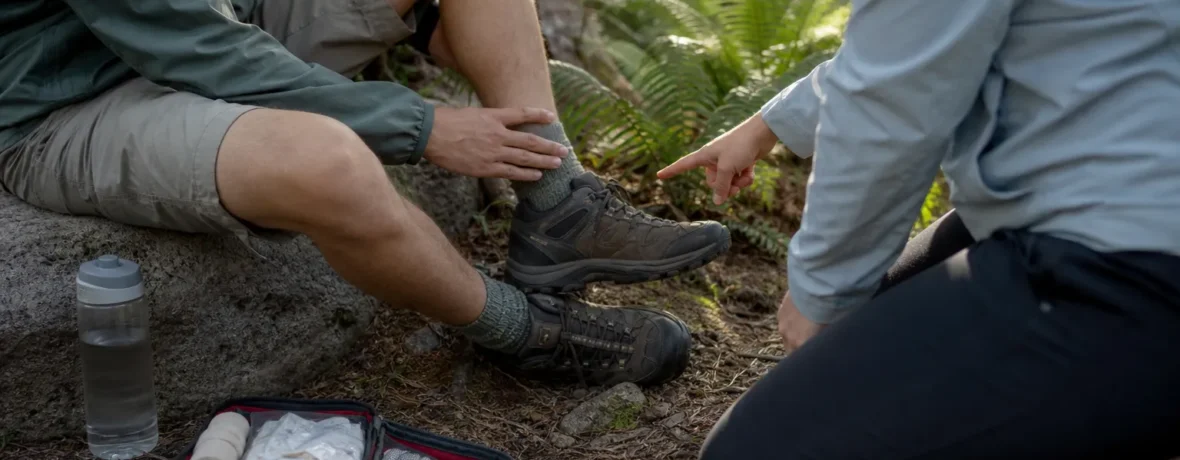
What does a snake bite look like? Usually 1–4 small punctures or scratches with redness, pain, and swelling within minutes. A venomous bite often has two deeper fang marks, fast-spreading swelling, bruising, numbness, nausea, weakness, or trouble breathing. A dry bite can look similar at first but symptoms do not progress.
On a hike, you may not see the snake clearly. You may only feel a sharp jab near your boot cuff, calf, hand, or ankle. That uncertainty is exactly why snake bites deserve a calm, fast response. You are not trying to play trail medic. You are trying to slow things down, get off the trail safely, and reach real medical care.
What does a snake bite look like right after it happens?
A fresh snake bite usually looks like tiny punctures, paired fang marks, scratches, or a scraped-looking wound.
Do not expect a movie-perfect bite. Fang marks can be uneven. One fang may land deeper than the other. Clothing, socks, gaiters, or a glancing strike can leave only one clear puncture. A nonvenomous snake may leave several small tooth marks in a curved pattern instead of two obvious holes.
Common early signs include:
- One or two puncture marks
- Several tiny scratches or tooth marks
- Redness around the bite
- Burning, stinging, or throbbing pain
- Swelling near the bite
- Light bleeding or oozing
- Tender skin around the area
The CDC’s venomous snake guidance says signs and symptoms vary by snake species and advises getting medical help quickly after a bite. That is the line to remember: variation is normal, delay is risky.
How can you tell if a snake bite is venomous?
You cannot tell with certainty from the bite marks alone.
Venomous bites often hurt more, swell faster, and spread beyond the bite area. In the U.S., most serious venomous bites come from pit vipers: rattlesnakes, copperheads, and cottonmouths. Coral snakes are different. Their bites may cause little pain at first, but neurologic symptoms can develop later.
| Feature | Venomous bite | Dry or nonvenomous bite |
|---|---|---|
| Marks | Often 1–2 deeper fang punctures, sometimes uneven | Small scratches, tiny tooth marks, or shallow punctures |
| Pain | Often sharp, burning, throbbing, or worsening | Mild to moderate and usually not spreading |
| Swelling | Can spread quickly up a finger, hand, foot, leg, or arm | May stay local and limited |
| Body symptoms | Nausea, weakness, dizziness, numbness, trouble breathing, metallic taste, or abnormal bleeding can occur | Usually no whole-body symptoms |
NIH MedlinePlus on snake bites notes that swelling and color change after a bite can suggest venom involvement. Still, do not wait for dramatic symptoms before acting. A quiet bite can become a bad bite.
What is a dry snake bite?
A dry snake bite is a bite from a venomous snake where no venom is injected.
That sounds reassuring. It is not a free pass. A dry bite can still puncture skin, bleed, hurt, swell a little, and get dirty from soil, sweat, or trail grit. More importantly, you may not know it is dry during the first few minutes.
Think of “dry bite” as a medical conclusion, not a trail diagnosis. If symptoms stay local and do not progress, clinicians may determine that no venom entered the wound. Your job on trail is simpler: treat every possible venomous snake bite as venomous until medical help says otherwise.
What symptoms mean venom may be spreading?
Spreading swelling, worsening pain, bruising, numbness, weakness, vomiting, or breathing trouble are red flags.
Venom can affect tissue near the bite, blood clotting, nerves, muscles, or breathing, depending on the snake. Pit viper bites often cause local pain, swelling, bruising, and tissue injury. Coral snake bites may cause delayed neurologic symptoms such as weakness, trouble swallowing, or breathing problems.
Watch for these warning signs:
- Swelling that moves past the nearest joint
- Skin turning blue, purple, gray, or very pale
- Severe or increasing pain
- Tingling, numbness, or weakness
- Nausea, vomiting, sweating, or faintness
- Shortness of breath or trouble swallowing
- Bleeding from the gums, nose, urine, stool, or bite site
- Confusion, extreme drowsiness, or collapse
The Mayo Clinic’s snakebite first aid recommends seeking emergency medical help and keeping the bitten person still and calm while waiting for care.
What should you do after a snake bite on trail?
Get away from the snake, call emergency help, keep still, and head toward medical care.
Speed matters, but panic burns energy and raises your heart rate. Move with purpose. Do not sprint unless you are in immediate danger from the snake, terrain, weather, or another hazard.
- Move out of strike range. Back away. Do not try to catch, kill, pin, or identify the snake by getting closer.
- Call 911 if you have service. If not, send two people for help when possible. Use a satellite messenger or emergency beacon if you carry one.
- Remove rings, watches, bracelets, and tight clothing. Swelling can make these dangerous fast.
- Keep the bite area still. Limit walking. Splint or loosely support the limb if you can do it without slowing evacuation.
- Keep the limb at heart level. The 2026 Wilderness Medical Society pit viper envenomation guidelines recommend loose immobilization and keeping the bitten limb at heart level while prioritizing prompt transport.
- Mark swelling and tenderness. Use a pen to mark the leading edge of swelling and write the time. Repeat if swelling spreads.
- Take a photo from a safe distance only if easy. A blurry photo is not worth a second bite.
- Get to a hospital. Antivenom decisions, wound care, labs, and monitoring belong in medical hands.
What should you not do for a snake bite?
Do not cut, suck, ice, shock, or tourniquet the bite.
Old snakebite tricks hang around campfire culture like bad weather. Skip them. They waste time and can make tissue damage worse.
- Do not cut the bite open.
- Do not suck venom out with your mouth or a device.
- Do not apply ice.
- Do not use a tourniquet.
- Do not drink alcohol.
- Do not take caffeine to “stay alert.”
- Do not try to walk it off.
- Do not wait for symptoms if the bite could be from a venomous snake.
The Wilderness Medical Society guidelines state that suction devices, cut-and-suck methods, electrotherapy, cryotherapy, tourniquets, and pressure immobilization have not shown benefit for North American pit viper bites and may cause harm.
When to see a doctor
See a doctor urgently for any suspected venomous snake bite.
Call 911 or go to an emergency department if a snake bite breaks the skin and you did not clearly identify the snake as harmless. If the bite happened in rattlesnake, copperhead, cottonmouth, or coral snake country, treat it as serious. If the bitten person is a child, older adult, pregnant, medically fragile, or has trouble breathing, faintness, swelling, vomiting, weakness, or confusion, treat it as an emergency.
You should also get medical care for bites that look minor. Teeth can drive bacteria under the skin, and clinicians may need to clean the wound, check the skin, monitor swelling, assess tetanus status, and decide whether antivenom or observation is needed. Do not diagnose yourself by comparing photos online.
How can hikers avoid snake bites?
Most snake bites can be avoided by giving snakes space and watching where you place hands and feet.
Snakes do not want trail drama. Many bites happen when people step too close, reach into hidden spots, handle snakes, or try to move them. Give every snake room, even if it looks dead. Freshly killed snakes can still bite through reflex movement.
- Stay on clear trail when possible.
- Use trekking poles to move grass before stepping into it.
- Look before stepping over logs or rocks.
- Never put your hands where you cannot see.
- Shake out shoes before putting them on at camp.
- Keep tents zipped.
- Use a headlamp at night.
- Do not wear earbuds so loud you miss a warning rattle.
- Give any snake at least several body lengths of space.
Boots, long pants, and gaiters can reduce skin exposure, but they do not make you bite-proof. Your best protection is boring and reliable: slow down around rock piles, brush, warm pavement, water edges, and sunny trail margins.
Related reading
- What Does a Tick Bite Look Like? Photos and Warning Signs
- Tick Bites on Dogs After a Hike: What to Look For
- What Does Poison Ivy Look Like? Leaves of Three and Lookalikes
- What Does a Poison Ivy Rash Look Like?
FAQ
Can a snake bite have only one fang mark?
Yes. A snake bite can show one clear puncture if only one fang lands, if the strike glances off, or if clothing blocks part of the bite. Do not assume one mark means harmless.
Does a dry snake bite hurt?
Yes, a dry bite can hurt. The teeth still puncture or scrape skin, even if venom was not injected.
How fast does swelling start after a venomous snake bite?
Swelling can start within minutes, especially with many pit viper bites. Some venomous bites, including coral snake bites, may have delayed or subtle early symptoms, so lack of swelling does not prove safety.
Should you go to the ER for a copperhead bite?
Yes. Copperhead bites are venomous bites and need medical evaluation, even when symptoms seem mild at first.
Can you identify a venomous snake bite from a photo?
No, not reliably. Photos can show punctures, swelling, or bruising, but they cannot confirm how much venom entered the body or what treatment is needed.
What should you carry for snake bite first aid while hiking?
Carry a phone, satellite messenger in remote areas, pen, elastic wrap for loose splinting only, basic wound supplies, and your medical information. Do not carry a suction kit expecting it to treat venom.