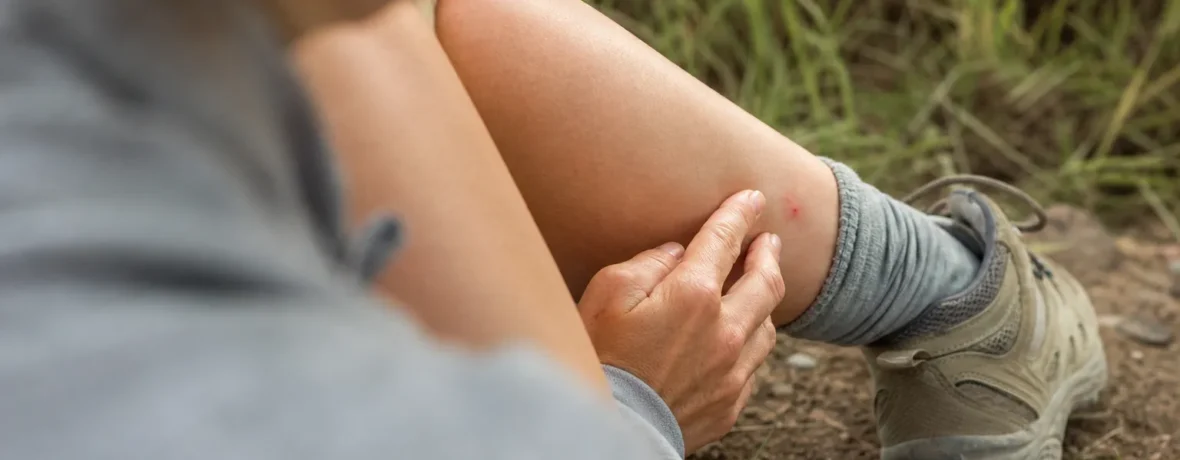
A tick bite usually looks like a small red bump, similar to a mosquito bite, and may itch for 1-2 days. But a spreading rash larger than 2 inches [5 cm], a bull’s-eye pattern, fever, headache, joint pain, or fatigue after a tick bite needs medical attention.
What does a tick bite look like on skin?
Most tick bites start as a small, irritated spot where the tick attached.
On the trail or back at the car, you may notice the tick before you notice the bite. Ticks often stay attached, especially in warm, tucked-away places: behind knees, along the waistband, in the armpits, around sock lines, behind ears, at the hairline, and near the groin.
Once the tick is gone, the bite can look like:
- A tiny red dot or bump
- Mild swelling around the puncture spot
- Skin irritation that resembles a mosquito bite
- A small scab if the area was scratched
- Redness that fades within 1-2 days
The CDC says a small bump or redness right after a tick bite is common and is not, by itself, a sign of Lyme disease. The problem is the bite can change later. That’s why you should check the spot once daily for the next month, not every ten minutes until you panic.
What does a tick bite look like on a human?
On a human, a normal tick bite is usually a small red bump, but skin tone changes how obvious it looks.
On lighter skin, the bite may look pink, red, or inflamed. On darker skin, redness may show as purple, brown, grayish, or simply darker than the surrounding skin. Swelling, warmth, tenderness, and a spreading edge can be easier to spot than color alone.
If you’re comparing your skin to photos online, use caution. Many tick-bite photos show dramatic bull’s-eye rashes, but not every concerning rash looks like a target. Some are solid red. Some are oval. Some look bruise-like. Some are faint at first and grow over several days.
Good photos to take at home are simple: use bright natural light, include a coin or ruler for scale, and take one photo each day from the same distance. If you end up calling a clinician, those photos help show whether the rash is expanding.
What does a tick bite look like compared with other bug bites?
A tick bite is more suspicious when you found an attached tick or the rash expands over days.
| Bite or rash | Common look | What to watch |
|---|---|---|
| Typical tick bite | Small red bump or dot; mild local irritation | Should improve in 1-2 days |
| Mosquito bite | Raised itchy welt; often multiple bites | Usually shrinks without spreading outward |
| Lyme-type rash | Expanding round or oval rash; may or may not have a bull’s-eye | Can appear 3-30 days after a bite and grow to 12 inches [30 cm] or wider |
| Infected skin irritation | Increasing redness, pain, warmth, swelling, or drainage | Needs medical advice, especially if worsening |
Does a tick bite always have a bull’s-eye rash?
No, a tick bite does not always form a bull’s-eye rash.
The classic bull’s-eye gets all the attention because it’s easy to remember. Real skin is messier. The Lyme disease rash, called erythema migrans, can be round, oval, solid red, target-shaped, faint, or warm without being painful. According to the CDC’s Lyme disease symptom guide, this rash occurs in many people with Lyme disease, typically starts 3-30 days after a bite, and may expand to 12 inches [30 cm] or more.
That expanding part matters. A tiny red spot right after removing a tick is common. A rash that keeps getting wider over several days is different. Mark the edge with a washable pen, take a photo, and check it the next day. If the red area has marched past your mark, call a healthcare provider.
Also, a similar expanding rash can happen with Southern Tick-Associated Rash Illness, known as STARI. That rash can look like Lyme disease, but it is linked to lone star tick bites. You do not need to solve that puzzle alone from a photo. Let a clinician sort it out.
How long after a tick bite do symptoms show up?
Symptoms can appear within days to several weeks after a tick bite.
For Lyme disease, early symptoms often show up 3-30 days after the bite. Other tickborne illnesses can have different timing, but many share the same early warning signs: fever, chills, headache, fatigue, muscle aches, joint pain, and rash. That overlap is one reason guessing from the rash alone is risky.
After any attached tick, set a 30-day reminder on your phone. Not glamorous. Very useful. During that window, watch for:
- A rash that expands over time
- Fever or chills
- Headache that feels unusual for you
- New fatigue that hits hard
- Muscle aches or joint pain
- Swollen lymph nodes
- Facial drooping, dizziness, chest symptoms, or shortness of breath
What should you do right after finding a tick?
Remove the tick with fine-tipped tweezers as soon as you can.
Skip the folk tricks. No burning match. No petroleum jelly. No nail polish. The CDC’s tick-bite instructions recommend steady removal with tweezers, then cleaning the bite area and your hands.
- Use fine-tipped tweezers and grasp the tick as close to your skin as possible.
- Pull upward with steady, even pressure. Do not twist or jerk.
- If tiny mouthparts remain, leave them alone if they do not come out easily. Let the skin heal.
- Clean the bite and your hands with soap and water or rubbing alcohol.
- Save the tick in a sealed bag or container if you want help identifying it.
- Write down the date, trail or location, and where on your body it bit you.
The Wilderness Medical Society guidelines also back mechanical removal with forceps and steady pressure, and they advise against passive methods such as petroleum jelly or chemicals.
When to see a doctor
See a doctor if you develop a rash or fever within several weeks of a tick bite.
Call sooner if the tick may have been attached for a long time, if you are in a region where Lyme disease is common, or if you feel sick after the bite. Bring your photos, the date of the bite, the likely location, and the saved tick if you have it. That gives the clinician useful trail data, not just “something bit me.”
Get medical care promptly for any of these warning signs:
- A spreading rash, especially one wider than 2 inches [5 cm]
- A bull’s-eye or target-like rash
- Fever, chills, headache, or severe fatigue
- Muscle pain or joint swelling
- Neck stiffness
- Facial droop or weakness
- Heart palpitations, dizziness, or shortness of breath
- Redness, warmth, swelling, pus, or worsening pain at the bite site
Do not start leftover antibiotics or guess at treatment. Tickborne diseases need medical judgment based on symptoms, exposure, timing, and sometimes testing. MedlinePlus from the NIH is a good plain-language reference if you want to read more before you call.
How can hikers prevent tick bites in the first place?
The best tick bite is the one you never have to inspect.
Ticks wait in grass, brush, leaf litter, and low vegetation. They do not need a deep wilderness setting. A weedy trailhead, a meadow lunch stop, or the edge of your campsite can do the job.
Use this quick hiking checklist:
- Walk near the center of the trail when vegetation is brushing your legs.
- Wear long pants in grassy or brushy areas.
- Tuck pants into socks when ticks are heavy. It looks dorky. It works.
- Choose light-colored clothing so crawling ticks are easier to spot.
- Use an EPA-registered repellent according to the label.
- Treat clothing and gear with permethrin if the product label allows it.
- Do a quick tick check during breaks, then a full-body check after the hike.
- Shower soon after getting home and check hidden zones carefully.
The Mayo Clinic’s Lyme disease overview also stresses prevention basics such as protective clothing, repellents, and checking yourself, children, gear, and pets after time in tick habitat.
Related reading
- Tick Bites on Dogs After a Hike: What to Look For
- What Does a Snake Bite Look Like? Venomous vs Dry Bites
- What Does Poison Ivy Look Like? Leaves of Three and Lookalikes
- When to Worry About a Tick Bite
FAQ
What does a tick bite look like at first?
At first, a tick bite often looks like a small red bump or dot. It may itch or feel irritated, and mild redness that fades in 1-2 days is common.
How do I know if a tick bite is serious?
A tick bite is more serious if you develop a spreading rash, fever, chills, headache, fatigue, muscle aches, or joint pain within several weeks. A bull’s-eye rash is a warning sign, but a concerning rash does not have to look like a perfect target.
Can a tick bite look like a mosquito bite?
Yes, a normal tick bite can look very similar to a mosquito bite. The difference is context: finding an attached tick, then seeing a rash expand over days, deserves more attention than a welt that shrinks and disappears.
Should I squeeze a tick bite?
No, do not squeeze the bite or dig aggressively into the skin. Remove the tick with fine-tipped tweezers, clean the area, and watch for symptoms.
How long should I watch a tick bite?
Watch the bite and your overall symptoms for 30 days. Take dated photos if the spot changes, and call a healthcare provider if you develop rash, fever, fatigue, headache, muscle pain, or joint swelling.
Do all tick bites cause Lyme disease?
No, most tick bites do not cause Lyme disease. Risk depends on the tick species, where you were bitten, how long the tick was attached, and whether that tick carried a germ.