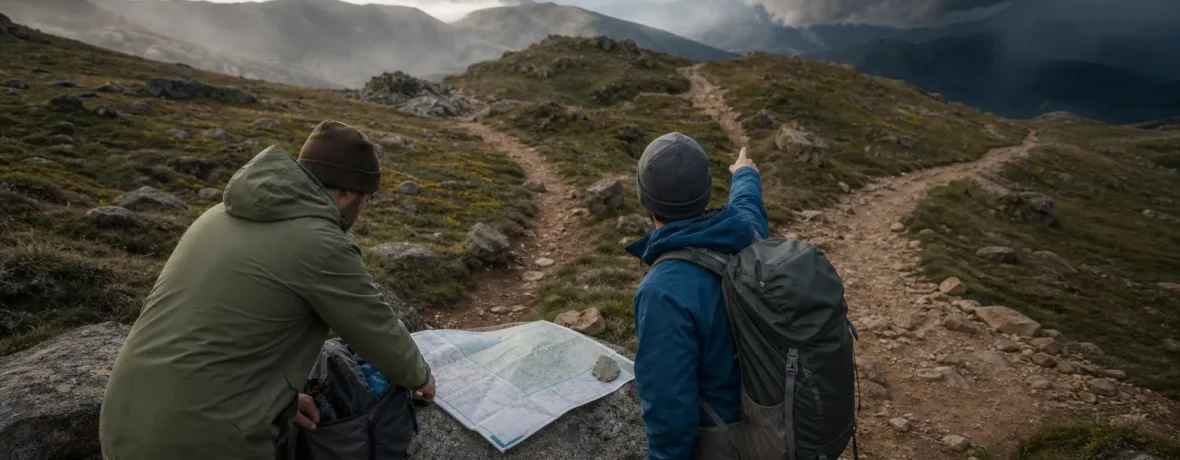
Turning back on a hike is the right call when weather, daylight, route-finding, water, injury, altitude symptoms, heat, cold, or group pace make the return unsafe. Set a turnaround time before you start; if you are 15 minutes late, turn around. Yes, even 0.2 miles [0.3 km] from the top.
Here is the blunt position: a hiker who turns around early is not quitting. A hiker who ignores the obvious because the summit feels close is gambling.
The trail does not care how far you drove, how many photos you hoped to take, or how many people on the internet tagged the same viewpoint last weekend. The trail gives you conditions. You answer with judgment.
That judgment is the art. Not drama. Not heroics. Just the clean, sometimes painful decision to say, “Not today,” while you still have enough strength, light, food, warmth, and attention to get out under your own power.
When is turning back on a hike the right call?
Turn back when the return trip is no longer comfortably within your margin.
That margin is the space between “this is going fine” and “we need help.” Smart hikers protect it like water in the desert. They do not spend it all on the last ridge, the last switchback, or the last push because the map says the destination is near.
The National Park Service tells hikers to plan and prepare, carry the essentials, and be ready for a trip to run late; its Hike Smart guidance also warns that if any part of the hike is uphill in either direction, you should plan for it to take at least double the time it took to go downhill.
That one detail wrecks many lazy plans. If you descended first, the hard part may be waiting for you at the end. If you climbed first, the descent may pound your knees, slow your group, and punish tired feet. Either way, “halfway in distance” is not always halfway in effort.
| Signal | Bad thinking | Better call |
|---|---|---|
| Clouds building over exposed terrain | “We can beat it.” | Drop below ridges and turn around. |
| One hiker is slowing hard | “They’ll recover at the top.” | Stop, assess, and head back together. |
| You missed your planned turnaround time | “Just 15 more minutes.” | Honor the clock immediately. |
| Route is unclear | “The trail must reconnect.” | Return to the last known point. |
Is turning back on a hike a failure?
No. Pushing past clear warning signs is the failure.
Summits are optional. Trailheads are not. The whole point is to come back with all the people you started with, all the fingers you started with, and enough humility to try again when the odds are better.
There is a strange vanity in hiking culture that treats retreat like embarrassment. It shows up in little phrases: “We came this far.” “It’s only another mile.” “The forecast said it would clear.” Those sentences sound brave for ten seconds. Then the wind hits harder, the snow covers the tread, someone bonks, or the sun drops behind the ridge.
A clean turnaround is not timid. It is disciplined. It means you can separate the plan from the reality in front of you. That is one of the hardest skills in the hills.
How do you set a turnaround time?
Pick the time before you leave the trailhead, then obey it.
A turnaround time is not a suggestion. It is a guardrail. Set it by working backward from sunset, terrain, group speed, weather risk, and the slowest person in the group. Then add padding. Real padding. Not five decorative minutes.
- Find sunset. Decide when you want to be back at the trailhead, not merely off the summit.
- Estimate your return time conservatively. Downhill can be faster, but loose rock, snow, mud, darkness, or sore knees can erase that advantage.
- Add a buffer of at least 60 minutes. Use more if the route is remote, exposed, snowy, or unfamiliar.
- Account for the slowest hiker. Group pace is not set by the fittest person.
- Say the time out loud. Put it on a watch or phone alarm.
- Turn around when it rings. Do not renegotiate with the mountain.
If you reach the summit before that time, great. Take the photo, eat the snack, put on a layer, and leave before your margin evaporates. If you do not reach it, also great. You made the right decision while it was still easy enough to be boring.
What are the weather signs that mean you should turn around?
Turn around when weather starts removing options.
Weather does not need to be catastrophic to be dangerous. A colder wind can turn a sweaty shirt into a problem. Fog can make a simple ridge confusing. Rain can make slabs slick. Heat can turn a pleasant trail into a slow bake. Lightning is the big one: the National Weather Service’s outdoor lightning safety guidance says mountain thunderstorms often develop in the early afternoon, and hikers should plan early and be down the mountain by noon when storms are likely.
Do not wait for thunder directly overhead. If you are on a ridge, summit, open slope, high pass, or broad alpine basin and storm clouds are growing, you are already behind. Turning back early feels annoying. Turning back late can feel impossible.
- Dark clouds building vertically
- Thunder, even faint thunder
- Sudden wind shift or sharp temperature drop
- Fog reducing visibility on an exposed or unsigned route
- Rain on steep rock, roots, clay, or snow
- Heat that forces frequent stops and poor decision-making
The test is simple: if the return route would become much harder in 30 minutes, go now.
What should you check before deciding to keep going?
Check the group, the clock, the sky, the map, and your supplies.
Do it honestly. Not with summit fever whispering in your ear. A good trail check takes 2 minutes and can save the day from sliding into a mess.
- People: Is anyone stumbling, quiet, unusually irritable, chilled, overheated, nauseated, or limping?
- Time: Are you on pace to return before dark with a real buffer?
- Weather: Is the sky improving, holding steady, or getting worse?
- Navigation: Do you know exactly where you are and where the route goes next?
- Water and food: Do you have enough for the return plus delay time?
- Warmth: Could you stop for 30 minutes without getting dangerously cold?
- Terrain: Will the next section make retreat slower or more exposed?
The National Park Service trip planning guide gives the plainest advice: if a safety concern affects your activity, consider turning around instead of pushing ahead. That is not soft. That is the whole game.
How do you tell your group you are turning back?
Say it early, clearly, and without inviting a debate you are not willing to lose.
Try this: “I’m turning around here. We are behind our turnaround time, and the weather is building. The safe move is to go down now.”
Notice what is missing. No apology. No long speech. No courtroom argument. You can be kind and still be firm.
Group dynamics get weird on trails. Strong hikers may minimize risk because they feel fine. Tired hikers may hide trouble because they do not want to be the reason everyone stops. New hikers may assume the most confident person knows best. That is how groups drift into bad calls.
If you are leading, you owe the group a decision before the decision gets dramatic. If you are not leading, you still own your feet, your body, and your ride home. Speak up. A good hiking partner will listen. A bad one is giving you useful information for future plans.
When to see a doctor
Get medical help when symptoms are severe, worsening, or do not improve with rest, cooling, warming, hydration, or descent.
This is not a place for trail bravado. For altitude concerns, the CDC says people with altitude illness should not go higher until symptoms are gone, and symptoms that worsen while resting should prompt travel to lower elevation; its high-altitude travel guidance lists serious warning signs such as confusion, loss of coordination, shortness of breath, weakness, and cough.
For heat illness, the CDC’s heat-related illness guidance describes heat stroke as an emergency and lists signs including confusion, slurred speech, loss of consciousness, seizures, and very high body temperature. For cold exposure, Mayo Clinic says to call 911 or your local emergency number if you suspect hypothermia; its hypothermia first aid guidance lists warning signs such as shivering, slurred speech, shallow breathing, clumsiness, drowsiness, confusion, and loss of consciousness.
Do not diagnose on the trail. Treat those signs as reasons to stop the objective, protect the person, and get help.
Related reading
- Is Rucking Bad for Your Back or Knees?
- Type 2 Fun: Why Hard Hikes Feel Good Later
- The Seven Summits Explained
- What Is Geocaching?
FAQ
How close to the summit is too close to turn around?
No distance is too close. If conditions cross your safety line 50 yards [46 m] from the summit, turn around there.
What is the best turnaround time for a day hike?
The best turnaround time is the latest time that still gets you back before dark with a buffer. For many day hikes, that means turning around several hours before sunset, not at sunset.
Should the fastest hiker decide when the group turns back?
No. The decision should be based on the slowest hiker, the weakest margin, and the safest return plan.
Is it okay to split the group if some people want to continue?
Usually, no. Splitting a group can create two problems instead of one, especially if gear, navigation, or experience is uneven.
What should I do after turning back?
Reset the tone. Eat, drink, add or remove layers, confirm the route, and focus on the return instead of replaying the lost summit.
How do I avoid summit fever?
Decide your rules before the hike starts. A set turnaround time, weather limits, and group check-ins make the decision less emotional when the top is finally in sight.