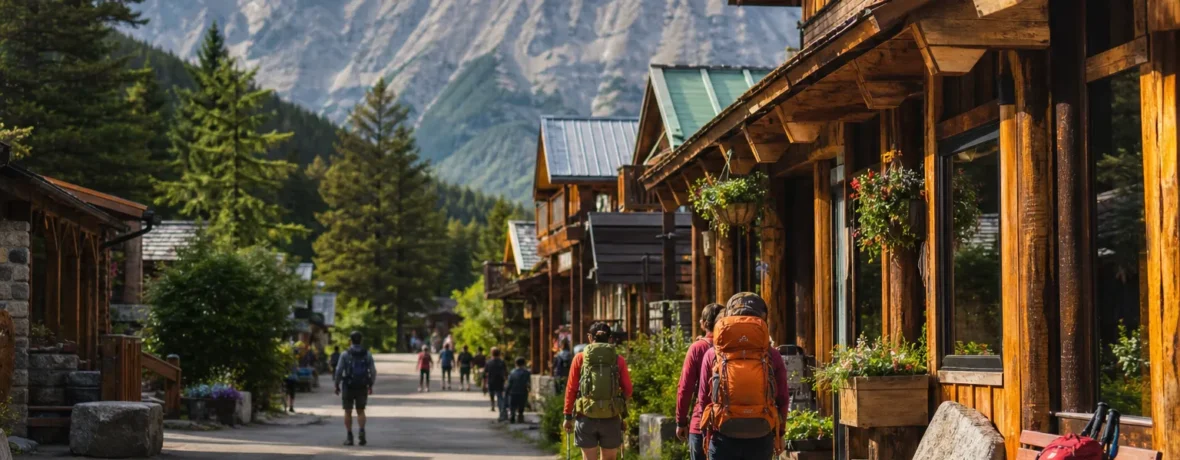
A trail town is a community close enough to a hiking route that walkers use it for food, lodging, showers, laundry, rides, mail drops, repairs, and rest. It may sit directly on trail or a few miles [kilometers] away. A good one serves hikers without losing its own everyday character.
What makes a town a trail town?
A trail town is defined by usefulness, access, and welcome.
The phrase is not one single legal category. It is trail slang, local identity, and sometimes a formal designation, depending on the trail. The Appalachian Trail Conservancy’s A.T. Community program, for example, recognizes communities that help promote and protect the Appalachian Trail. The Continental Divide Trail Coalition’s Gateway Community program works with towns that see the CDT as a local asset and a draw for visitors.
But hikers do not wait for a plaque on Main Street. If a place helps them get clean, fed, rested, and back to the trail, they will call it a trail town.
| Feature | Why it matters to hikers | Good sign |
|---|---|---|
| Close trail access | Less time spent off route | Walkable road crossing, shuttle, bus, or reliable ride options |
| Resupply | Food and fuel keep the hike moving | Grocery, outfitter, general store, or post office |
| Recovery | Bodies need sleep, calories, and clean clothes | Laundry, showers, lodging, restaurants, shade, and seating |
| Hiker tolerance | Dirty packs and hungry people change the rhythm of a small town | Clear rules, patient locals, and hikers who act like guests |
How do hikers use trail towns?
Hikers use trail towns to reset before the next section.
On a long-distance hike, town is not a vacation from the trail. It is logistics with a burger on top. You arrive with low food, a damp tent, socks that can stand up by themselves, and a phone battery making threats.
- Get into town. That might mean walking, catching a shuttle, using public transit, or arranging a legal ride.
- Handle the basics first. Eat, drink water, shower, and start laundry before the day slips away.
- Resupply with intention. Buy enough meals and snacks for the next stretch, plus one buffer meal if the route is remote or the weather looks ugly.
- Fix what is failing. Replace socks, patch gear, dry your quilt, charge electronics, and sort maps or apps.
- Leave on purpose. Pack food before morning, check your ride plan, and get back to the trail before town gravity wins.
The Pacific Crest Trail Association’s resupply guidance makes the same practical point: hikers usually need a plan for getting food and supplies from towns or resupply locations, and access may involve side trails, road crossings, rides, or other transportation.
What services should a trail town have?
A useful trail town covers food, sleep, cleaning, communication, and transportation.
No town needs everything. A tiny store and a porch can save a hike if the next stretch is short. A larger town can become a full zero-day stop, where you take a day with no trail miles and let your knees remember they are attached to a human.
- Food: grocery store, general store, diner, cafe, gas station snacks, or farmers market.
- Lodging: hostel, motel, campground, cabin, church hostel, or legal public camping nearby.
- Hygiene: shower, laundromat, restroom, sink, and trash disposal.
- Trail logistics: post office, package-holding business, shuttle list, public transit, or outfitter.
- Repair options: gear tape, fuel, batteries, socks, shoes, trekking pole tips, and basic sewing supplies.
- Connectivity: cell service, Wi-Fi, outlets, and a quiet place to make calls.
- Medical backup: clinic, pharmacy, urgent care, or a clear way to reach one in the next larger town.
Availability changes fast in small towns. A store can close early, a shuttle driver can be booked, and a post office can keep limited hours. Check current local sources before counting on a single option.
Is a trail town the same as a gateway community?
No, but the two ideas overlap.
A trail town is the hiker’s working term. A gateway community is often an organized relationship between a town and a trail organization, land manager, or tourism group. A resort can function like a trail town for one night without being a town at all.
| Term | Plain meaning | Typical example |
|---|---|---|
| Trail town | A community hikers use for resupply, rest, and access | A small town near a road crossing |
| Gateway community | A place formally tied to a trail, park, or public land destination | A town promoted through a trail organization program |
| Trail resort | A private stop that offers hiker services | Lodge, camp, store, or remote pack station |
| Resupply point | Any place where hikers get food or packages | Post office, store, marina, ranch, or roadside business |
How should you act in a trail town?
Act like a tired guest, not a feral raccoon with a debit card.
Trail towns survive on relationships. A single hiker rarely ruins anything. A season of loud, smelly, entitled hikers can sour a place fast. The fix is simple: spend money where you use services, follow posted rules, tip when service deserves it, and remember that locals live there after you leave.
- Drop your pack where it is allowed, not across a doorway.
- Shower before sitting down in a crowded restaurant when you can. The Appalachian Trail Conservancy’s health and hygiene guidance calls this a courtesy when reaching town.
- Do not wash mud, food scraps, or fuel residue in a business bathroom sink.
- Ask before charging devices behind counters or leaving packages.
- Keep your group volume down near motels, hostels, libraries, and neighborhoods.
- Pack out trash if a trailhead bin is full.
- Follow Leave No Trace habits in town too, especially around parks, riverbanks, and informal campsites; the Leave No Trace 7 Principles are not only for deep wilderness.
Can a small town become a trail town?
Yes, if it gives hikers clear access, basic services, and a reason to feel welcome.
A town does not need a mountain-view brewery or a row of hostels. Start smaller. Hikers remember the place that had a working hose, a fair shuttle number, a store owner who knew fuel canisters mattered, and a bench in the shade.
- Map the hiker path. Identify where hikers enter town, where they buy food, where they sleep, and how they return to the trail.
- Make information visible. Post current hours, shuttle contacts, package rules, restroom locations, and camping rules in one obvious place.
- Train front-line businesses. Grocery clerks, motel staff, and cafe workers get the questions first.
- Create low-cost comfort. Shade, water, trash cans, outlets, and seating can matter as much as a new building.
- Set boundaries early. Clear rules protect residents, businesses, and hikers from awkward guessing.
- Work with trail groups. Local clubs, national trail organizations, and land managers can help align promotion with stewardship.
What makes a great trail town memorable?
A great trail town makes the hard parts of hiking easier without sanding off its own personality.
The best ones are not always the biggest. Hikers talk for miles about places that are simple, fair, and kind. A clean laundromat. A diner that does not flinch at five backpacks. A motel with a hose outside. A store that stocks tortillas, peanut butter, instant potatoes, tuna packets, ramen, candy, and fuel. A librarian who knows where the outlets are.
Character matters too. Murals, old brick storefronts, church suppers, farmers markets, rodeo posters, swimming holes, and one excellent breakfast counter all become part of the trail story. Hikers arrive hungry, but they leave with a memory of people.
Related reading
- What Is Trail Magic?
- Youngest and Oldest Appalachian Trail Thru-Hikers
- What Is a Trail Angel?
- Who Built the Appalachian Trail?
FAQ
What is the meaning of trail town?
A trail town is a community near a hiking trail where hikers stop for supplies, rest, food, lodging, laundry, showers, mail, or transportation. The term is practical first: if hikers rely on the town between trail sections, it functions as a trail town.
Does a trail town have to be directly on the trail?
No. Some trail towns sit directly on the route, while others are reached by road, shuttle, bus, or side trail. What matters is dependable access and useful services.
What do hikers buy in trail towns?
Hikers usually buy food for the next section, restaurant meals, fuel, socks, batteries, toiletries, and replacement gear. They may also pay for lodging, showers, laundry, shuttles, and package pickup where offered.
Are trail towns only for thru-hikers?
No. Day hikers, section hikers, bikepackers, trail runners, paddlers, and road-trippers may all use the same services. Thru-hikers make the culture more visible because they arrive in waves and need many things at once.
How can hikers support trail towns?
Spend money locally, follow rules, be patient with small staffs, and leave public spaces cleaner than you found them. If a town helped your hike, recommend specific businesses to other hikers and thank the people who made the stop work.