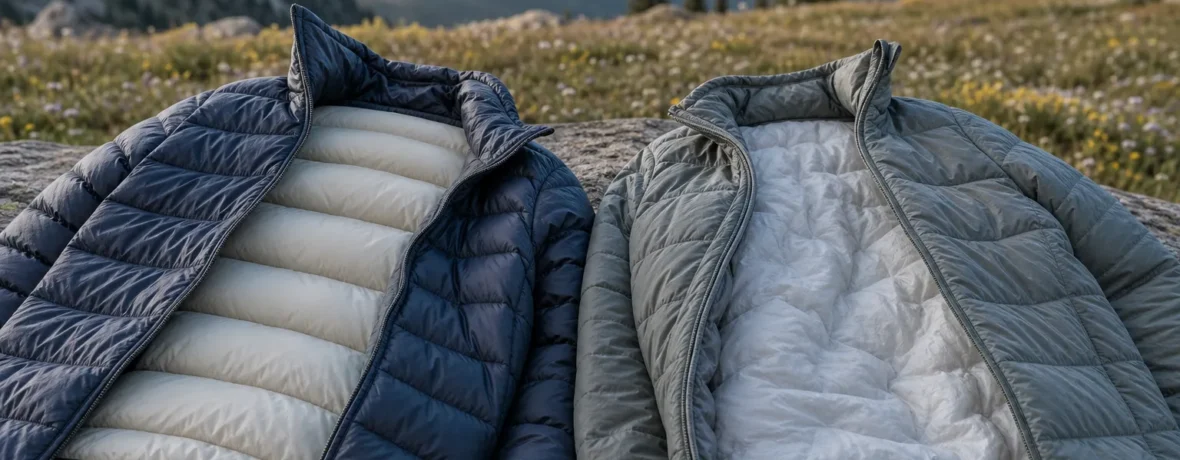
Choose down for the lightest, warmest, most packable insulation in cold and dry conditions. Choose synthetic for wet weather, heavy sweating, tight budgets, and rough daily use. Down usually wins on warmth-to-weight; synthetic wins when moisture and lower cost matter more.
Synthetic vs down: which insulation is warmer?
Down is usually warmer for the weight. That does not mean every down jacket beats every synthetic jacket, because warmth comes from the full build: insulation type, fill amount, baffle design, fabric, fit, hood, cuffs, zipper draft protection, and how much room you leave for base layers.
Down works by trapping still air inside clusters of fine filaments. The higher-quality the down and the more of it a garment uses, the more loft it can create for each ounce. Fill power measures how many cubic inches 1 oz [28 g] of down can occupy under a standard test; an 850-fill down has more loft per ounce than 650-fill down. The lab IDFL gives a plain-language overview of fill power and down product evaluation.
Synthetic insulation uses polyester fibers or sheets to trap air. Some synthetic fills mimic down clusters; others use continuous sheets that resist cold spots and hold together under abuse. Synthetic insulation is often listed by weight, such as grams per square meter, but that number does not compare cleanly across brands because fiber structure, quilting, and shell fabric change the real warmth.
Here is the trail version: down gives you more warmth in a smaller, lighter package. Synthetic gives you steadier performance when weather, sweat, and camp chores get messy.
| Factor | Down insulation | Synthetic insulation |
|---|---|---|
| Warmth-to-weight | Best choice when dry | Good, but usually heavier for equal warmth |
| Pack size | Compresses very small | Bulkier in most jackets and bags |
| Wet-weather performance | Loses loft when soaked | Keeps more insulation value when damp |
| Durability under compression | Can last for years with careful care | Fibers can lose loft faster after repeated stuffing |
| Cost | Usually higher | Usually lower |
Is synthetic insulation better than down when wet?
Yes, synthetic is the safer pick when getting wet is likely. Down clusters collapse when soaked, and collapsed insulation cannot trap much warm air. Synthetic fibers absorb less water, dry faster, and keep more structure when damp.
This is the biggest real-world split between the two. A dry down jacket feels magical: warm, airy, barely there in your pack. A wet down jacket feels sad. It clumps. It loses loft. It takes longer to dry on a cold trip, especially inside a tent where humidity is already high.
Synthetic insulation is not waterproof. Soaked is soaked. But a synthetic puffy can still give you useful warmth after drizzle, condensation, wet snow, or a sweat-heavy climb. That matters when you are hiking in the Pacific Northwest, the Appalachians, the upper Midwest during shoulder season, or any coastal range where damp air hangs around camp.
REI’s insulation guide makes the same practical split: down is strong for cold, dry, weight-conscious trips, while synthetic is quick-drying and better in wet conditions.
Hydrophobic down helps. It is down treated with a water-repellent finish so the clusters resist moisture longer. Good shell fabric helps too. Still, treated down is not the same thing as synthetic insulation in steady rain, repeated condensation, or a bag that gets damp night after night.
Which packs smaller, down or synthetic?
Down packs smaller. If you are counting every cubic inch in a 40-liter pack, down usually earns the spot.
High-fill-power down compresses into tight stuff sacks and rebounds well when cared for. That makes it a favorite for backpacking quilts, sleeping bags, belay-style jackets, and ultralight camp layers. On a multi-day trip, the space savings can be just as valuable as the weight savings, especially when your food bag is full on day one.
Synthetic insulation takes more room. Sheet-style synthetic fills can be especially bulky, though they also tend to spread insulation evenly and avoid the feather leakage you can see with down. Modern synthetic cluster fills compress better than older versions, but down still wins the packability contest in most comparable gear.
Do not store either one compressed at home. A stuff sack is for the trail, not the closet. Long-term compression crushes loft, and loft is warmth.
Is down or synthetic better for backpacking?
Down is better for dry backpacking; synthetic is better for wet or high-sweat backpacking. Match the insulation to the trip, not to a gear-forum argument.
For high desert, alpine summer trips, clear shoulder-season forecasts, and cold dry winter camps, down is hard to beat. A down sleeping bag or quilt can save several ounces and several liters of pack space compared with many synthetic options. A down puffy also slips easily into the top of your pack for rest stops and dinner at camp.
For rainy forests, canoe approaches, snowshoe trips near freezing, and routes where you expect wet brush or heavy condensation, synthetic starts looking smarter. It also makes sense if you hike hard, sweat through layers, and throw on insulation during short stops before your base layer has dried.
Use this quick decision path:
- Check the moisture risk. If you expect rain, wet snow, fog, river travel, or tent condensation for multiple nights, lean synthetic.
- Check the temperature range. In cold, dry air below freezing, down often shines because moisture is less likely to fall as rain.
- Check your pack volume. If your kit is tight and every inch matters, down helps.
- Check your activity level. If you run hot and sweat hard, synthetic is more forgiving.
- Check your budget. If cost matters more than minimum weight, synthetic usually gives solid trail warmth for less money.
Should you choose a down or synthetic jacket?
Choose down for camp warmth and synthetic for active, damp, stop-and-go hiking. A jacket lives a harder life than a sleeping bag because you wear it in wind, snow, drizzle, brush, cooking steam, and sweat.
A down puffy is best as a static layer. Put it on when you stop moving. Wear it while filtering water, eating dinner, watching sunset, or standing around before dawn. Keep it protected under a shell if snow or light rain starts. Pack it in a dry bag if the forecast looks ugly.
A synthetic puffy is better when the jacket may get damp while you are still working. It is a good fit for hiking uphill in cold weather, winter day hikes, damp shoulder-season trips, and camp chores in mixed weather. If you need one jacket that you will abuse, stuff, wear around town, wear under a shell, and not baby, synthetic makes sense.
Fit matters. Insulation needs loft, so do not buy a puffy that crushes flat over your base layer. It should seal at the cuffs, hem, neck, and hood without squeezing your torso. Dead air is your friend. Drafts are not.
Is down or synthetic better for sleeping bags and quilts?
Down is usually better for backpacking sleeping bags and quilts when you can keep your sleep system dry. Sleep insulation spends more time inside your pack and tent, so it is easier to protect than a jacket.
That is why down dominates many lightweight backpacking sleep systems. You get serious warmth with less bulk, and the bag or quilt can last for many seasons if you store it loose, wash it correctly, and keep it away from campfire sparks.
Synthetic sleeping bags still have a strong place. They are useful for beginners, budget kits, car camping, kids, wet climates, paddling trips, and loaner gear. If your shelter leaks or your dog climbs on your bag with wet paws, synthetic takes the insult better.
For quilts, the same rules apply. A down quilt is light and compact. A synthetic quilt is bulkier but more forgiving if you cowboy camp under condensation, sleep under a tarp, or take trips where rain gear and shelter skills are still developing.
How long does down last compared with synthetic insulation?
Down can last longer with careful care. Synthetic insulation usually loses loft faster after repeated compression, especially if it is stored stuffed or crushed under heavy gear.
Good down is resilient. Shake it out, dry it fully, and store it loose, and it can keep lofting season after season. The catch is that down needs care. Body oils, dirt, smoke, and moisture reduce loft. Washing down requires the right detergent and patient drying with low heat until the clusters are fully dry.
Synthetic insulation is simpler to wash and less fussy in rough use. That makes it practical for jackets you wear often, loan to friends, use around dogs, or carry on dirty day hikes. Still, synthetic fibers can break down and mat over time. Once a synthetic jacket loses loft, it is difficult to restore all of it.
Here is the care checklist:
- Store insulated gear loose, never jammed in its trail stuff sack.
- Dry gear completely before storage.
- Use a clean liner or sleep clothes to keep body oils out of bags and quilts.
- Wash only when needed, using insulation-safe cleaner.
- Keep puffies away from sparks, sharp branches, and rough granite.
- Repair shell tears fast so insulation does not escape or shift.
What do fill power and fill weight mean?
Fill power measures loft quality, while fill weight tells you how much down is inside. You need both numbers to judge a down piece.
Fill power alone is not warmth. A jacket with 3 oz [85 g] of 850-fill down can be warmer than a jacket with 2 oz [57 g] of 900-fill down, depending on cut and construction. A sleeping bag with more total down can beat a higher-fill-power bag if the higher number is paired with too little actual fill.
Think of it like this:
- Fill power: how lofty the down is per ounce.
- Fill weight: how many ounces or grams of down the item contains.
- Baffle design: how well the gear holds insulation in place.
- Shell fabric: how well the outer fabric blocks wind and protects loft.
- Fit: how well the garment or bag traps warm air around you.
With synthetic insulation, brands often give insulation weight in grams per square meter. That helps compare pieces within the same brand or insulation family, but it is not a universal warmth rating. A 60 g/m² active-insulation jacket and a 100 g/m² static puffy are built for different jobs.
Is down ethical?
Down can be sourced more responsibly, but you need to check the standard behind the label. The strongest trail answer is to look for third-party certification rather than vague comfort claims.
The Responsible Down Standard from Textile Exchange is a voluntary standard focused on animal welfare and chain of custody for down and feathers from certified farms to the final product. Certification does not make down impact-free, but it gives you a clearer baseline than an unverified hangtag.
The U.S. Federal Trade Commission also warns that advertising claims for feather and down products must be truthful, non-deceptive, and supported by evidence; its business guidance on feather and down advertising is useful if you want to understand label language.
Synthetic insulation has its own footprint. It is usually polyester, which is derived from petroleum unless recycled content is used. It can shed microfibers during washing and wear. Some brands use recycled polyester, bluesign-approved fabrics, or repair programs, but the cleanest choice is still the one you will use for years and care for properly.
What should you buy for your next hike?
Buy the insulation that matches your worst likely condition. Gear feels smart when it handles the ugly part of the trip, not just the sunny trailhead plan.
Pick down if your trips are mostly dry, cold, and pack-weight sensitive. That means western alpine routes, desert nights, high routes with stable weather, hut approaches, and backpacking where your sleep system stays inside a dry shelter. Down also makes sense if you want the smallest emergency puffy that still brings real warmth.
Pick synthetic if your trips are wet, humid, or rough. That means rainy shoulder seasons, long damp forests, wet snow near 32°F [0°C], paddling, winter day hikes, and any trip where you may wear insulation while working hard. Synthetic is also the friendlier choice for new hikers because it costs less, handles mistakes better, and asks for less delicate care.
Use a hybrid strategy if you hike year-round. Many experienced hikers carry a synthetic active layer for cold movement and a down piece for dry camp warmth. For sleeping, they may use a down bag inside a reliable shelter, then add a synthetic overquilt in deep winter to move condensation away from the down. Simple. Effective.
Related reading
- How to Wash a Down Jacket in a Washing Machine
- What Is a Down Jacket? Fill Power, Baffles and Warmth
- Hiking Shoes vs Hiking Boots: Which Should You Buy?
- Softshell vs Hardshell Jackets for Hiking
FAQ
Is synthetic warmer than down?
No, not for the same weight in most backpacking gear. Down usually gives more warmth per ounce, but synthetic can feel warmer in wet conditions because it keeps more loft when damp.
Does down still work if it gets wet?
Down works poorly when soaked. Water collapses the clusters, reduces loft, and slows drying, so protect down with a shell, dry bag, and smart camp habits.
Is synthetic insulation good for winter hiking?
Yes, synthetic insulation is strong for winter hiking when you sweat, stop often, or deal with wet snow. It is especially useful as an active layer or safety layer on cold day hikes.
Is an 800-fill down jacket warmer than a 650-fill jacket?
Not always. An 800-fill jacket has higher-loft down per ounce, but a 650-fill jacket with more fill weight, better coverage, and fewer drafts can be warmer.
Can you wash down and synthetic gear at home?
Yes, if the care label allows it. Use insulation-safe cleaner, rinse well, dry fully, and store loose; down needs extra drying time so the clusters do not stay damp inside.
Which is better for a beginner: synthetic or down?
Synthetic is usually better for a first puffy or budget sleeping bag. It costs less, handles damp mistakes better, and gives you room to learn your layering and shelter system before spending more on premium down.