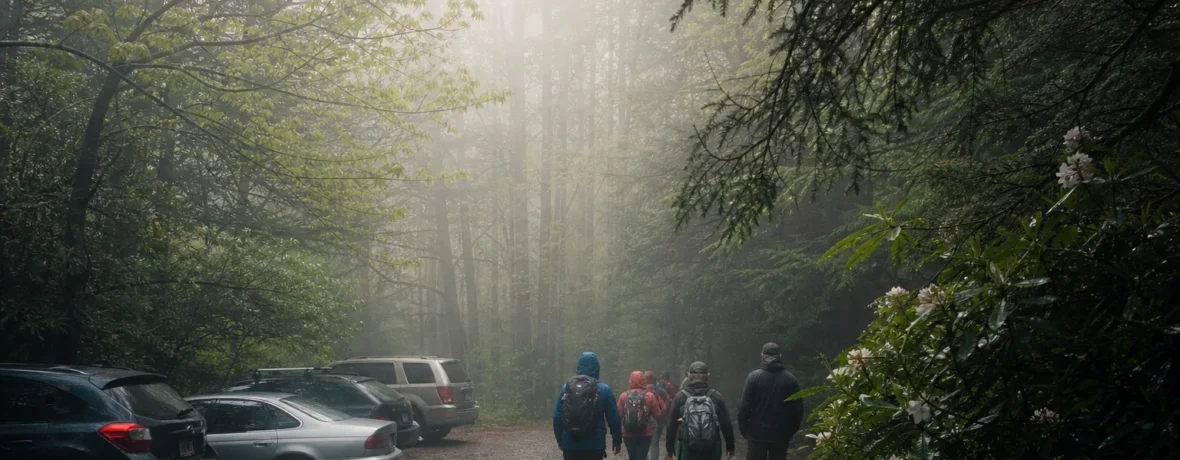
A Smoky Mountains parking pass is required if you park inside Great Smoky Mountains National Park for more than 15 minutes. As of November 2026, parking tags cost $5 daily, $15 weekly, or $40 annually, while park entrance remains free. One tag covers one vehicle, not one person.
Do you need a Smoky Mountains parking pass for every stop?
Yes, if your vehicle is parked for more than 15 minutes inside the park. As of November 2026, the National Park Service says a parking tag is required anywhere within Great Smoky Mountains National Park boundaries, and the tag is not tied to one trailhead, overlook, picnic area, or visitor center. Read the current rule on the official Great Smoky Mountains fees and passes page.
If you are only driving through Newfound Gap Road, Little River Road, Cades Cove Loop Road, or another park road without parking longer than 15 minutes, you do not need a tag. The moment you settle into a trailhead lot, roadside pullout, picnic area, or overlook for more than that grace period, you do.
That makes the tag simple but easy to forget. You do not pass an entrance booth. Nobody hands you a ticket at the boundary. You have to buy, print or pick up, and display the tag yourself.
How much does the Great Smoky Mountains parking tag cost?
The price is $5, $15, or $40, depending on the length of your visit. As of November 2026, Great Smoky Mountains National Park lists three parking tag options for all vehicle sizes and types.
| Tag type | Price | Best for |
|---|---|---|
| Daily | $5 | One hike, one scenic drive, or a quick day in the park |
| Weekly | $15 | A long weekend or vacation week based near Gatlinburg, Townsend, Cherokee, or Bryson City |
| Annual | $40 | Repeat visits during the year |
Daily tags expire at 11:59 p.m. ET on the date printed on the tag. Weekly tags expire at 11:59 p.m. ET seven days from the purchase date. Annual tags are valid for 12 months from the month of purchase, according to the park’s current fee page.
The math is plain. If you will park in the Smokies on three separate days in the same week, the weekly tag costs the same as three daily tags. If you will visit three different weeks in a year, the annual tag usually wins.
Is the Great Smoky Mountains national park parking pass an entrance fee?
No, it is a parking tag, not an entrance fee. As of November 2026, Great Smoky Mountains National Park does not charge an entrance fee, but most visitors who park for more than 15 minutes still need a parking tag.
That distinction matters. Your America the Beautiful Pass, Senior Pass, Access Pass, Military Pass, or other interagency pass does not replace the Smokies parking tag. The park’s official FAQ states that access passes do not cover parking fees.
A parking tag also does not reserve a space. It gives you permission to park where parking is allowed. It does not hold a spot at Alum Cave, Laurel Falls, Newfound Gap, Cades Cove, Kuwohi, or anywhere else. Busy lots can still fill early.
Where can you buy a Great Smoky Mountains parking tag?
You can buy tags online or onsite. As of November 2026, the park sells daily, weekly, and annual parking tags in person at listed sales locations, daily and weekly tags at parking tag machines, daily and weekly tags through Recreation.gov, and annual tags online through Smokies Life.
For daily and weekly tags, the cleanest plan is to buy ahead through the official Recreation.gov Great Smoky Mountains parking tag page, then print it before you leave home. Recreation.gov says digital versions are not accepted and park staff will not print the tag for you.
- Decide whether you need a daily, weekly, or annual tag.
- Have your license plate number ready; the tag must match the vehicle.
- Buy the tag online, at a listed in-person sales location, or at a parking tag machine.
- Print a daily or weekly tag if you bought it online.
- Display it in the correct place before you walk away from the vehicle.
Parking tag machines are useful when you arrive before a visitor center opens or after it closes. As of November 2026, the park lists machines at places including Sugarlands Visitor Center, Greenbrier Ranger Station, Cosby Picnic Area, Big Creek, Metcalf Bottoms Picnic Area, Townsend Wye, Cades Cove Orientation Shelter, Look Rock Campground, Newfound Gap Overlook, Kuwohi parking area, Oconaluftee Visitor Center, Deep Creek Picnic Area, and Cataloochee Valley Overlook.
How do you display the Smokies parking tag?
Put it where a ranger can see it. As of November 2026, annual tags must be displayed in the front, lower passenger-side windshield, while daily and weekly tags must be placed face-up on the front, lower passenger-side dashboard.
A screenshot on your phone is not enough. A PDF saved in your email is not enough. A tag sitting in your glove box is not enough. The park requires a physical tag displayed in the vehicle.
Before you step onto the trail, check these details:
- The license plate number on the tag matches the vehicle.
- The printed date is correct for your visit.
- The tag is visible from outside the vehicle.
- The tag is not copied, altered, or reused in another vehicle.
- You are parked in a legal parking space, not blocking a gate, lane, road edge, or emergency access.
Parking tags are not refundable, replaceable, transferable, or upgradable, according to the official park rules. If you lose one, buy the wrong date, or switch vehicles, do not count on a fix at the trailhead.
Who does not need a parking tag in Great Smoky Mountains National Park?
Some visitors are exempt, but most parked vehicles need a tag. As of November 2026, vehicles displaying a state-issued disability placard or disability license plate do not need to purchase a parking tag.
Frontcountry campers get one narrow break. The park’s frontcountry camping page says campers parked at their designated campsite do not need a parking tag there, but they do need one if they park elsewhere in the park.
Other exemptions can apply to certain school groups, permitted researchers, burials, cemetery visits, Decoration Days, and First Amendment activities. Those situations may require a placard, permit, or advance approval. If that sounds like your visit, handle it before you drive into the park.
Do not assume a camping reservation covers all parking. Backcountry campers, picnic pavilion reservation holders, and concession customers are not broadly exempt under the park’s parking tag guidance.
What happens if you park without a valid tag?
You can be warned, cited, or towed. As of November 2026, the park says failure to follow the parking tag rules may result in a verbal warning, a warning sticker, a citation, or towing at your expense.
The easier move is boring and smart: buy the tag before you need it. This is especially true if your plan starts at dawn, ends after dark, or depends on a weak cell signal. The Smokies have plenty of steep hollows where phones turn into expensive cameras.
A tag will not solve crowding. For popular trailheads, aim early, late, or off-season. If a lot is full, keep moving until you find legal parking. The tag is permission to park, not permission to wedge your tires into a ditch.
Related reading
- When Was Great Smoky Mountains National Park Established?
- Why Are They Called the Smoky Mountains?
- America the Beautiful Pass: Price, Coverage and Where to Buy
- National Park Pass Changes for 2026
FAQ
Do I need a parking tag if I am only driving through the Smokies?
No. As of November 2026, motorists passing through the park do not need a parking tag if they do not park for more than 15 minutes. Stop longer than that inside the boundary, and the rule kicks in.
Does an America the Beautiful Pass cover Smoky Mountains parking?
No. As of November 2026, America the Beautiful, Senior, Access, and Military passes are not accepted in place of a Great Smoky Mountains parking tag. The Smokies tag is a separate parking fee.
Can I show a digital parking tag on my phone?
No. As of November 2026, digital parking tags are not accepted. If you buy a daily or weekly tag online, print it and display the physical copy in your vehicle.
Does a parking tag guarantee a space at popular trailheads?
No. A parking tag does not reserve a parking spot or guarantee availability at any location. Busy places still fill, especially on weekends, holidays, and peak leaf-season days.
Do I need one tag per person or per vehicle?
You need one tag per vehicle. As of November 2026, each tag is valid for a single vehicle and must show the matching license plate number. If your group brings two cars, you need two tags.