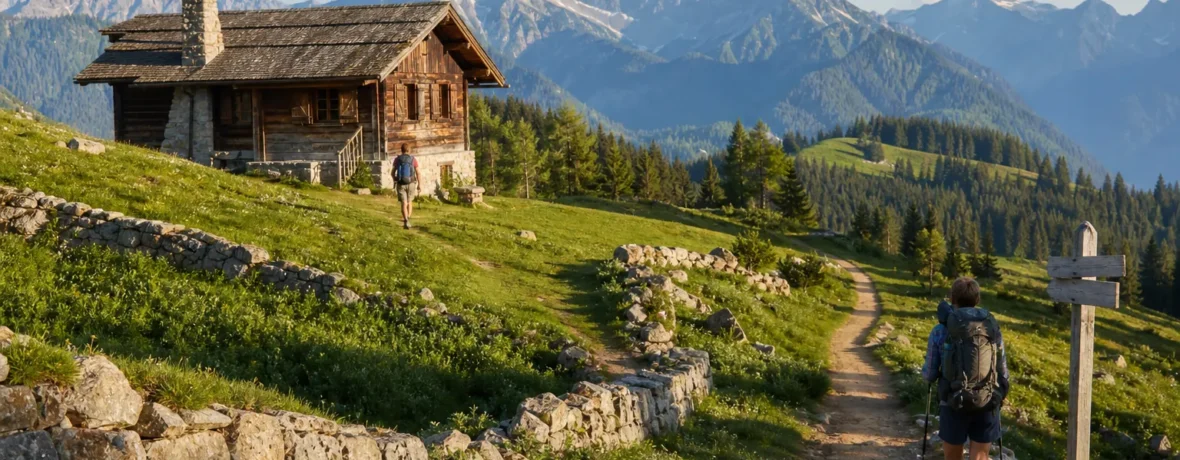
Hiking in Europe vs US trails comes down to comfort versus wildness: Europe is better for hut-to-hut trips, village resupply, transit access, and marked routes; the US is better for big wilderness, solitude, and self-supported backpacking. Choose Europe if you want beds and meals. Choose the US if you want space and fewer roofs.
Is hiking in Europe vs US really that different?
Yes, the difference is practical, not just cultural.
In Europe, a long hike often feels stitched into everyday life. You may walk from a train station to a village, climb through pasture, sleep in a hut, cross a pass, then drop into another town for coffee. The trail is not always “remote” in the American sense. It is often lived-in country: farms, ski lifts, chapels, cows, timber roads, and rifugios sharing the same mountainside.
In the US, the classic hiking ideal leans harder toward wilderness. You carry your shelter. You filter your water. You plan around trailhead quotas, bear canisters, fire rules, and long drives. The reward is space. Huge space. A 15-mile [24 km] day in the Sierra, Rockies, Cascades, or desert Southwest can put you in a basin with no village lights, no dinner bell, and no soft bed waiting.
Here is the position: Europe offers the better system for most first-time multi-day hikers. The huts lower the barrier. Transit often lowers the car problem. Waymarking can be excellent. But the US offers the stronger wilderness experience. If your idea of hiking is sleeping under your own tarp with no buildings in sight, Europe can feel busy and managed. If your idea is moving light between mountain meals, the US can feel like punishment with better scenery.
| Category | Europe | US |
|---|---|---|
| Best strength | Hut-to-hut hiking, villages, public transport | Wilderness, solitude, huge public lands |
| Typical overnight | Mountain hut, inn, refuge, campground | Tent, backcountry site, dispersed camp, campground |
| Planning pressure | Reserve huts and understand local access rules | Check permits, quotas, fires, bears, closures |
| Best for | Light packs and social mountain travel | Self-reliant backpacking and empty country |
Are European hiking huts better than American backcountry campsites?
For comfort, yes; for solitude, no.
European huts are the great cheat code. They let you walk serious mountain terrain with a smaller pack because you are not carrying a full sleep system, stove, and multiple days of food. In Switzerland, Swiss Alpine Club huts provide more than 9,000 places across 153 huts, and a standard adult overnight in an SAC hut runs CHF 25 to CHF 45, while half-board runs CHF 60 to CHF 90, as of November 2026, according to the Swiss Alpine Club hut information published by Switzerland Tourism.
That changes your whole packing list. A European hut trip can mean a 20- to 30-liter pack, hut liner, rain shell, warm layer, snacks, water, and cash or card. You eat dinner at a table. You sleep in a dorm. You hear snoring. You wake early because everyone else does. It is communal, efficient, and deeply civilized in the best way.
The US backcountry campsite is almost the opposite. Nobody cooks dinner for you. A good site is flat, legal, durable, and near water without being too near water. You bring the stove, the bear storage, the tent, the insulation, and the judgment. It is more work. It is also more private and more flexible when permits allow it.
Neither model is morally superior. But they create different hikers. Huts reward route linking and social patience. US backpacking rewards systems: food weight, weather margin, water carries, campsite selection, and the ability to stay calm when the map says the next reliable source is 9 miles [14.5 km] away.
Do you need permits to hike in Europe or the US?
Usually not for day hikes, but overnight rules can be strict on both continents.
This is where American hikers get into trouble: they assume Europe is casual because there are huts and villages. It is not casual. It is local. Rules can change by country, region, park, landowner, season, fire risk, and conservation zone. A legal bivouac in one valley may be banned in the next.
The US system is more centralized on federal lands, but still fragmented. National parks, national forests, BLM land, state parks, tribal land, and private land all play by different rulebooks. Yosemite is a good example of how formal US backpacking can be: a wilderness permit is required year-round for any overnight stay in Yosemite Wilderness, and permits are tied to trailhead quotas, as of November 2026, according to the official Yosemite Wilderness Permits page on Recreation.gov. Yosemite’s listed reservation fee is $10 per permit plus $5 per person for reservations acquired after the lottery, as of November 2026.
Entrance costs also matter in the US. The National Park Service lists the America the Beautiful pass at $80 for US citizens and permanent residents, while the nonresident annual pass is $250, as of November 2026, on the official NPS entrance passes page. Nonresidents age 16 and older also face a $100 nonresident fee at 11 named national parks unless covered by the nonresident annual pass, as of November 2026.
Europe has plenty of fees too, but they often show up as hut nights, cable cars, local buses, private shuttles, parking, or national park camping arrangements rather than a single wilderness permit. Alpine Club membership can reduce hut costs in some countries. The Austrian Alpine Club says members pay at least €12 less for overnight stays in Alpine Club huts, as of November 2026, on its official hut regulations page.
Can you wild camp in Europe like you can in the US?
No, not as a general rule.
This is the biggest attitude adjustment for Americans. In the US, dispersed camping is part of the backpacking language, especially on many national forest and BLM lands where it is allowed unless restricted. You still need to check closures, fire rules, water setbacks, group-size rules, bear storage, and local orders. But the expectation is often: if camping is legal and you choose a durable site, you can carry your home on your back.
Europe is far more patchy. Scotland is not Spain. Norway is not Italy. A French national park core is not a random forest outside a village. The legal answer changes fast, and “I saw a flat meadow” is not a plan.
France shows the nuance well. The official French national parks portal says bivouacking in national parks is possible only in certain places and under conditions, with exceptions including Port-Cros, Porquerolles, and Calanques; wild camping is strictly prohibited, as of November 2026, on the French national parks bivouac guidance page. The same page lists park-by-park time windows and location limits. That is the pattern you should expect in much of Europe: read the local rule, not a continent-wide blog post.
My take: if you want to camp wild every night, the US is cleaner and better. If you want to walk village to hut to inn, Europe wins. Trying to force a US-style dispersed-camping mindset onto Europe is how you end up stressed, illegal, or both.
Are trails better marked in Europe or the US?
Europe is often better marked near towns and classic routes; the US is often better mapped for wilderness travel.
European waymarking can feel luxurious. Painted blazes, color codes, signposts, hut names, walking times, and village arrows appear often on established routes. In the Alps, it is common to plan by time rather than miles because 4 miles [6.4 km] with 3,000 feet [914 m] of gain is not the same animal as 4 rolling miles [6.4 km] through forest.
But do not confuse signs with simplicity. European trail networks can be dense. One junction may point to six villages, three huts, a pass, a lake, and a cable-car station. If you only know the name of your final town, you can still blow a turn. Carry offline maps. Learn the local trail grading. In Switzerland, for example, a “mountain hiking trail” is not the same as an easy valley path, and an “alpine route” is a different commitment altogether.
US trails are usually less dense but can be more consequential. A sign may simply say “Trail” or name a lake 11 miles [17.7 km] away. In wilderness, you may have fewer escape options, fewer huts, fewer roads, and longer stretches between maintained junctions. The tread may be obvious on famous routes and faint on lesser-used ones. Snow, wildfire damage, monsoon washouts, and deadfall can turn a line on a map into a full-body problem.
The short version: Europe helps you keep moving; the US makes you prove you know where you are.
What rules trip up American hikers in Europe?
The rules that trip people up are camping, dogs, huts, drones, fires, and private land.
American hikers often picture “public land” as a big green blob on the map. Europe does not work that neatly. Access traditions can be generous, but ownership, grazing, protected habitats, hunting areas, and municipal rules still matter. A trail may cross private working land by permission or custom. That does not mean you can pitch a tent, light a stove, fly a drone, or let your dog chase livestock.
Hut rules also surprise people. A hut is not a hotel with mud on the floor. You may need a reservation. You may need a hut sleeping bag liner. Boots may stay in a boot room. Dinner may be served at one time. Quiet hours are real. If you cancel late, the hut may lose income because every bed counts. In Swiss SAC huts, reservations are strongly recommended for high season and weekends, and many huts have limited reception, Wi-Fi, and charging options, as of November 2026, according to the Swiss hut guidance linked above.
Dogs deserve special care. In Europe, dogs may be allowed on many trails but banned from some huts, restricted near livestock, required on leash, or barred from sensitive areas. In US national parks, the National Park Service says many parks do not allow pets on hiking trails or boardwalks, and where pets are allowed, they should be on a 6-foot leash, as of November 2026, on the NPS hiking with pets page.
Drones are another hard no in many protected places. In US national parks, the NPS prohibition on launching, landing, or operating uncrewed aircraft on NPS lands and waters remains in force with limited exceptions, as of November 2026, according to the official NPS uncrewed aircraft guidance. Europe varies by country and protected area, but if wildlife, cliffs, huts, villages, or national parks are involved, assume nothing.
- Do not assume wild camping is legal. Check the exact park, municipality, or land agency.
- Do not skip hut reservations. Popular routes can fill, especially weekends and peak season.
- Do not bring a dog without checking huts and protected-area rules. “Trail legal” and “hut legal” are different questions.
- Do not fly a drone because the view is good. Protected landscapes often restrict them.
- Do not treat grazing land like empty land. Close gates, give livestock room, and leash dogs where required.
How should you plan your first hike in Europe or the US?
Plan Europe around beds; plan the US around permits, food, water, and legal camps.
If you are choosing your first overseas hiking trip, do not start with the hardest terrain you can find. Start with the system you want to learn. Europe teaches reservations, timing, hut etiquette, transit logistics, and changing languages. The US teaches load management, campsite judgment, wilderness permits, and longer safety margins.
- Pick the overnight style first. Hut, inn, campground, or wild camp. This decision controls pack weight, budget, and route choice.
- Check the land manager or hut operator. Use official park, forest, hut, or national trail sources before blogs and social posts.
- Book the constrained pieces. In Europe, that usually means huts. In the US, that often means permits, campsites, timed entry, or trailhead parking.
- Build a bad-weather exit. Know the nearest road, bus stop, hut, ranger station, or town before you need it.
- Pack for the actual system. A hut route does not need a full backpacking kitchen. A US wilderness route probably does.
- Recheck conditions close to departure. Snowfields, fire closures, washed-out bridges, heat, storms, and wildlife rules can change the trip.
For Europe, the sweet spot for a first hut trip is usually three to five days. Long enough to feel like a journey. Short enough that one bad forecast does not wreck two weeks. Pick a well-known route with several exit points and staffed huts. Keep daily mileage modest because steep European trails can stack gain fast. A 7-mile [11.3 km] day with 4,000 feet [1,219 m] of climbing is not a casual stroll because the hut has soup.
For the US, start with a two- or three-night backpacking trip in a place with clear regulations and reliable water. Learn your shelter, stove, food system, and sleep setup before a major route. The US rewards hikers who test boring things: canister fit, blister prevention, water capacity, cold-soak tolerance, headlamp batteries, map downloads, and how your knees feel on day three.
Which is better: Europe or the US?
Europe is better for accessible multi-day hiking; the US is better for wilderness backpacking.
That is the honest split. Europe has built a brilliant mountain travel culture around connection: trails to huts, huts to villages, villages to trains. You can move through big terrain with a lighter pack and still eat well. You can cross borders on foot. You can finish a hard day with a roof over your head. For many hikers, that is not cheating. That is the point.
The US has protected a different kind of gift: scale. The best American hikes make you feel small in a way Europe often does not. Long ridgelines. Desert silence. Forests that swallow sound. Basins where the only dinner service is whatever you packed three days ago. The price is friction: permits, drives, heavier packs, and more self-reliance.
So choose by appetite, not by bragging rights. If you want companionship, lighter gear, marked passes, and a mattress at night, go to Europe. If you want long carries, legal solitude, and the satisfaction of making your own tiny camp in a huge place, go to the US.
The mistake is ranking them as if they are trying to do the same job. They are not. Europe is the master of the connected hike. The US is the master of the wild one.
Related reading
- Hiking vs Walking: Where One Ends and the Other Begins
- Mountaineering vs Hiking: Where the Line Is
- Thru-Hiking vs the Camino: Two Different Journeys
- Hiking Shoes vs Hiking Boots: Which Should You Buy?
FAQ
Is hiking in Europe harder than hiking in the US?
Not automatically. Europe can be steeper and more exposed on Alpine routes, while the US can be harder because of heavier packs, longer water carries, and bigger gaps between help.
Can beginners do hut-to-hut hiking in Europe?
Yes, if they choose a beginner-friendly route and book huts in advance. Start with short days, staffed huts, clear waymarking, and bail-out options by bus, train, or valley road.
Do US hikers need travel insurance for Europe?
For a major hiking trip, yes, it is smart. Look for coverage that fits hiking altitude, evacuation, medical care, trip interruption, and the countries you will enter.
Are European huts like hotels?
No. They offer shelter, food, and a bed, but they are usually shared, simple, and rule-driven. Expect dorm rooms, early mornings, limited showers, and less privacy than a hotel.
Can I hike in US national parks without a permit?
Often yes for day hikes, but not always for specific routes, timed-entry areas, or overnight trips. For backpacking, check the exact park page because permits, quotas, and campsite rules can be strict.
What is the biggest packing difference between Europe and the US?
Europe often lets you carry less because huts and villages provide meals and beds. In the US, you usually carry more because shelter, food, water treatment, and sleep gear are part of the trip.