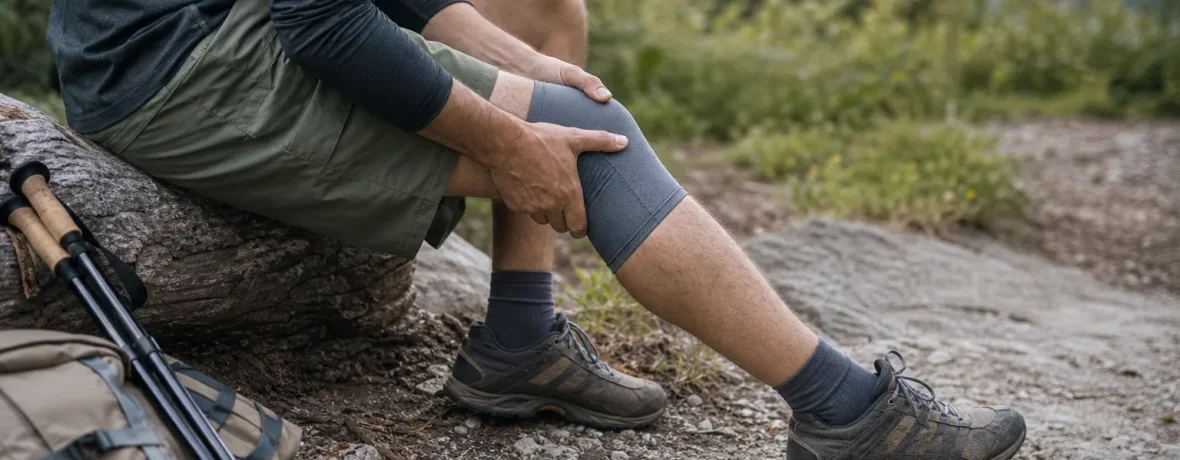
What is runner’s knee? It’s patellofemoral pain syndrome: dull, aching pain at the front of or around the kneecap that often flares on downhills, stairs, squats, or long sitting. For hikers, it’s usually fixable with load management, hip-and-quad strengthening, better descent technique, and medical care if red flags show up.
What is runner’s knee?
Runner’s knee is front-of-knee pain linked to how the kneecap and surrounding tissues handle load. The medical name is patellofemoral pain syndrome, and NIH MedlinePlus describes anterior knee pain as pain around the front and center of the knee, often aggravated by stairs, squatting, kneeling, or sitting with bent knees.
On trail, it often shows up as a nagging ache behind or around the kneecap. Uphill may feel fine. Flat trail may feel fine. Then the descent starts and your knee gets loud. Not dramatic at first. Just a dull bite under the kneecap every step down.
This article gives hiking-focused guidance, not a diagnosis. Knee pain can come from cartilage, tendons, ligaments, arthritis, referred hip pain, or a fall you brushed off too quickly.
Why does runner’s knee happen in hikers?
Runner’s knee usually comes from repeated stress plus a knee that is not tracking or absorbing force well. AAOS notes that patellofemoral pain can involve overuse, abnormal kneecap tracking, and muscle weakness or imbalance, especially in the quads and hip muscles.
Hiking adds its own troublemakers:
- Long downhills: Descending loads the quads hard and increases pressure around the kneecap.
- Big steps: Dropping off rocks or water bars turns each step into a mini lunge.
- Heavy packs: Extra weight makes every downhill foot strike more demanding.
- Sudden mileage jumps: Your knees may tolerate 4 miles [6.4 km], then complain when you jump to 10 miles [16.1 km] with 2,000 feet [610 m] of descent.
- Weak hips: If your hip control fades, your knee may drift inward on descents.
- Worn shoes: Collapsed midsoles and sloppy heel hold can make your stride messier.
The Wilderness Medicine Society’s Wilderness Medicine Letter discusses anterior knee pain problems in hikers and links downhill travel with common overuse complaints around the kneecap. That tracks with what many hikers feel: the pain waits until the trail points down.
What does runner’s knee feel like on the trail?
It usually feels like a dull ache around or behind the kneecap. The pain may build during downhill hiking, stairs, squats, kneeling, or sitting in a car after the hike with your knee bent.
Common patterns include:
- Pain at the front of the knee, not deep in the calf or high in the thigh
- Ache that gets worse with downhill steps
- Discomfort after sitting with knees bent for a long drive home
- Grinding, clicking, or popping that may or may not hurt
- Stiffness the next morning after a steep hike
Mayo Clinic describes patellofemoral pain as a dull, aching pain in the front of the knee that can be aggravated by running, squatting, climbing stairs, or sitting with bent knees.
Is runner’s knee the same as IT band pain or tendonitis?
No. These problems can overlap, but the pain location and triggers often differ.
| Problem | Typical pain spot | Common hiking trigger |
|---|---|---|
| Runner’s knee | Front of knee, around or behind kneecap | Downhills, stairs, squats, long sitting |
| IT band irritation | Outside of knee | Long descents, cambered trail, repetitive downhill strides |
| Patellar tendon irritation | Below kneecap on the tendon | Steep climbs, jumping down rocks, fast descents |
| Meniscus injury | Joint line, often inside or outside | Twisting, deep squats, a specific misstep |
Use this table as a map, not a verdict. If your knee locks, gives way, swells fast, or hurts sharply after a twist, treat it as more than ordinary overuse.
Can you hike with runner’s knee?
Yes, if symptoms are mild, stable, and settle quickly after you back off. No, if pain changes your gait, worsens with each mile, or lingers into normal walking the next day.
A simple trail rule: if pain makes you limp, end the hike or turn around. Limping changes your mechanics and can irritate your hip, back, ankle, or the other knee. Pride is not a treatment plan.
For a low-risk test hike, pick a short route with easy bailout options. Keep the grade mellow. Leave the heavy overnight pack at home. If your pain stays low, does not sharpen, and feels normal the next morning, you have useful feedback. If it flares, your knee is telling you the load is still too high.
How do you fix runner’s knee before your next hike?
Start by reducing the load that irritates it, then rebuild the strength that helps control it. Mayo Clinic’s treatment guidance starts with simple measures and often includes physical therapy to improve strength, range of motion, and stability.
- Cut the aggravator first. For the next 7 to 14 days, reduce steep descents, speed hiking, running, and loaded stairs.
- Keep moving if it stays comfortable. Flat walking, easy cycling, or swimming may let you maintain fitness without poking the bear.
- Shorten your downhill stride. Take quick, small steps instead of braking hard with a locked knee.
- Use trekking poles. Plant both poles slightly ahead on descents and let your arms share the work.
- Lighten your pack. Remove duplicate gear, extra water where reliable sources exist, and “just in case” items you never use.
- Build hips and quads. Stronger legs help the kneecap tolerate hiking loads.
- Return gradually. Add distance, elevation, or pack weight one at a time. Not all three in the same weekend.
The CDC’s adult activity guidelines include muscle-strengthening activity at least 2 days per week. For hikers, that strength work is not gym vanity. It is knee insurance.
What exercises help runner’s knee for hikers?
The best exercises are controlled, pain-respectful moves that train your hips, quads, glutes, calves, and balance. Start easy, use slow reps, and stop any move that causes sharp pain.
Try this 2-day-per-week starter checklist:
- Step-downs: Use a 4- to 6-inch [10- to 15-cm] step. Lower slowly, keep your knee tracking over your middle toes.
- Wall sits: Hold a shallow knee bend. Do not sink deep if that triggers pain.
- Side-lying leg raises: Train the outer hip muscles that help control knee drift.
- Glute bridges: Build hip extension for climbs and descents.
- Calf raises: Strong calves help manage foot and ankle control on uneven trail.
- Single-leg balance: Stand on one foot, then progress to a folded towel or cushion.
Keep the effort smooth. Shaky is fine. Sharp is not. If symptoms keep returning, a physical therapist can check hip strength, ankle mobility, stride, and downhill mechanics in a way a generic exercise list cannot.
What gear changes help runner’s knee on hikes?
Gear will not fix weak hips or a training spike, but it can reduce irritation while you rebuild. Start with the cheapest changes: poles, pack weight, and route choice.
- Trekking poles: Especially useful on descents, creek crossings, loose tread, and long stair-step trails.
- Shoes with stable heel hold: Your foot should not slosh side to side on descents.
- Fresh midsoles: If your shoes feel dead or uneven, your knees may notice before your feet do.
- Knee sleeve: Some hikers like the warmth and light compression. It should not numb, pinch, or mask worsening pain.
- Lighter pack: The most reliable gear upgrade may be leaving weight behind.
When to see a doctor
See a doctor promptly if knee pain is severe, follows a fall or twist, causes major swelling, or keeps you from bearing weight. Also get medical help for fever, redness, warmth, a visibly deformed joint, locking, repeated giving way, numbness, or pain that does not improve after you reduce hiking load.
NIH MedlinePlus guidance on knee pain includes signs that need medical evaluation, especially when swelling, instability, fever, or inability to bear weight is present. If you are planning a remote trip, do not “test it” 12 miles [19.3 km] from the trailhead.
Related reading
- Swimmer's Itch in Mountain Lakes
- Knee Pain After Hiking: Causes and Fixes
- What Is Trail Running and How Is It Different?
- Best Hiking Shoes 2026: Men’s and Women’s Low-Cut Picks, Tested
FAQ
Does runner’s knee go away on its own?
Sometimes, if you reduce the load that triggered it and rebuild strength. If you keep hammering steep descents with the same pack and stride, it can linger.
Is downhill hiking bad for runner’s knee?
Downhill hiking is a common trigger because it increases braking forces through the front of the knee. Shorter steps, trekking poles, and slower pacing can make descents more knee-friendly.
Should I wear a knee brace for runner’s knee?
A sleeve or brace may help symptoms for some hikers, but it is not the main fix. Treat it as support while you address strength, load, shoes, and descent technique.
Can weak hips cause knee pain while hiking?
Yes, weak or poorly controlled hip muscles can let the knee drift inward during step-downs and descents. Hip strengthening is a core part of many patellofemoral pain rehab plans.
What should I do if knee pain starts mid-hike?
Slow down, shorten your stride, use poles, and avoid big step-downs. If you start limping, the smart move is to turn around before a cranky knee becomes a rescue problem.