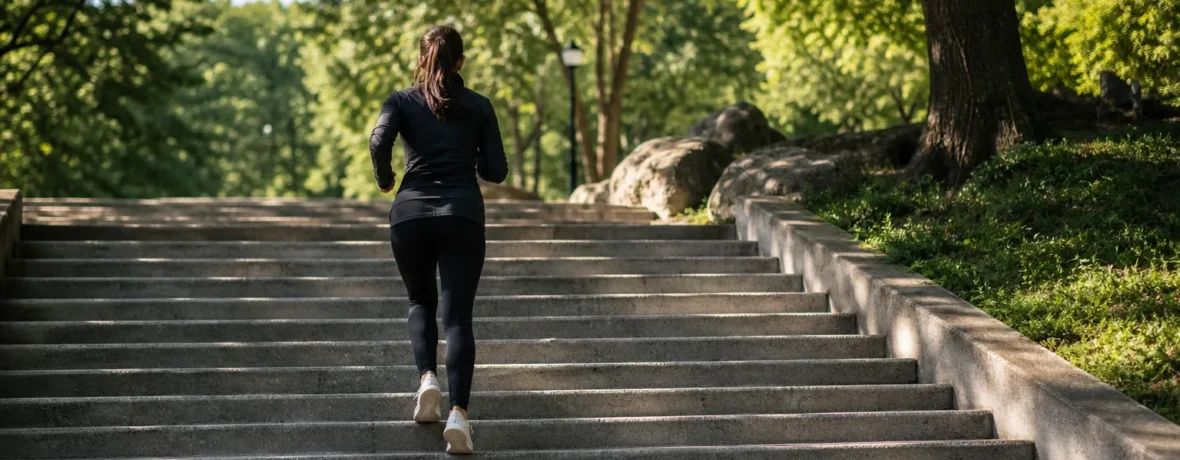
Yes. The StairMaster is solid cardio for hiking if you use it 2-3 days per week for 20-45 minutes, keep posture tall, and pair it with strength training and real trail time. It trains uphill effort well, but it will not fully prepare your feet, ankles, knees, or downhill legs.
Is StairMaster good cardio for hikers?
Yes, the StairMaster is good cardio for hikers who need stronger climbing fitness.
It gives you a steady uphill workload without needing a mountain, a long approach road, or a perfect weather window. That matters when your next trip has 1,500-3,000 ft [457-914 m] of gain and your weekday training options are a gym, a lunch break, and whatever energy you have left after work.
The motion is simple: step, drive, breathe, repeat. Your heart rate rises fast because your glutes, quads, calves, and hip flexors are working on every step. That makes it a useful aerobic tool, especially when you set the pace low enough to keep going instead of turning the session into a 6-minute sufferfest.
For general health, adults should aim for 150 minutes of moderate-intensity aerobic activity each week, plus 2 days of muscle-strengthening work, according to the CDC adult physical activity guidelines. Hiking prep fits neatly into that: use the StairMaster for your aerobic base, then add strength and trail-specific work so your body can handle the pack, rocks, roots, and descents.
Is StairMaster cardio or strength training?
It is cardio first, with a strength-endurance bonus.
That exact search, is StairMaster cardio, gets messy because the machine burns your legs so hard that it feels like leg day. Still, it does not replace squats, step-ups, lunges, deadlifts, calf raises, or loaded carries. The resistance is your body weight, repeated for time. Great for endurance. Limited for maximum strength.
Think of it this way: if your lungs are the weak link on climbs, the StairMaster helps. If your knees ache on descents, your hips collapse inward, or your pack feels like it owns you after mile 7 [11 km], you need strength work too.
| Training Tool | Best For | What It Misses |
|---|---|---|
| StairMaster | Uphill cardio, climbing rhythm, short weekday sessions | Downhill loading, uneven ground, foot toughness |
| Treadmill incline | Long steady climbs, easier pacing, pack walking | Big step height, trail balance |
| Outdoor hills | Trail feel, pacing, weather, terrain skills | Convenience and exact control |
| Strength training | Joint support, pack carrying, downhill resilience | Sustained aerobic climbing unless paired with cardio |
How should you use the StairMaster for hiking training?
Use it with purpose, not ego.
Most hikers get more out of controlled sessions than from clinging to the rails at a speed they cannot hold. Your goal is hiking fitness, not winning an imaginary gym race against the person on the next machine.
- Warm up for 5-8 minutes. Start easy. Let your breathing, ankles, calves, and hips catch up before you ask for harder work.
- Stand tall. Lightly touch the rails for balance if needed, but do not hang your weight on them. If you need to lean hard, lower the level.
- Use full-foot pressure. Drive through the whole foot, not just the toes. That keeps your calves from doing all the work.
- Train in zones. Do easy aerobic sessions, tempo climbs, and short intervals on different days instead of making every workout brutal.
- Cool down for 5 minutes. Step down gradually, then walk easy. The American Heart Association’s warm-up and cool-down guidance supports easing the heart into and out of exercise.
What StairMaster workouts help most for hiking?
The best workouts match the hike you are training for.
If your trip is a long, steady climb, do longer moderate sessions. If your route has punchy switchbacks, add intervals. If you are coming back from a lazy winter, keep it boring and consistent for the first 2-3 weeks.
- Base climb: 25-45 minutes at a pace where you can speak in short sentences.
- Hill intervals: 6-10 rounds of 1 minute hard, 2 minutes easy.
- Pack prep: 20-30 minutes at an easy pace with a light daypack only if your form stays clean.
- Long climb simulation: 45-60 minutes easy to moderate, best used after several weeks of shorter sessions.
For intensity, you can use breath, effort, or heart rate. The American Heart Association target heart rate chart describes moderate intensity as 50-70% of maximum heart rate and vigorous intensity as 70-85%. If you take heart medication or have a heart condition, ask a clinician what range makes sense for you.
What does the StairMaster not train for hiking?
It does not train downhill hiking well.
That is the big miss. Uphill hiking burns the lungs. Downhill hiking hammers the legs. Your quads brake your body on every step, your knees manage force, and your feet slide, grip, twist, and stabilize. The StairMaster moves under you in a predictable pattern, so it cannot fully copy that.
It also does not toughen your skin for long miles, teach foot placement, build confidence on loose rock, or show you how your shoes feel after 4 hours. A gym machine is a tool. The trail is still the exam.
- Add step-downs or slow downhill treadmill walking if your knees struggle on descents.
- Do single-leg strength work for balance and hip control.
- Train outside in the shoes and socks you plan to hike in.
- Use trekking poles outdoors before a big trip, not for the first time at the trailhead.
Should you wear a backpack on the StairMaster?
Sometimes, but start light and keep the session short.
A pack changes your center of gravity. That is useful for hiking prep, but it can also push you into sloppy posture fast. Start with a light daypack, keep both hands free or barely touching the rails, and stop the weighted version if your low back tightens or your stride turns choppy.
Do not load a heavy pack on the StairMaster just to prove you can suffer. Save heavier pack work for outdoor walks, incline treadmill sessions, or step-ups where you can control the movement and step off safely.
How often should hikers use the StairMaster?
Two to three sessions per week works for most hiking goals.
That gives you enough practice to build climbing fitness without crowding out strength, mobility, and real walking. If you already hike on weekends, two weekday StairMaster sessions can be plenty. If you are training for a steep trip and cannot get outside much, three sessions can work if at least one is easy.
- Beginner: 2 days per week, 15-25 minutes each.
- Intermediate: 2-3 days per week, 25-45 minutes each.
- Big climb prep: 3 days per week, mixing intervals, steady climbing, and one longer easy session.
Keep one simple rule: increase time or intensity, not both at once. Your calves and Achilles tendons may complain if you jump from zero to monster sessions.
When to see a doctor
See a doctor before hard training if you have chest pain, fainting, unexplained shortness of breath, a known heart condition, or symptoms that feel unusual for you.
Also get medical guidance if you are returning after surgery, pregnancy complications, a major illness, or a long layoff with multiple health concerns. Use the StairMaster gently until you are cleared for harder work. For altitude trips, fitness helps you move better, but it does not remove altitude illness risk; the CDC Yellow Book altitude guidance says training and physical fitness do not affect the risk of altitude illness.
Related reading
- Is Jump Rope Good Cardio?
- Is Rowing Good Cardio?
- Is the StairMaster Good for Weight Loss?
- Is the Elliptical Good Cardio?
FAQ
Is the StairMaster better than running for hiking?
It is better for uphill specificity, but not always better overall. Running builds strong aerobic fitness, while the StairMaster more closely matches the climbing motion used on steep trails.
Can the StairMaster replace hiking?
No, it cannot fully replace hiking. It helps your uphill engine, but you still need outdoor miles for balance, footwork, downhill strength, shoe testing, and pack comfort.
How long should I do the StairMaster for hiking fitness?
Start with 15-25 minutes if you are new to it. Build toward 30-45 minutes for regular training, and use occasional 45-60 minute easy sessions for longer climb prep.
Is the StairMaster good for backpacking training?
Yes, it can help with backpacking climbs. Pair it with loaded walks, strength training, and outdoor hikes because backpacking demands more than uphill cardio.
Why do my calves burn so much on the StairMaster?
Your calves may be doing too much work if you step mostly on your toes. Slow down, place more of your foot on each step, stand taller, and reduce the level until your glutes and quads share the load.
Should I hold the rails on the StairMaster?
Use the rails lightly for balance, not support. If you are leaning hard on your hands, the setting is too fast for productive hiking training.