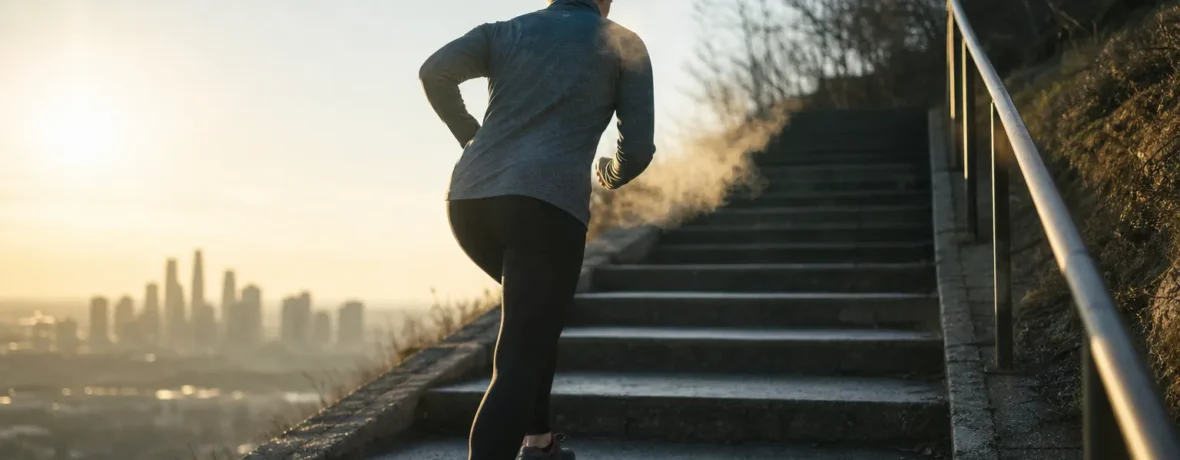
Yes, it can be. A 30-minute StairMaster workout can burn roughly 330-490 calories for a 150-220 lb [68-100 kg] person at vigorous effort. Weight loss happens when that work helps you maintain a calorie deficit consistently.
Is StairMaster Good for Weight Loss Compared With Other Cardio?
Yes, the StairMaster is a strong weight-loss tool because climbing is hard work.
You are moving your body upward step after step, which asks more from your glutes, quads, hamstrings, calves, lungs, and heart than easy flat walking. That does not make it magic. It makes it useful. The machine gives you a controlled way to stack vertical work without needing a hill, a trailhead, daylight, or good weather.
The 2024 Adult Compendium of Physical Activities lists a stair-treadmill ergometer at 9.3 METs, which puts it in vigorous territory for many people. METs are a standard way to estimate energy cost, and the higher the MET value, the more energy the activity demands. You can see the listing in the 2024 Adult Compendium conditioning exercise table.
| Workout | Typical feel | Best use |
|---|---|---|
| StairMaster | Hard breathing, heavy legs, steady climbing | Fat loss, hiking legs, vertical conditioning |
| Incline treadmill walk | Steady, more adjustable, less technical | Longer low-impact sessions |
| Flat treadmill walk | Easier to sustain | Beginner volume and recovery days |
| Rowing machine | Full-body, technique-heavy | Cardio with upper-body involvement |
Does StairMaster Burn Fat?
Yes, does StairMaster burn fat is a fair question, and the answer is yes when your overall day puts you in an energy deficit.
Your body does not burn belly fat just because your abs feel tight on the machine. It burns stored fat when you use more energy than you take in over time. The StairMaster helps by burning calories, improving aerobic fitness, and building the kind of uphill durability that carries straight into hiking.
The CDC explains that physical activity supports weight loss by helping create a calorie deficit, especially when paired with eating patterns that match your goal. That is the lever. Not sweat. Not soreness. Not the number glowing on the console.
How Many Calories Does the StairMaster Burn?
A 30-minute StairMaster session can burn roughly 330-490 calories for many adults.
Here is a practical estimate using 9.3 METs from the Compendium. These are not lab results for your body. They are planning numbers. Your speed, step height, fitness, body size, rail use, and machine model all change the final burn.
| Body weight | 20 minutes | 30 minutes |
|---|---|---|
| 150 lb [68 kg] | 220 calories | 330 calories |
| 180 lb [82 kg] | 266 calories | 399 calories |
| 220 lb [100 kg] | 325 calories | 487 calories |
One warning: do not treat the machine’s calorie number like a receipt. Fitness machines often estimate high or low because they do not know your true effort, mechanics, or how much weight you are dumping into the handrails.
How Long Should You Use the StairMaster to Lose Weight?
Start with 15-25 minutes, 3 days per week, then build toward 30-45 minutes if your knees, calves, and recovery can handle it.
The CDC recommends adults get at least 150 minutes of moderate-intensity aerobic activity per week, or 75 minutes of vigorous-intensity activity, plus muscle-strengthening work on 2 days. For greater weight-control support, some people need more weekly activity, and the CDC notes that healthy weight loss also depends on food, sleep, stress, and consistency. See the CDC adult physical activity guidelines.
For weight loss, think in weeks, not heroic single sessions. A hard 50-minute climb followed by 6 days of couch time is weaker than 25 minutes repeated 4 times with good food choices.
What Is the Best StairMaster Workout for Weight Loss?
The best workout is one you can repeat without limping through the rest of your week.
Use this simple 4-week build if you are already cleared for exercise and can walk briskly for 30 minutes without pain.
- Week 1: 15 minutes, 3 times per week. Easy pace. You should breathe harder but stay in control.
- Week 2: 20 minutes, 3 times per week. Add 3 short pickups of 30 seconds each.
- Week 3: 25 minutes, 3-4 times per week. Keep one session very easy.
- Week 4: 30 minutes, 4 times per week. Make one session interval-based and the others steady.
A clean interval session looks like this:
- 5 minutes easy warm-up
- 8 rounds of 1 minute hard, 1 minute easy
- 5-8 minutes easy cool-down
Hard does not mean flailing. It means strong posture, quiet feet, and breathing that makes talking tough.
What StairMaster Speed Is Best for Fat Loss?
The best speed is the fastest pace you can hold with good form and repeat consistently.
For most people, that means a pace where you can say a short sentence but not chat comfortably during steady work. During intervals, you may only get out a few words. The CDC describes vigorous activity as breathing hard and fast with a higher heart rate than moderate work; its guide to measuring physical activity intensity is a useful check.
Skip the ego pace if it turns you into a hunched gargoyle gripping both rails. That makes the workout easier on your legs and worse for your hiking posture. Light fingertips are fine for balance. Hanging off the console is not.
Is the StairMaster Better Than Running for Weight Loss?
Not always, but it can be better for hikers who want climbing strength with less pounding.
Running is excellent cardio, but it is impact-heavy. The StairMaster keeps you stepping upward without the repeated landing forces of running. That can make it easier to add hard cardio if your joints dislike pavement.
For hiking fitness, the StairMaster has a clear advantage: it trains uphill movement. Your glutes and quads learn to keep working while your breathing climbs. Add a pack later, and you get even closer to trail demands.
How Do You Use the StairMaster Without Wrecking Your Knees?
Use clean form, progress slowly, and stop if pain changes your stride.
The StairMaster is simple, but simple does not mean foolproof. Bad posture and sudden volume can light up knees, Achilles tendons, calves, hips, and low backs.
- Stand tall, ribs stacked over hips.
- Use the rails for balance, not body-weight support.
- Step through your whole foot instead of bouncing only on your toes.
- Keep knees tracking in the same direction as your toes.
- Increase total weekly time by small chunks, not massive jumps.
- Take at least 1 easy or rest day after hard stair intervals.
If you are training for hiking, add strength work too: step-ups, split squats, deadlifts, calf raises, and loaded carries. The machine builds climbing fitness. Strength work builds the chassis.
Can the StairMaster Help With Hiking Training?
Yes, it is one of the best gym machines for uphill hiking fitness.
Trails are rarely flat. Climbs demand repeated hip and knee extension, calf endurance, steady breathing, and the patience to keep moving when the grade gets rude. The StairMaster checks those boxes.
To make it more hiking-specific, use these tweaks:
- For long climbs: 30-45 minutes at a steady, controlled pace.
- For steep trail bursts: 10 rounds of 45 seconds hard, 75 seconds easy.
- For pack prep: add a light pack only after 3-4 weeks of pain-free sessions.
- For downhill readiness: add strength training, because the StairMaster does not train downhill braking well.
What Mistakes Stop the StairMaster From Helping Weight Loss?
The biggest mistake is using the machine hard, then eating back the deficit without realizing it.
That post-workout hunger can be loud. If weight loss is the goal, pair your sessions with basic food structure: protein at meals, high-fiber carbs, plenty of water, and fewer liquid calories. No drama. Just less guesswork.
Watch for these traps:
- Leaning hard on the rails and cutting the workload
- Doing every session at maximum effort
- Skipping strength training
- Trusting calorie estimates as exact
- Changing workouts every week instead of building consistency
- Ignoring sleep, which can make appetite harder to manage
When to See a Doctor
See a doctor before starting vigorous StairMaster training if you have heart disease, chest pain, fainting, uncontrolled blood pressure, major joint pain, diabetes complications, or you have been inactive and plan to train hard.
Stop exercising and seek medical help if you feel chest pressure, severe shortness of breath, dizziness, faintness, pain spreading to the arm or jaw, or sudden unusual weakness. For general medical guidance on exercise and body weight, MedlinePlus has a plain-language resource on exercise and activity for weight loss.
No article can diagnose pain or tell you what is safe for your specific medical history. If something feels wrong, get checked.
Related reading
- Is Hiking Good for Weight Loss?
- Is Rucking Good for Weight Loss?
- Is the StairMaster Good Cardio for Hiking Fitness?
- Is Jump Rope Good Cardio?
FAQ
Is 20 minutes on the StairMaster enough to lose weight?
Yes, 20 minutes can help if it contributes to a weekly calorie deficit. A 150-220 lb [68-100 kg] person may burn roughly 220-325 calories in 20 minutes at vigorous effort.
Can I do the StairMaster every day?
You can, but most people should not start there. Begin with 3 days per week, then add days only if your knees, calves, sleep, and energy stay solid.
Does the StairMaster slim your legs?
It can help reduce overall body fat, which may make your legs leaner. It also trains your glutes, quads, hamstrings, and calves, so your legs may feel firmer and stronger.
Is StairMaster good for belly fat?
Yes, but not because it targets belly fat directly. It burns calories, and your body decides where fat comes off based on genetics, hormones, and total energy balance.
Should I use the StairMaster before or after weights?
For weight loss, either can work. If strength is a priority, lift first and use the StairMaster after; if cardio fitness is the priority, climb first while your legs are fresh.
Is the StairMaster good for beginners?
Yes, if you start easy. Use 5-15 minutes at a comfortable pace, hold the rails lightly for balance, and build time before you chase speed.