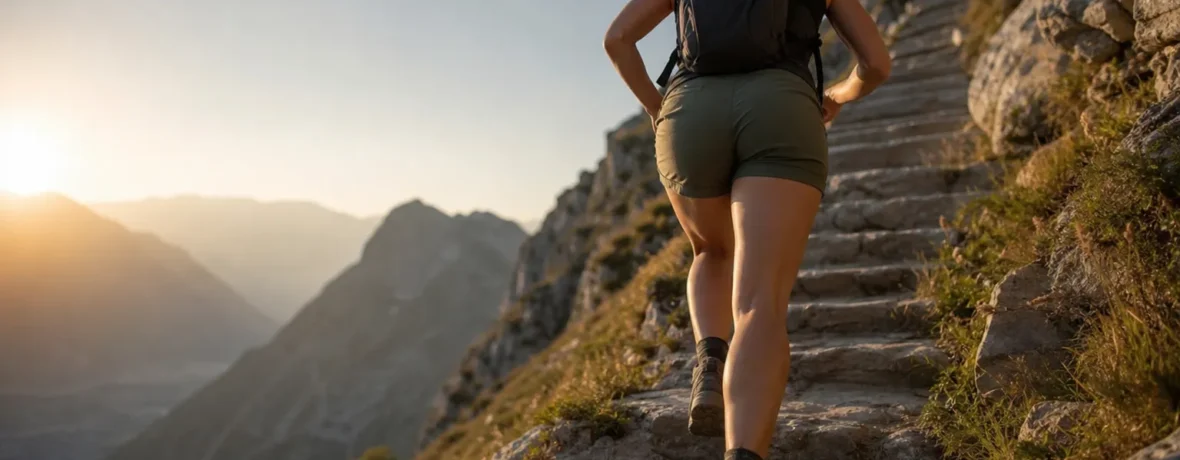
Yes. The StairMaster can strengthen and modestly grow your glutes if you climb 2–4 days per week, 15–30 minutes per session, with upright posture, full-foot steps, and progressive resistance. For serious size, pair it with 2 weekly strength sessions using hip thrusts, squats, lunges, or step-ups.
Does StairMaster build glutes if you use it every week?
Yes, but only if you make your glutes do the work.
The StairMaster is basically an endless uphill trail with handrails and no summit photo. Every step asks your hip to extend, which is one of the main jobs of your glutes. That matters for hikers because strong glutes help drive you uphill, steady your pelvis under a pack, and take some pressure off your knees on long climbs.
But there’s a catch. If you hunch over, lean on the rails, tap tiny steps with your toes, and let momentum carry you, your quads and calves take over. Your glutes get invited to the party, then left standing by the snack table.
For more glute work, use:
- Full-foot contact on each step, not just your toes.
- A tall torso with ribs stacked over hips.
- Light fingertips on the rails, not bodyweight support.
- A step height that lets you push through your heel and midfoot.
- Enough resistance or speed that the last 5 minutes feel hard but controlled.
The CDC recommends adults do muscle-strengthening work at least 2 days per week, along with regular aerobic activity. The StairMaster can help cover the aerobic side and train lower-body endurance, but it should not be your only strength plan if bigger, stronger glutes are the goal. See the CDC adult physical activity guidelines for the baseline weekly recommendations.
Is StairMaster good for glutes?
Yes, is StairMaster good for glutes depends on posture, range of motion, and effort.
Think of the StairMaster as glute endurance training first and muscle-building training second. It can make your backside stronger for repeated climbing, especially when you train with intention. That’s gold for hiking. Long ascents are not one heroic squat. They are hundreds or thousands of step-ups in a row.
A simple step-up works the legs and buttocks, according to Mayo Clinic’s step-up exercise guidance. The StairMaster uses a similar pattern, just repeated continuously. The more you push the step down through your whole foot, the more your glutes contribute.
Use this quick comparison:
| Training choice | Best for | Glute-building limit |
|---|---|---|
| StairMaster | Climbing endurance, conditioning, hiking prep | Limited external load |
| Weighted step-ups | Trail-specific strength | Needs balance and setup |
| Hip thrusts | Direct glute strength and size | Less hiking-specific |
| Squats and lunges | Total lower-body strength | Technique matters under load |
How should you use the StairMaster to target your glutes?
Use slower, stronger steps instead of frantic toe-tapping.
Here’s the trail-ready way to do it:
- Warm up for 5 minutes. Keep the pace easy. Let your ankles, knees, and hips get moving before you ask for power.
- Stand tall. Keep your chest up and your hips under you. If your shoulders are over the console, back off the speed.
- Place your whole foot on the step. Push through the heel and midfoot. This helps shift work toward the glutes and hamstrings.
- Take controlled steps. Aim for a steady rhythm where every step has pressure behind it.
- Use the rails for balance only. If your arms are holding you up, your legs are doing less work.
- Add resistance gradually. Increase level, time, or interval difficulty one piece at a time.
- Cool down for 3–5 minutes. Step easy, breathe, then get off before your form turns sloppy.
A solid glute-focused session looks like this: 5 minutes easy, 10 rounds of 1 minute strong and 1 minute easy, then 5 minutes easy. That gives you 30 minutes total. Hard enough to matter. Short enough to repeat.
What StairMaster mistakes stop your glutes from working?
The biggest mistake is leaning on the machine.
You see it all the time: elbows locked, wrists loaded, spine folded, feet flicking the steps like a sewing machine. That may keep the belt moving, but it steals work from your hips. If you want stronger glutes for steep trails, your body has to support itself.
Watch for these form leaks:
- Leaning hard on the rails: Your upper body unloads your legs.
- Taking shallow steps: Less hip movement means less glute demand.
- Going too fast: Speed can turn the workout into calf bouncing.
- Letting knees cave inward: Keep knees tracking over toes.
- Training hard every day: Sore, tired glutes do not build well.
MedlinePlus recommends leaving a full day of rest between strength workouts for the same muscles. That’s a good rule for hard StairMaster glute sessions too, especially if you are also lifting, hiking, or running. See MedlinePlus indoor fitness guidance for more basic training structure.
Can the StairMaster replace glute strength training?
No, not if you want maximum strength or size.
The StairMaster is useful. It is not magic. Muscle growth usually needs progressive overload: more load, more reps, more sets, or harder variations over time. The StairMaster gives you repetition and fatigue, but it does not load your hips the same way a barbell hip thrust, heavy step-up, Romanian deadlift, or split squat can.
For hikers, the best setup is both:
- StairMaster: 1–3 sessions per week for climbing endurance.
- Strength training: 2 sessions per week for glute, hamstring, quad, and calf strength.
- Actual hiking: 1 longer outing when your schedule allows.
- Recovery: At least 1 easier day after hard lower-body work.
If you only care about hiking better, the StairMaster can carry a lot of the load. If you want visible glute growth, lift too. Keep the machine. Add iron.
What is the best StairMaster workout for hiking glutes?
The best workout is controlled, uphill-style, and repeatable.
Try this 3-day weekly structure:
| Day | Workout | Goal |
|---|---|---|
| Day 1 | 20–30 minutes steady, moderate pace | Climbing endurance |
| Day 2 | Lower-body strength: step-ups, lunges, hip hinges | Glute strength |
| Day 3 | 25–35 minutes with 8–12 short hard intervals | Power and stamina |
Keep one day between the hardest lower-body sessions when you can. Your legs adapt between workouts, not while you are punishing them into mush.
If you are training for a steep hike, wear the shoes you plan to hike in for some sessions. Skip the loaded pack on the StairMaster unless you already tolerate it well. A pack changes posture fast, and poor posture defeats the whole point.
How long does it take to see stronger glutes from the StairMaster?
You can feel better climbing within a few weeks, but visible glute growth takes longer.
Expect coordination and stamina to improve first. Your steps feel smoother. Hills feel less rude. Your breathing still works hard, but your hips do not quit as early.
For muscle size, think in months, not days. Train glutes 2–4 times per week across StairMaster sessions and strength work. Eat enough protein and total food. Sleep. Then keep going long enough for your body to believe you mean it.
Use these progress markers:
- You can climb the same time at a higher level.
- You can finish intervals without leaning on the rails.
- Your uphill hiking pace improves.
- Your knees feel more controlled on climbs and descents.
- Your strength exercises move up in weight or reps.
When to see a doctor
Stop and get medical help if exercise brings chest pain, fainting, severe shortness of breath, or pain spreading to the jaw, neck, or arm.
Hard stair climbing is intense. Burning muscles and heavy breathing can be normal during a tough workout, but sharp pain, dizziness, faintness, or symptoms that feel wrong are not training badges. They are stop signs.
Check with a healthcare professional before starting hard StairMaster training if you have heart disease, lung disease, diabetes, uncontrolled blood pressure, recent injury, or a long break from exercise. Mayo Clinic lists chest, jaw, neck, or arm discomfort, dizziness, faintness, and severe shortness of breath as reasons to seek medical guidance during activity; read its exercise safety guidance for more context.
Related reading
- Does Incline Walking Build Glutes?
- Does Walking Build Muscle?
- What Does the StairMaster Do for Hikers?
- Is the StairMaster Good Cardio for Hiking Fitness?
FAQ
Does the StairMaster make your butt bigger?
It can, but it is better at building glute endurance than major size. For bigger glutes, combine StairMaster sessions with loaded hip thrusts, step-ups, squats, lunges, or deadlift variations.
How many minutes on the StairMaster should I do for glutes?
Start with 15–20 minutes, then build to 25–35 minutes as your form holds. Quality matters more than surviving 60 sloppy minutes while hanging from the rails.
Should I skip steps on the StairMaster for glutes?
Sometimes, yes, if you can do it safely and without leaning. Skipping steps increases hip range of motion, but it also raises balance demands, so keep the pace slow and controlled.
Is the StairMaster better than walking uphill?
For consistent indoor climbing, yes. For real hiking skill, no machine fully replaces uneven trail, changing grades, rocks, roots, and downhill work.
How often should hikers use the StairMaster?
Use it 1–3 days per week, depending on your hiking, lifting, and recovery. If your legs stay sore or your knees get cranky, reduce intensity before adding more time.
What muscles does the StairMaster work besides glutes?
It also trains quads, hamstrings, calves, hip flexors, and your trunk muscles. Your glutes work hardest when you stand tall, use a full foot on the step, and push down with control.