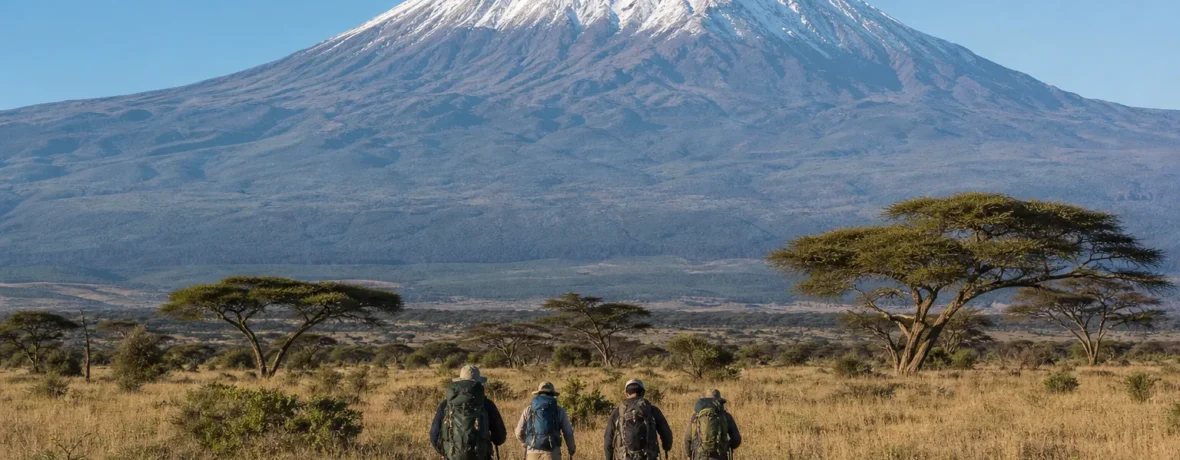
How to train for Kilimanjaro: spend 12 weeks building uphill hiking endurance, leg and core strength, and back-to-back long walks with a loaded daypack. Aim for 4–6 training days per week, peak with a 6–8 hour hike, then taper for 10–14 days before flying.
How to train for Kilimanjaro in 12 weeks?
Train with steady hiking, stairs, strength work, and long days on tired legs.
Mount Kilimanjaro rises to 19,341 ft [5,895 m], according to Tanzania National Parks. You do not need technical climbing skills for the standard trekking routes, but you do need durable legs, a calm engine, and the patience to walk slowly for many hours at altitude.
The goal is not to become a runner. It is to become hard to wear down. Kilimanjaro rewards people who can hike slowly, keep eating, keep drinking, and repeat the same effort day after day.
- Weeks 1–3: Build the habit. Walk or hike 4 days per week. Add 1 strength session and 1 stair or hill session. Keep most efforts easy enough that you can speak in full sentences.
- Weeks 4–6: Add climbing legs. Increase your longest hike to 3–5 hours. Start using the shoes and daypack you will take to Tanzania. Add step-ups, lunges, squats, calf raises, and loaded carries.
- Weeks 7–9: Train for long trail days. Hike on back-to-back days once per week. One day should be longer; the second should be shorter and steady. This teaches you to move well when your legs are already tired.
- Weeks 10–11: Peak, then hold. Your biggest hike should land here: 6–8 hours with 2,000–4,000 ft [610–1,219 m] of climbing if your local terrain allows it. Do not crush yourself every day.
- Week 12: Taper. Cut volume by 40–60%. Keep moving, but arrive fresh. A tired body adapts poorly on the mountain.
What should a Kilimanjaro training plan include?
A smart plan includes hiking, uphill work, strength training, mobility, and recovery.
You are training for a walking trip, not a gym challenge. The best sessions look boring on paper and powerful on the trail: long walks, steady climbs, repeated stairs, and simple strength moves done well.
| Training piece | How often | What it prepares |
|---|---|---|
| Easy walks or hikes | 2–3 days per week | All-day endurance and foot toughness |
| Hill, stair, or treadmill incline work | 1 day per week | Long uphill sections and summit night |
| Strength training | 2 days per week | Knees, hips, glutes, calves, back, and core |
| Back-to-back long walks | 1 weekend per week in peak phase | Multi-day fatigue |
If you already meet the baseline adult fitness guidelines, you have a head start. The CDC adult activity guidelines call for 150 minutes of moderate-intensity activity per week plus 2 days of muscle-strengthening activity. Kilimanjaro training usually needs more than that during the final 8 weeks, but those numbers make a useful floor.
How fit do you need to be to climb Kilimanjaro?
You need hiking fitness, not elite fitness.
A good benchmark: you can hike for 5–6 hours with a 10–15 lb [4.5–6.8 kg] daypack, wake up the next morning, and walk again without limping. You should also be comfortable climbing stairs or hills for 45–60 minutes at a steady pace.
Your pace does not need to be fast. In fact, rushing is one of the worst habits you can bring. Kilimanjaro days are slow by design. Porters and guides often set a pace that feels almost too easy at first. Trust it. The mountain gets the final vote.
Use these checkpoints before you go:
- You can walk 4 miles [6.4 km] on flat ground without stopping.
- You can hike 8–10 miles [12.9–16.1 km] on rolling terrain.
- You can climb 1,500–2,500 ft [457–762 m] in a day at a steady effort.
- You can carry your daypack with water, layers, snacks, and rain gear.
- You can train 4 days per week without nagging pain.
How much hiking should you do before Kilimanjaro?
Build to one long hike per week, then add back-to-back hiking days.
Your long hike is the anchor session. Start where you are. If your current longest walk is 90 minutes, do not jump to 6 hours next weekend. Add 30–60 minutes every 1–2 weeks until you reach a 6–8 hour day near weeks 10 or 11.
If you live near mountains, use them. If you live somewhere flat, use bridges, stadium stairs, parking garages, treadmill incline, or repeated loops on the steepest hill you can find. A 30-minute hill repeated 4 times can become a serious session.
Train in the footwear you plan to wear. Hot spots, heel lift, bruised toes, and sock problems should show up at home, not above 13,000 ft [3,962 m]. Wear your pack too. Start with 5 lb [2.3 kg], then work toward 10–15 lb [4.5–6.8 kg]. You are not training to carry your duffel; porters typically carry expedition bags. You are training to carry your trail essentials comfortably.
How do you train for Kilimanjaro altitude?
You cannot fully train for 19,341 ft [5,895 m] at sea level.
Altitude is the wild card. Fitness helps you handle the workload, but it does not guarantee acclimatization. The CDC Yellow Book guidance on altitude illness says gradual acclimatization is the best prevention strategy. That is why many trekkers choose itineraries with more days on the mountain instead of the shortest schedule.
Use training to control what you can:
- Arrive with strong legs so the walking effort stays lower.
- Practice a slow pace, even when you feel good.
- Learn to eat small snacks while moving.
- Practice drinking regularly without overdoing it.
- Sleep well in the final 2 weeks before travel.
Do not treat a hard workout as altitude prep. It is not the same thing. A crushing interval session at home does not mimic sleeping above 12,000 ft [3,658 m]. If you have a history of altitude illness, heart disease, lung disease, severe anemia, or another medical condition that could be affected by high altitude, talk with a clinician who understands travel or wilderness medicine before you book.
The Wilderness Medical Society altitude illness guidelines discuss prevention and treatment options for acute altitude illness. Medication decisions belong with a qualified clinician, not a packing blog, a group chat, or a last-minute gear shop conversation.
What strength exercises help most for Kilimanjaro?
Train your legs, hips, calves, core, and upper back.
Strength training keeps your stride stable when the trail gets rough and your pack starts to tug on your shoulders. Keep it simple. You do not need exotic moves. You need control, range of motion, and repeatable force.
- Step-ups: Use a bench or box. Drive through the whole foot. Start bodyweight, then add a light pack.
- Split squats: Great for quads, glutes, balance, and downhill control.
- Romanian deadlifts: Build hamstrings, glutes, and back-of-leg strength for climbing.
- Calf raises: Do them straight-knee and bent-knee. Your calves work all day on steep ground.
- Planks and side planks: Train your trunk to stay quiet while your legs move.
- Rows: Strengthen the upper back for pack comfort and posture.
Two strength sessions per week is enough for most hikers. During the heaviest hiking weeks, reduce the gym load instead of trying to win both battles. Sore legs are not the prize. Durable legs are.
What should you practice before the trip?
Practice the small trail habits that fall apart when you are tired.
Big mountains expose sloppy systems. Test everything during training: boots, socks, rain shell, snacks, poles, blister care, and layers. Summit night can be cold, slow, and mentally strange. You want your hands to know where your gloves are before your brain gets foggy.
- Walk with trekking poles until the rhythm feels automatic.
- Test your rain jacket and pants in actual rain or a hose test.
- Eat the snacks you plan to bring on long hikes.
- Practice layering without stopping for 15 minutes.
- Use the same pack pockets every time: snacks here, gloves there, headlamp in one fixed place.
- Break in boots or trail shoes on rough ground, not just sidewalks.
- Learn your blister hot spots and tape them before they flare.
How should you taper before Kilimanjaro?
Reduce training for 10–14 days before departure.
Tapering does not mean sitting still. It means letting the work settle into your body. Keep walking. Keep doing light mobility. Keep one short hill or stair session if it makes you feel sharp. Drop the long hikes, heavy leg strength, and anything that risks a tweak.
During the final week, focus on sleep, gear checks, and travel logistics. Trim your toenails. Pack blister supplies. Walk in your flight socks or travel shoes before the airport day. Hydrate normally. Eat familiar food. This is not the week for a new cleanse, new boots, new insoles, or your first deadlift session.
When to see a doctor
See a doctor before training hard if you have health risks or symptoms that could make altitude unsafe.
Talk with a clinician before your trip if you have heart disease, lung disease, high blood pressure, diabetes, sickle cell trait or disease, severe anemia, pregnancy, a history of blood clots, prior high-altitude pulmonary edema, prior high-altitude cerebral edema, or repeated severe altitude sickness. Also get checked if training brings chest pain, fainting, unusual shortness of breath, irregular heartbeat, severe dizziness, or joint pain that changes your gait.
For general high-altitude travel advice, the CDC Travelers’ Health altitude page recommends speaking with a doctor when gradual ascent is not possible or when medical conditions may increase risk. Do not self-diagnose altitude symptoms on the mountain. Tell your guide early if you feel worse than normal fatigue.
Related reading
- How to Train for a Long-Distance Hike
- How to Train for High-Altitude Hiking at Sea Level
- How to Train for Backpacking With a Loaded Pack
- How to Train for the Everest Base Camp Trek
FAQ
Can a beginner train for Kilimanjaro?
Yes, a beginner can train for Kilimanjaro if they start early and build consistently. Give yourself 4–6 months if you are currently inactive, and use the first 8 weeks to create a base before following a harder 12-week schedule.
Is running required for Kilimanjaro?
No, running is not required. Hiking, brisk walking, stairs, and incline treadmill sessions transfer better for most trekkers because Kilimanjaro is a long uphill walk, not a race.
How heavy should my training pack be?
Train with 10–15 lb [4.5–6.8 kg] for most longer hikes. That usually matches the feel of carrying water, layers, snacks, rain gear, camera, and small essentials.
How many days a week should I train?
Train 4–6 days per week during the main build. A strong week might include 2 hikes, 1 stair or hill session, 2 strength sessions, and 1 easy recovery walk.
What is the biggest training mistake for Kilimanjaro?
The biggest mistake is training hard but not training specifically. Gym fitness helps, but you still need long hikes, descents, pack time, foot conditioning, and back-to-back walking days.
Can you train for Kilimanjaro without mountains?
Yes, you can train without mountains. Use stairs, treadmill incline, bridges, stadiums, weighted step-ups, and long flat walks to build the engine and legs you need.