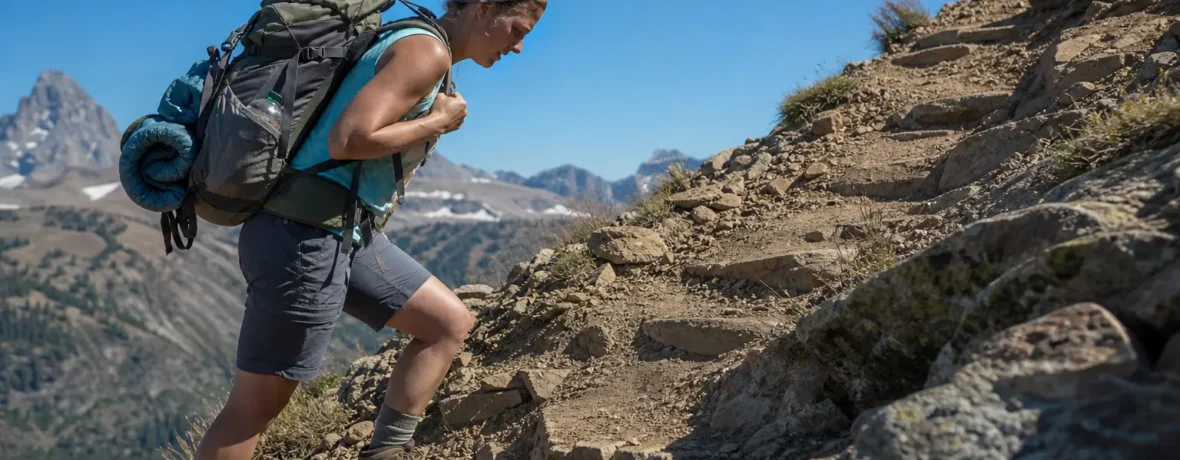
How many calories does hiking burn? Using MET estimates, hiking burns 250–700 calories per hour for most adults. A 150 lb [68 kg] hiker burns 429 calories/hour on cross-country trail, 557 with a daypack, and 643 climbing hills with a heavy pack. Grade, load, pace, footing, and breaks change the number fast.
How many calories does hiking burn per hour?
Most trail hikes land between 250 and 700 calories per hour.
The cleaner answer depends on your body weight and the work you are doing. Exercise scientists often estimate energy cost with METs, short for metabolic equivalents. The Compendium of Physical Activities lists hiking, cross-country at 6.0 METs, backpacking or hiking with a daypack at 7.8 METs, and hill climbing with load at higher values.
Use this formula:
Calories per hour = MET × 3.5 × body weight in kg ÷ 200 × 60
| Body weight | Cross-country hiking, 6.0 METs | Daypack hiking, 7.8 METs | Hill/load effort, 9.0 METs |
|---|---|---|---|
| 120 lb [54 kg] | 343 cal/hr | 446 cal/hr | 514 cal/hr |
| 150 lb [68 kg] | 429 cal/hr | 557 cal/hr | 643 cal/hr |
| 180 lb [82 kg] | 514 cal/hr | 669 cal/hr | 772 cal/hr |
| 200 lb [91 kg] | 572 cal/hr | 743 cal/hr | 857 cal/hr |
These are estimates, not lab measurements. They include the energy your body would burn at rest during that hour, so don’t treat them like a perfect “extra calories” score.
How many calories do you burn hiking with a pack?
A pack can add 100–300 calories per hour when it turns a walk into loaded climbing.
The jump is not magic. Weight on your back raises the force your legs need to produce every step, especially uphill. A light 8 lb [4 kg] hydration pack on rolling trail may barely move the needle. A 30 lb [14 kg] overnight pack on a 10% grade is a different animal.
The Compendium lists “backpacking, hiking with a daypack” at 7.8 METs, while cross-country hiking is 6.0 METs. For a 150 lb [68 kg] hiker, that difference is 128 calories per hour: 557 instead of 429.
Pack weight hits harder when you are:
- Climbing sustained grades instead of rolling trail
- Stepping over rocks, roots, snow, or sand
- Using a poorly fitted pack that bounces or pulls backward
- Hiking at altitude, in heat, or into wind
- Carrying more than 20% of your body weight
What affects calories burned hiking the most?
Grade is the biggest trail variable, then pack weight, pace, footing, and stop time.
Flat miles can feel steady. Climbs get expensive. The Compendium lists no-load hill climbing at 5.3 METs for a 1–5% grade at a moderate-to-brisk pace, 7.0 METs for a 6–10% grade, and 8.8 METs for an 11–20% grade at a slow-to-moderate pace. Same body. Same shoes. More slope. More burn.
Terrain matters because hiking is not treadmill walking. A rooty trail forces braking, balancing, side-stepping, and short bursts of power. Loose sand or snow steals energy. Downhill hiking burns less than climbing, but it can trash your quads because every step asks your legs to brake your body and pack.
How do you estimate your hiking calories before a trip?
Use body weight, expected MET level, and moving time.
Do not use total trailhead-to-car time unless you hike without breaks. Lunch on a summit is not the same as grinding up switchbacks.
- Convert your weight to kilograms. Divide pounds by 2.205. Example: 150 lb ÷ 2.205 = 68 kg.
- Pick a MET value. Use 5.3 for normal hiking through fields and hillsides, 6.0 for cross-country hiking, 7.8 for daypack hiking, and 8.8–10.0 for steep climbing.
- Estimate moving time. If your hike takes 4 hours with 45 minutes of stops, use 3.25 hours.
- Run the formula. MET × 3.5 × kg ÷ 200 × minutes.
- Adjust with common sense. Add a buffer for heat, snow, mud, altitude, a heavy overnight pack, or a route with constant step-ups.
Example: a 180 lb [82 kg] hiker on a 3-hour daypack hike at 7.8 METs burns 2,006 calories: 7.8 × 3.5 × 82 ÷ 200 × 180.
Is hiking moderate or vigorous exercise?
Easy trail hiking can be moderate; uphill hiking with a heavy backpack is usually vigorous.
The CDC intensity guide says moderate activity lets you talk but not sing, while vigorous activity leaves you unable to say more than a few words without pausing for breath. The CDC specifically lists hiking uphill or with a heavy backpack as vigorous activity.
That talk test is useful because heart rate can be messy on trail. Caffeine, heat, poor sleep, altitude, anxiety, and dehydration can all push your heart rate around. Your breathing tells the truth quicker.
If you are using hiking as training, aim for a mix:
- Easy base hikes: You can hold a full conversation.
- Steady climbs: You can talk in short sentences.
- Hard pushes: You can manage only a few words.
Does hiking help with weight loss?
Yes, hiking can support weight loss when it helps create a calorie deficit you can repeat.
A single hard hike will not rewrite your body. A steady pattern can. The CDC adult activity guidance recommends 150 minutes of moderate-intensity activity or 75 minutes of vigorous-intensity activity each week, plus muscle-strengthening work on 2 days.
Hiking earns its keep because many people will do it longer than gym cardio. Two hours on a scenic trail feels different from two hours staring at a wall. Still, appetite can roar after big climbs, so pack food on purpose instead of “rewarding” the hike with random snacks later.
Good trail fuel for longer hikes:
- Water plus electrolytes when you sweat heavily
- Carbohydrates for climbs lasting longer than 90 minutes
- Protein after the hike if you are training regularly
- Salty foods for hot days and long efforts
When to see a doctor
Stop hiking and get medical help if you have chest pressure, severe shortness of breath, dizziness, or pain that feels wrong.
Hiking is safe for many people, but hills, heat, altitude, and heavy packs raise the workload. The NIH/NIDDK safety guidance says to stop and seek help for pain, tightness, or pressure in the chest, neck, shoulder, or arm; extreme shortness of breath; dizziness; or sickness during activity.
If you have heart disease, diabetes, high blood pressure, a history of fainting, unexplained shortness of breath, or joint pain that changes your gait, talk with a clinician before you ramp up steep hikes or loaded pack training. The NIH/NHLBI also advises people with heart problems or chronic disease to ask what types of activity are safe for them.
Related reading
- How Many Calories Does Walking Burn vs Hiking?
- How Many Steps in a Mile (Walking vs Hiking)?
- How Many Miles Should You Walk a Day?
- Does Incline Walking Burn Fat?
FAQ
Quick answers, no fluff.
How many calories does a 5-mile hike burn?
A 5-mile hike burns 600–1,800 calories for most adults. A flat 5-mile walk with breaks sits near the low end, while a steep hike with a loaded pack sits near the high end.
Does hiking burn more calories than walking?
Yes, hiking usually burns more calories than walking on level pavement. Uneven ground, climbs, descents, and pack weight raise the workload beyond a normal walk.
Do heavier people burn more calories hiking?
Yes, a heavier body generally burns more calories for the same trail, pace, and time. Moving 200 lb [91 kg] uphill requires more energy than moving 120 lb [54 kg] uphill.
Do trekking poles change calorie burn?
Trekking poles can raise upper-body involvement, but they may also make your pace smoother and reduce leg strain. Treat any calorie difference as secondary to grade, pack weight, and moving time.
Are fitness watches accurate for hiking calories?
Fitness watches give useful estimates, not lab-grade numbers. They can miss pack weight, trail surface, scrambling, wind, and stop time, so expect a margin of error.
What burns more calories: hiking uphill or downhill?
Uphill hiking burns more calories per minute. Downhill hiking usually costs less energy, but it can create more muscle soreness because your legs are braking your body and pack with every step.