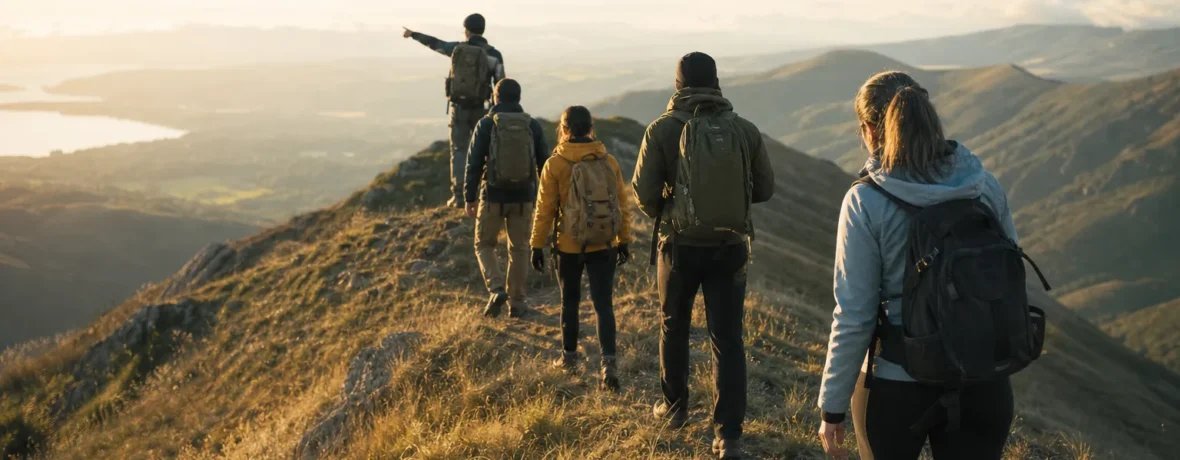
To lead a group hike well, choose a route that fits the least-experienced hiker, cap the group at a manageable size, share a written plan 48 hours ahead, carry the Ten Essentials, set a steady pace, use a sweep hiker, and turn back before small problems become emergencies.
How to lead a group hike step by step?
Start with the people, not the trail.
A strong group hike feels relaxed because the leader did the thinking early. You are not just picking a pretty line on a map. You are matching distance, elevation gain, weather, daylight, trail rules, gear, personalities, and risk tolerance into one plan people can actually follow.
Here is the clean way to run it.
-
Pick the purpose. Is this a social walk, a fitness hike, a beginner-friendly outing, a summit attempt, a birding hike, or a training day? The goal controls the pace and the route.
-
Choose the route for the least-prepared hiker who is still invited. If one person is new, do not plan a 12-mile [19 km] ridge day with 3,000 feet [914 m] of gain.
-
Check current trail conditions. Look at the official land manager page for permits, closures, group-size limits, dogs, parking, fire restrictions, and seasonal hazards.
-
Set a firm meet time, start time, turnaround time, and finish estimate. “Meet at 8:00, boots moving at 8:20” beats “let’s meet in the morning.”
-
Send a short trip brief 48 hours ahead. Include distance, elevation gain, surface, expected weather, bathroom situation, water availability, required gear, and your phone number.
-
Collect basic info. Ask who has medical concerns, allergies, mobility limits, emergency contacts, or no experience with the terrain. Keep it private and simple.
-
Name a sweep hiker. This person stays last and makes sure nobody drifts behind, takes a wrong junction, or quietly suffers.
-
Give a trailhead talk. Cover the route, pace, regroup points, bathroom etiquette, hazards, what to do if separated, and the turnaround rule.
-
Walk at a conversational pace. Put slower hikers near the front, not the back. That keeps the group together without making anyone feel chased.
-
Regroup at junctions, water crossings, viewpoints, and steep climbs. No one passes a junction until the whole group is accounted for.
-
Watch faces, not just mileage. Fatigue shows up as silence, stumbling, irritability, poor decisions, and repeated gear fussing.
-
Finish with a headcount, a quick debrief, and a thank-you. Ask what worked and what should change next time.
How do you choose the right trail for a group hike?
Pick a trail everyone can finish with energy left.
That sounds conservative. Good. Conservative plans make fun group hikes. Hero plans make awkward parking lot apologies.
Look at five things before you commit: distance, elevation gain, trail surface, exposure, and escape options. A 5-mile [8 km] trail on packed dirt is not the same as a 5-mile [8 km] boulder hop with creek crossings. A 1,500-foot [457 m] climb can feel friendly in cool shade and brutal on an exposed south-facing slope in July.
Use this quick comparison when matching the route to the group.
| Group type | Good target | Avoid |
|---|---|---|
| First-time hikers | 2 to 4 miles [3 to 6 km], modest gain, clear trail signs | Scrambling, exposed ridges, confusing junctions |
| Mixed fitness group | 4 to 7 miles [6 to 11 km], bailout options, shaded breaks | One-way routes with no easy exit |
| Experienced hikers | Longer route with clear expectations and firm turnaround time | Vague objectives and loose pacing |
| Families or youth groups | Short loop, bathrooms nearby, frequent stopping points | Steep drop-offs, high heat, long road walks |
Before you post the hike, confirm rules on the official site for that land manager. Group limits vary by park, forest, wilderness area, and even by trail. As of November 2026, the National Park Service page for group hiking at Guadalupe Mountains National Park says day-use hiking groups may not be larger than 20 people on park trails and larger groups need planning and a special permit. That is one park, not a national rule.
For broader planning, the National Park Service Hike Smart guidance is a solid baseline: choose the right trail for your group, pack the Ten Essentials, and put the slowest hiker near the front.
What should you tell hikers before the trip?
Tell them exactly what they are signing up for.
Do not sell the hike like a vacation brochure. Give people the plain facts so they can make a smart yes-or-no decision. A clear trip brief prevents most trailhead surprises.
Send this 48 hours before the hike:
- Trail name and official trailhead location
- Meet time and boots-moving time
- Distance in miles [kilometers]
- Elevation gain in feet [meters]
- Expected pace and estimated finish time
- Terrain: smooth path, rocks, roots, sand, mud, snow, stream crossings, exposure
- Weather forecast and expected high and low temperatures
- Water availability, if any
- Bathroom situation
- Parking pass, entry fee, or permit note, if verified on the official site
- Dog policy, if dogs are invited
- Required gear
- Your phone number and backup contact plan
- Turnaround time
Use direct language. “This hike is not beginner-friendly” is kinder than letting someone suffer for 6 miles [10 km]. “Bring 2 liters of water” is clearer than “bring plenty of water.” “No cotton jeans” is better than hoping people know why wet denim is miserable.
If the hike has a real consequence—heat, snow, altitude, a long descent, no cell service—say that before anyone gets in the car.
What gear should a group hike leader carry?
Carry your own kit plus a few extras for predictable group problems.
Every hiker should bring personal basics. The leader should not become the group’s pack mule. Still, people forget things. Someone will show up with one tiny bottle of water, dead phone battery, no headlamp, or shoes that looked fine in the store.
The National Park Service Ten Essentials are the right foundation: navigation, sun protection, insulation, illumination, first aid, fire, repair kit and tools, nutrition, hydration, and emergency shelter.
As leader, add group-minded extras:
- Paper map or downloaded offline map, plus a power bank
- Small first-aid kit with blister supplies
- Emergency blanket or lightweight shelter
- Extra water treatment method
- Extra snacks with quick calories
- Headlamp, even for a day hike
- Whistle
- Small repair kit: tape, cord, safety pins, multitool
- Group roster and emergency contacts
- Trash bag
- Toilet paper and hand sanitizer
- Satellite messenger or personal locator beacon for remote routes
Tell hikers what they must carry themselves. Water, layers, rain protection, food, medication they normally use, and a headlamp should not live only in the leader’s pack.
How do you keep a hiking group together?
Use structure before people spread out.
Groups separate when the leader assumes everyone heard the plan, knows the route, and walks at the same speed. They do not. Even strong hikers miss turns when they are talking. New hikers stop to adjust laces and then feel embarrassed. Fast hikers float ahead without realizing they have broken the group.
Set these rules at the trailhead:
- No one passes a trail junction until the full group arrives.
- The leader sets or approves the pace.
- The sweep hiker is always last.
- Anyone can call for a short stop.
- If separated, stop at the last known point or the next agreed regroup point.
- No side trips without telling the leader.
Put the slowest steady hiker near the front. That single move solves half of group pacing. It also protects pride. Nobody wants to feel like luggage being dragged up the mountain.
For larger groups, use pods of 4 to 6 people with a mini-lead and a sweep in each pod. Keep pods close enough to regroup at set spots, but not so bunched that the group blocks the trail.
How should you pace a group hike?
Start slower than people want to go.
The first 20 minutes set the day. If the group rockets out of the parking lot, newer hikers may burn matches they need later. A calm opening pace lets legs warm up, breathing settle, and gear issues show themselves early.
Use the talk test. On most casual group hikes, people should be able to speak in short sentences while walking. If half the group is silent and staring at their boots, you are going too fast. If the front is restless, give them jobs: junction marker, photo stop scout, snack reminder, or sweep rotation.
Plan breaks before people are cooked. Short, regular pauses beat one long collapse. Good break spots have room for the whole group to stand off the trail, shade or wind protection when possible, and a clear restart time. Say, “Five minutes here. Packs on at 10:15.” Then move at 10:15.
Use a turnaround time, not just a destination. If the summit is still 1 mile [1.6 km] away at the turnaround time, turn around. The mountain does not care about your group chat.
What safety briefing should you give at the trailhead?
Keep it short, clear, and serious.
A trailhead talk is not a lecture. It is a 3-minute reset that turns a loose crowd into a group.
Cover these points:
- Route: “We are taking the blue-blazed loop clockwise.”
- Distance and gain: “This is 6 miles [10 km] with 1,200 feet [366 m] of climbing.”
- Regroup points: “We stop at every junction and at the creek crossing.”
- Pace: “Comfortable, no racing.”
- Sweep: “Jordan is last all day. If you need to stop, tell Jordan.”
- Hazards: heat, ice, ticks, poison ivy, loose rock, water crossings, wildlife, hunting season, or exposure
- Emergency plan: “If you are separated, stop. Call or text if you have service. Do not wander downhill guessing.”
- Turnaround time: “We turn around at noon, wherever we are.”
- Leave No Trace: stay on durable surfaces, pack out trash, and give wildlife space
For trail impact and etiquette, point hikers to the Leave No Trace Seven Principles. Treat them as practical habits, not trail-police theater.
How do you handle difficult hikers in a group?
Correct behavior early and calmly.
Most problems come from three types: the racer, the complainer, and the underprepared hiker. None require drama. They require leadership.
The racer keeps pushing ahead. Give them a role or a boundary: “Please stop at every junction until the sweep arrives.” If they ignore that, they are no longer hiking with the group.
The complainer drains the mood. Listen once. Fix what can be fixed: pace, break, layer change, snack, blister stop. If the complaint is just noise, keep moving and do not let one person steer the whole day.
The underprepared hiker needs a decision. If they lack water, insulation, shoes, or fitness for the route, change the plan before you leave the trailhead. A shorter hike is not a failure. Dragging someone into a preventable problem is.
Use private corrections when possible. Public shaming makes people defensive. A quiet “Hey, stay behind me on the descent” works better than barking orders in front of 12 people.
What should you do if someone gets hurt or sick?
Stop the group, stabilize the scene, and make a conservative plan.
Do not let the whole group crowd the person. Assign jobs fast: one person manages the group, one assists the injured hiker, one checks location, one prepares to call for help if needed.
For minor problems such as a hot spot, mild nausea, or low energy, stop early. Fixing a blister when it is a warm patch of skin takes 3 minutes. Waiting until it is open skin can end the hike.
For heat stress, confusion, fainting, chest pain, severe allergic reaction, major bleeding, suspected fracture, head injury, or worsening symptoms, treat it as an emergency. Move the person out of immediate danger only if staying put is unsafe. Call 911 when you have service. If you carry a satellite messenger, know how to use the SOS function before the hike.
Ticks are common in many hiking areas. The CDC tick prevention guidance recommends avoiding brushy areas, walking near the center of trails, using EPA-registered repellents, checking clothing and skin after outdoor time, and removing attached ticks promptly with fine-tipped tweezers.
When to see a doctor
Get medical help right away for severe, worsening, or unusual symptoms.
A hike leader should not diagnose people on the trail. Your job is to spot red flags, stop the hike when needed, and help the person reach professional care.
Seek urgent care or emergency help for chest pain, trouble breathing, fainting, confusion, seizure, severe headache after a fall, suspected broken bone, uncontrolled bleeding, symptoms of stroke, severe allergic reaction, or heat illness with altered mental status. Wilderness Medical Society guidance on heat illness emphasizes field stabilization and medical transport for suspected heat stroke when proper field cooling and medical oversight are not in place.
After a tick bite, the CDC advises watching for fever, rash, aches, or other symptoms in the following weeks and contacting a healthcare provider if symptoms develop. Tell the provider where and when the bite likely happened.
How do you end a group hike well?
Finish with accountability, not a slow fade.
The hike is not over when the first person reaches the cars. It is over when everyone is back, safe, and accounted for.
At the trailhead, do a headcount. Ask if anyone needs water, a ride, or help with a blister before people scatter. Thank the sweep. Thank anyone who helped with junctions, photos, morale, or first aid.
Then send a short follow-up later that day:
- “Everyone back safely.”
- Photo link, if there is one
- Lost-and-found note
- Reminder to check for ticks where relevant
- One thing that went well
- Date or idea for the next hike
If something went wrong, write down what happened while it is fresh. Route too hard? Start too late? Group too large? Gear expectations unclear? Fix the system before the next hike.
Related reading
- A Walk in the Woods: Bill Bryson's AT Story vs Reality
- Kids' Hiking Boots: How to Size and When to Buy
- Mountain Porters: The People Who Carry Expeditions
- Teaching Leave No Trace to Kids
FAQ
How many people should be in a group hike?
For casual hikes, 6 to 10 people is usually easiest to manage. Larger groups need a sweep, clearer rules, more regroup points, and sometimes permits or official approval depending on the land manager.
Should the leader hike in front or back?
The leader usually hikes near the front, with a trusted sweep in back. On tricky descents, confusing junctions, or mixed-skill sections, the leader may pause mid-group to watch everyone pass safely.
What is a sweep hiker?
A sweep hiker is the person assigned to stay last. Their job is to make sure nobody falls behind, misses a turn, or deals with a problem alone.
What if someone wants to turn around?
Take the request seriously and do not send them back alone unless the setting is safe, simple, and agreed upon. The better move is to send a capable buddy or adjust the whole group plan.
Do you need a permit to lead a group hike?
Sometimes, yes. Permit rules depend on the park, forest, wilderness area, group size, and whether the hike is commercial, organized, educational, or private, so check the official land manager page before announcing the hike.
What is the biggest mistake group hike leaders make?
The biggest mistake is choosing a hike for the strongest people instead of the whole group. If the route, pace, or weather is wrong for even one invited hiker, the leader owns that problem.