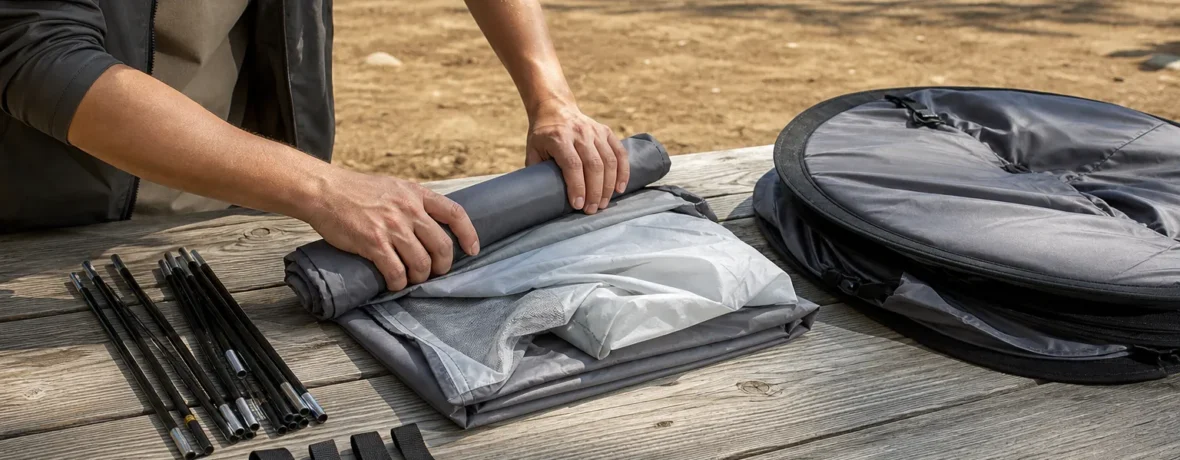
To fold a tent, dry it first, empty all pockets, remove stakes, fold the body to the width of the stuff sack, place the pole bag at one end, roll tightly for 30-60 seconds, and slide it in. For pop-up tents, fold the frame into overlapping circles only after tension is controlled.
How to fold a tent so it fits back in the bag?
Fold it to the bag’s width, then roll around the poles.
That sounds too simple when you’re standing in a windy campsite with damp nylon slapping your shins. Still, that is the trick. The stuff sack is not magic. It is a ruler. Match the folded tent width to the sack length, push air out as you go, and use the pole bag as a stiff core so the roll stays tight.
Before you start, give yourself room. If you packed on a tent pad, use the cleanest dry section of the pad. If you packed on dirt, shake the tent away from your open pack, not over it. Leave No Trace recommends using durable surfaces such as designated tent pads, bare ground, gravel, or rock when camping and handling gear, which also keeps your shelter cleaner during takedown: Leave No Trace durable surfaces guidance.
Step-by-step: folding a standard backpacking or camping tent
- Open the doors and vents. Let trapped air escape. A sealed tent turns into a balloon when you roll it.
- Empty the tent. Check mesh pockets, corners, vestibules, and the footprint. Headlamps and tent stakes love hiding in corners.
- Remove the rainfly. Shake off water, needles, sand, and leaves. If it is wet, drape it over a branch, rock, picnic table, or vehicle for a few minutes while you pack the rest.
- Pull the stakes. Count them. Wipe mud off before they go into the stake bag, or that mud ends up inside your shelter fabric.
- Take out the poles. Push shock-corded poles out of sleeves instead of pulling them. Pushing reduces stress on the cord and ferrules.
- Collapse poles from the middle first. This spreads tension across the shock cord instead of stretching one end over and over.
- Lay the tent body flat. Floor down is fine if the ground is dry. If the floor is wet or muddy, fold it floor-to-floor so grime stays contained.
- Fold long sides inward. Make a rectangle the same width as your stuff sack. For many backpacking tents, that is roughly 18-22 inches [46-56 cm].
- Place the pole bag across one short end. Add the stake bag next to it, unless the stakes are muddy or sharp enough to worry you.
- Roll, don’t wad. Roll toward the far end with steady pressure. Use your forearms, not just your fingertips.
- Add the fly as you roll. If the fly is dry, lay it on top of the tent body before rolling. If it is wet, pack it separately in an outside pocket or plastic bag until you can dry it.
- Slide the roll into the sack. If it jams halfway, pull it out and reroll tighter. Forcing it can strain seams and zippers.
Some manufacturers prefer loose storage at home rather than keeping a shelter compressed. REI’s storage advice says to make sure a tent is dry before storage, while MSR’s tent care instructions warn against packing or storing tents wet, damp, or dirty. Read both if your shelter was expensive: REI tent storage advice and MSR tent care guidance.
Should you fold or stuff a tent?
Roll it for a tight trail pack; store it loosely at home.
Folding gives you control. Stuffing is fast. Both can work in the field, but they solve different problems. If the factory sack is snug, folding and rolling usually wins because it creates an even cylinder. If the sack is oversized, stuffing can reduce hard crease lines and saves time when rain is coming sideways.
The bigger mistake is not fold versus stuff. The bigger mistake is trapping moisture, grit, and pine needles inside the fabric for weeks. A wet tent packed overnight on trail is normal. A wet tent stored in a closet until next month is asking for mildew, odor, sticky coatings, and peeling seam tape.
| Method | Best for | Watch out for |
|---|---|---|
| Fold and roll | Tight stuff sacks, car camping tents, neat packing | Repeated sharp creases if stored folded for months |
| Stuff | Loose sacks, fast rain takedowns, ultralight shelters | Lumpy packing and trapped air if vents are closed |
| Loose storage | At-home storage between trips | Needs a dry, cool space away from direct sun |
How do you pack a wet tent?
Pack it wet only for travel, then dry it the same day.
Rain happens. Condensation happens. Morning dew happens even when the sky is clear. If you wait for perfect dryness every time, you will miss trail miles and annoy everyone in camp.
Here is the practical move: separate wet from dry. Put the wet fly in an outside pack pocket, under a rear compression strap, or inside a waterproof liner away from your sleeping bag and insulation. If the tent body is mostly dry, protect it from the fly. If everything is soaked, pack the whole shelter together and deal with it at lunch or at home.
When you get a dry window, unpack it. Shake it. Turn it inside out. Drape it over a line, railing, clean boulder, or open hatchback. Do not leave it baking in harsh sun for hours if you can avoid it; ultraviolet exposure is rough on fabrics and coatings. Shade plus moving air is your friend.
Wet-tent checklist before it goes in your pack
- Doors and vents open to release air
- Muddy stakes separated from fabric
- Rainfly packed away from sleeping bag
- Footprint shaken clean
- Poles wiped before bagging
- Tent dried fully once you reach home
How do you fold a rainfly and footprint?
Fold the rainfly loosely, and fold the footprint dirty-side-in.
The fly is usually the wettest piece. Treat it like a rain jacket: shake it hard, wipe the worst water off with a bandana, then fold or stuff it where it will not soak critical gear. If the fly is dry, lay it flat over the tent body before rolling everything together.
The footprint is different. Its job is to take abuse. Mud, grit, sap, and sharp debris collect on the bottom side, so fold it dirty-side-in. That keeps the mess contained. At home, unfold it, rinse it if needed, and dry it completely before storage.
If your tent uses a separate groundsheet and you are packing in sand or volcanic grit, do not roll that grit tightly against lightweight tent fabric. Sand acts like sandpaper. Give the footprint its own quick shake and, when needed, its own bag.
How to fold a pop up tent without bending the frame?
Control the frame, make one taco shape, then twist it into circles.
Pop-up tents are brilliant until takedown. Then they feel like a wrestling match with a spring-loaded beach umbrella. The frame wants to move. Your job is not to overpower it. Your job is to guide the tension in the right order.
Use the instructions for your exact model when you have them. Coleman’s pop-up tent instructions tell users to grasp the product firmly with both hands and make sure no people or breakable objects are nearby before folding: Coleman pop-up tent setup and folding instructions. That warning is there for a reason. The frame can spring open fast.
Step-by-step: collapsing a typical round pop-up tent
- Clear the area. Move kids, dogs, mugs, trekking poles, and sunglasses away from the tent.
- Open the door. Let air escape. A zipped tent fights you.
- Remove stakes and guy lines. Never twist a pop-up while it is still pinned to the ground.
- Shake out debris. Tip the opening downward and brush out sand, leaves, and crumbs.
- Bring the two side edges together. The tent should flatten into a large taco or clamshell shape.
- Stand it on one edge. Keep one hand high and one hand low so the frame cannot spring sideways.
- Fold the top edge downward. Push the upper arc toward your lower hand.
- Twist inward. The flexible frame should begin forming two or three smaller circles.
- Stack the circles. Guide them on top of each other instead of forcing them.
- Hold the bundle with one knee or hand. Slip the strap or sleeve over it before releasing pressure.
- Bag it flat. Do not cram a half-twisted frame into the case. Reset and try again if the circles are uneven.
If the frame resists, stop. Back up one step. Most pop-up damage happens when someone forces a twist while one loop is crossed the wrong way. You should feel spring tension, not a hard kink.
Why won’t my tent fit back in its stuff sack?
It is usually trapped air, poor width, or wet fabric.
Factory stuff sacks can be tight, but they are not usually impossible. The tent fit once. The question is what changed in the field.
Start with air. Open every door and vent. Then check the width. If your folded rectangle is wider than the stuff sack is long, the roll will bulge at both ends. Refold it narrower and roll again.
Wet fabric also packs larger. So does cold fabric. A damp fly can cling to itself and trap pockets of air inside the roll. If your shelter is wet, stop chasing a perfect factory pack. Get it small enough to carry, keep it away from dry insulation, and do the tidy pack later.
Fast fixes when the bag is winning
- Use the pole bag as a rolling core.
- Roll from the door end so air escapes through open vents.
- Keep the rainfly separate if it is wet.
- Loosen the stuff sack compression straps before loading.
- Turn the sack sideways and feed the roll in gradually.
- Replace the factory sack with a slightly larger one for real trail use.
How do you clean a tent before folding it?
Shake it first, spot clean only what needs it, then dry it fully.
Most tents do not need a full wash after every trip. They need grit removed, mud wiped off, and moisture gone. Use a soft sponge or cloth with clean water for dirty spots. Skip household detergents unless your tent maker says otherwise; strong cleaners can be rough on water-repellent finishes and coatings.
Pay attention to zippers. Dirt in a zipper track causes snags and tooth wear. Brush or rinse the grit out before the tent goes into storage. Same with pole tips, clips, and grommets. Tiny grit causes big irritation next trip.
Drying takes longer than people think. Webbing loops, seams, pole sleeves, and reinforced corners can stay damp after the broad fabric panels feel dry. Flip the tent. Open it. Let air reach the slow spots.
What mistakes damage tents during folding?
Sharp force, trapped moisture, and dirty storage do the most damage.
A tent is tough in the wind but surprisingly easy to hurt in your hands. A bent pole section, kinked pop-up frame, or gritty floor can shorten its life fast.
- Yanking poles through sleeves: Push poles out instead. Pulling separates sections and stresses the shock cord.
- Rolling stakes against fabric: Stake tips can scrape coatings or poke mesh. Use a stake bag.
- Forcing zippers closed: If the packed tent is bulging, reroll it. Do not use the zipper as a clamp.
- Long-term wet storage: Mildew and coating damage are hard to reverse.
- Hard creases in the same place: For long storage, keep the tent loose instead of tightly folded.
- Twisting pop-up frames blindly: If the loops are not stacking naturally, reset the fold.
What should you do when you get home?
Unpack the tent, dry every piece, and store it loose.
This is the step that saves money. Not glamorous. Not exciting. Very real.
Set the tent up in a garage, spare room, shaded yard, covered porch, or anywhere with airflow. Separate the fly, body, footprint, poles, and stakes. Let the fabric dry until seams, corners, and webbing are dry to the touch. Then store the fabric loosely in a large breathable sack, cotton storage bag, mesh laundry bag, or roomy bin with the lid cracked if your storage area is dry and pest-free.
Keep poles and stakes nearby but not jammed into the fabric under pressure. Store everything in a cool, dry place away from direct sunlight, fuel, solvents, and sharp tools. Before the next trip, do a quick pitch at home if the tent has been stored for months. You will catch missing stakes, sticky zippers, and pole issues before they become camp problems.
Related reading
- How to Waterproof a Tent: Seams, Rainfly and Floor
- How to Set Up a Tent Step by Step (Even Alone)
- How to Clean a Tent (Including Mold and Mildew)
- How to Choose a Tent: Capacity, Seasons and Weight
FAQ
Is it better to roll or fold a tent?
Rolling is better when you need the tent to fit neatly in its stuff sack. Folding first gives you the right width, and rolling pushes air out for a tighter pack.
Can you put a tent away wet for one night?
Yes, you can pack a wet tent temporarily during a trip. Dry it fully the same day if conditions allow, and never store it wet at home between trips.
How do you keep a tent from smelling musty?
Dry it completely before storage and remove dirt, leaves, and food crumbs. A musty smell usually comes from moisture trapped in fabric, seams, webbing, or the stuff sack.
Why is my pop-up tent impossible to fold?
The frame is probably twisted in the wrong sequence. Open it back up, clear the fabric from the frame, make the large taco shape again, then guide the loops into stacked circles without forcing a kink.
Should poles go inside the tent roll?
Yes, if the pole bag is clean and the tent design packs that way. The pole bag makes a firm core for rolling, but muddy stakes or sharp items should stay separate from lightweight fabric.