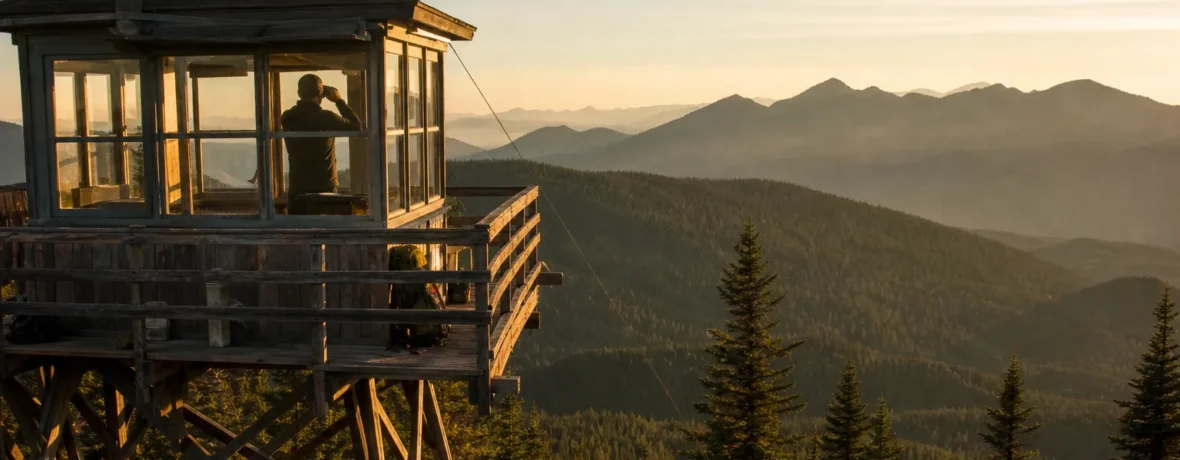
You can become a fire lookout by building outdoor work experience, learning map and radio basics, applying for seasonal Forestry Technician lookout jobs on USAJOBS, and calling local forests before hiring opens. Federal listings often run as GS-4 or GS-5 temporary jobs, with seasonal starts in spring or early summer.
If the job lives in your head like a clean line of peaks at sunset, good. Fire lookout work is real, rare, and still needed in places where human eyes beat cameras, satellites, and aircraft for fast smoke reports. It is also not a paid mountain vacation. You are there to detect fire, report it cleanly, track weather, handle a radio, keep logs, answer visitor questions, and stay sharp while alone for long stretches.
What does a fire lookout do?
A fire lookout watches a fixed area for smoke and reports exact information to dispatch.
On a working day, your eyes do the heavy lifting. You scan ridges, drainages, roads, campgrounds, and lightning-strike zones. When you spot smoke, you do not guess wildly or panic. You use a fire finder, maps, known landmarks, compass bearings, and radio procedure to give dispatch usable information.
A current USDA Forest Service lookout job announcement says the work includes using standard fire finders, estimating distance and smoke size, determining map location, reporting azimuth and smoke behavior by radio or telephone, recording daily weather, maintaining logs, relaying messages, and serving as a visitor contact at the lookout station, as of November 2026 on USAJOBS.
- Scan for smoke, lightning strikes, thunderheads, and changing wind.
- Report fire location, smoke color, volume, size, and behavior.
- Record weather observations and daily notes.
- Maintain lookout equipment and keep the station orderly.
- Relay radio traffic for crews, aircraft, dispatch, and nearby lookouts.
- Talk with hikers and visitors without losing focus on the horizon.
The best lookouts are calm and exact. Not dramatic. Not dreamy. Exact.
How to become a fire lookout?
Start by matching your experience to seasonal job requirements, then apply early and follow up with the local forest.
- Learn the job titles. Search for “Forestry Technician (Lookout),” “fire lookout,” “lookout,” and “0462 Forestry Technician.” Some state agencies use different titles, so search broadly.
- Create a USAJOBS profile. Federal Forest Service jobs are posted through USAJOBS; the Forest Service states that USAJOBS is the official location for competitive service position announcements on its job opportunities page.
- Build qualifying experience. Trail work, conservation corps, ranch work, landscaping, dispatching, visitor services, fire prevention, outdoor education, radio use, map work, and volunteer lookout time can all help when they match the duties.
- Write a plain, evidence-heavy resume. Spell out hours per week, dates, tools used, radio systems, map skills, weather logging, public contact, maintenance, and remote work.
- Call the district. A short call to the ranger district or fire management office can tell you which towers are staffed, which seasons are realistic, and what the hiring manager values.
- Apply before the closing date. Seasonal fire hiring can move early. The Forest Service FAQ says applicants should think about wildland fire hiring as early as September because many announcements close in October, as of January 2026.
- Be flexible on location. If you only want one famous tower near a trail town, your odds shrink. If you can work in California, Idaho, Oregon, Montana, Washington, Arizona, New Mexico, Colorado, or South Dakota, your odds improve.
- Prepare for the interview. Expect questions about being alone, radio communication, visitors, safety, smoke reporting, weather, and staying alert during slow hours.
What qualifications do you need to be a fire lookout?
You need enough outdoor, natural-resource, fire, dispatch, or related work experience to meet the specific job announcement.
Federal lookout postings are not all identical, so read the announcement line by line. For one Forest Service GS-4 Forestry Technician (Lookout) listing, applicants needed six months of general experience and six months of specialized experience, or two years of related study with at least 12 semester hours in fields such as forestry, agriculture, range management, conservation, wildlife management, watershed management, soil science, natural resources, outdoor recreation management, forest engineering, or wildland fire science, as of November 2026.
| Background | Why it helps | How to describe it |
|---|---|---|
| Trail crew or conservation corps | Shows you can work outdoors, use tools, follow safety rules, and live simply. | List tools, terrain, miles hiked, saw work if applicable, crew size, and season length. |
| Dispatch, radio, or emergency services | Shows calm communication under pressure. | List radio protocols, logging duties, incident support, and shift length. |
| Visitor services or ranger work | Shows public contact skills at busy sites. | List questions handled, safety messaging, permits checked, and interpretive work. |
| Forestry, fire, or natural resources classes | Can help meet education-based qualifications. | Upload transcripts if the announcement requires them. |
You do not need to be a smokejumper. You do need to prove you can observe, report, maintain focus, live remotely, and handle public contact without getting sloppy.
Do fire lookouts need wildland fire training?
Some lookout jobs may require fire training, and fireline-qualified roles have stricter requirements.
Read the specific job posting. A lookout stationed in a tower may not have the same requirements as a fireline position, but any role tied to wildland fire can come with agency training, safety standards, and fitness expectations. The Forest Service FAQ says fire support personnel complete classes, task books, and other steps before being issued a red card, while qualified Type 1 or Type 2 firefighters must pass the arduous Work Capacity Test.
For the Firefighter Type 2 qualification, the National Wildfire Coordinating Group lists required training such as ICS-100, IS-700, L-180, S-130, S-190, and RT-130 for returning firefighters, with an arduous fitness level, as of October 2026 on NWCG. Do not claim a red card, S-130, S-190, or any NWCG course unless you actually have the certificate or agency record.
If you are new, these skills help before you apply:
- Map reading with USGS topo maps.
- Compass bearings and triangulation basics.
- Radio discipline: short, clear, no chatter.
- Weather observation: wind direction, cloud build-up, visibility, storm movement.
- Basic maintenance: propane systems, shutters, steps, antennas, water storage, cleaning.
- Backcountry judgment: lightning, rough roads, heat, smoke, bears, and evacuation routes.
How much do fire lookouts get paid?
Federal seasonal lookout pay is usually hourly and depends on grade and location.
As of November 2026, current USDA Forest Service temporary Forestry Technician (Lookout) postings on USAJOBS showed GS-4 listings starting at $17.82 per hour and GS-5 listings starting at $19.52 per hour. The same posting notes that pay rates vary by location, and that the displayed rate can be the “Rest of U.S.” locality rate.
That is the federal picture. State agencies, local fire districts, contractors, and volunteer programs may work differently. Some paid positions include government housing or a remote duty station; others do not. Do not assume the tower is your free cabin unless the announcement or hiring manager says so.
| Path | Pay | Best for |
|---|---|---|
| Federal seasonal lookout | Hourly GS wage, verified in the job announcement | People seeking paid seasonal fire work |
| State agency lookout | Varies by state and posting | Applicants who can work outside federal hiring cycles |
| Volunteer lookout host | Usually unpaid | Building experience and serving a local forest |
| Lookout rental host or interpreter | Varies by forest, partner group, or agreement | People with visitor-service strengths |
Where do you find fire lookout jobs?
Start with USAJOBS for federal roles, then check state forestry agencies and local forest volunteer pages.
Federal jobs are the cleanest place to start because the announcement tells you the grade, duty locations, opening and closing dates, required documents, and qualifications. Use saved searches. Set alerts. Search in late summer and fall for the next fire season, then check again in winter and spring for re-announcements or hard-to-fill locations.
Use these search terms:
- Forestry Technician Lookout
- Fire lookout
- Lookout
- 0462 Forestry Technician
- Wildland fire lookout
- Fire detection
- Seasonal fire
Also check state forestry or natural resources agencies. California, Oregon, Washington, Idaho, Montana, Arizona, New Mexico, and Colorado have fire-heavy landscapes, but staffing changes by year. Search the state job board, not just general job sites.
Then go local. Call ranger districts. Ask if their lookouts are staffed by paid employees, volunteers, partner organizations, or not staffed. Ask when outreach begins. Ask if they keep an interest list. Be polite and brief. Fire offices get busy fast.
Can you volunteer as a fire lookout?
Yes, some forests use volunteer fire lookout hosts or partner groups.
Volunteering can be the sharpest way to learn the work before you chase a paid tower job. You may not get a lonely mountaintop cabin on day one. You may start by staffing a public lookout, answering visitor questions, watching for smoke, and learning from experienced volunteers.
The San Bernardino National Forest visitor guide lists Fire Lookout Hosts who watch for fire and provide interpretation and visitor information at multiple lookout towers, as of the 2022 Forest Service guide. Other forests use friends groups, historical associations, or local volunteer coordinators. Some lookout restoration projects also run through heritage volunteer programs rather than active fire detection.
When you ask about volunteering, ask these exact questions:
- Are volunteers used for active fire detection or only interpretation?
- Is training provided before the season?
- How many shifts are required?
- Can volunteers log hours for future job applications?
- Is the tower reached by road, trail, or high-clearance route?
- Are there age, background check, radio, or vehicle requirements?
What should you put on a fire lookout resume?
Put proof, not personality.
A federal resume for a lookout job must make the hiring person’s job easy. If the announcement asks for work schedule, hours per week, dates, duties, education, and related experience, give them exactly that. The 2026 Forest Service lookout announcement also says resumes cannot exceed two pages and that transcripts are needed if you use education to qualify.
Good resume bullets sound like this:
- Monitored trailhead and campground use during 40-hour weekly summer season; answered visitor safety questions and logged incidents.
- Used handheld radio to communicate with crew lead across remote work sites; followed call sign and check-in procedures.
- Read topographic maps and GPS tracks for trail maintenance assignments in steep terrain.
- Recorded daily weather, smoke, or visibility observations for outdoor program operations.
- Maintained tools, cleaned facilities, stocked water, and completed end-of-shift written logs.
Weak bullets sound like this: “Love hiking and nature.” Save that for your friends. Hiring staff need evidence.
Is being a fire lookout lonely?
Yes, it can be lonely, and that is part of the screening process.
Some towers see hikers every day. Others may sit at the end of a rough road or a steep trail with long quiet stretches. You may sleep in a small cab, haul water, use an outhouse, cook on a simple stove, and spend days with the same view. Gorgeous can still feel tight after three weeks.
You need to be steady alone. That means you can keep a routine, clean the space, monitor weather, do radio checks, exercise safely, read without vanishing from duty, and stay professional when visitors arrive at the worst moment. If you need constant entertainment, this job will rub the shine off fast.
The good part? You will learn the land in a way most hikers never do. You will know the afternoon wind, the storm track, the dusty road plume that is not smoke, and the drainage where haze pools after sunset.
What gear and skills should you have before lookout season?
Bring the skills the job needs first, then the gear that keeps you comfortable.
Your agency will set official equipment rules, especially for radios, fire gear, vehicles, and personal protective equipment. Do not freelance safety gear. For personal life in a remote post, think practical and dull. Dull is good. Dull keeps you fed, warm, hydrated, and ready when smoke pops at 4:40 p.m.
- Sturdy boots with real tread.
- Layering system for heat, wind, hail, and cold nights.
- Sun hat, sunglasses, sunscreen, and lip balm.
- Headlamp plus spare batteries.
- Paper maps and a compass for practice, even if the job uses digital tools.
- Simple meals that do not require constant refrigeration.
- Water storage plan approved by your supervisor.
- Notebook, pens, and a watch.
- Books, field guides, and quiet hobbies that do not distract from duty.
- First-aid kit for personal use, within agency policy.
Train for stairs, hiking, heat, and carrying loads. The Forest Service FAQ describes the arduous Work Capacity Test for fireline roles as a 3-mile [4.8 km] hike within 45 minutes while carrying a 45-pound [20 kg] pack, and says applicants are encouraged to consult a physician and begin training immediately if applying for a position that requires it. Your lookout posting may or may not require that test, so read the announcement instead of guessing.
Related reading
- Fire Lookouts: Who Works Them and How to Visit
- How to Become a Park Ranger: Education, Steps and Timeline
- How to Become a Forest Ranger
- How to Become a National Park Ranger (NPS)
FAQ
Do fire lookouts still exist?
Yes, fire lookouts still exist, though fewer are staffed than in the early tower era. Some are paid seasonal stations, some are volunteer-staffed, and some historic towers are used for interpretation or rentals.
Can you be a fire lookout with no experience?
Yes, but you still need to meet the job announcement’s qualifications. Outdoor work, volunteer time, natural-resource classes, radio experience, visitor services, and conservation corps work can help you qualify.
When should you apply for fire lookout jobs?
Start looking in late summer and early fall for the next fire season. The Forest Service says seasonal wildland fire applicants should think about hiring as early as September because many announcements close in October.
Do fire lookouts live in the tower?
Sometimes, but not always. Some lookouts live in the cab, some stay in a nearby cabin or guard station, and some commute from a district bunkhouse or town.
Is a fire lookout job safe?
It has real hazards: lightning, wildfire, smoke, rough roads, isolation, heat, wildlife, and falls. The job is safer when you follow agency procedures, maintain communication, keep escape plans clear, and report changing conditions early.
What is the best first step if you want the job?
Create a USAJOBS profile and set saved searches for Forestry Technician (Lookout). Then call forests with staffed towers, ask when they hire, and build a resume that proves outdoor judgment, radio discipline, map skills, and reliability.