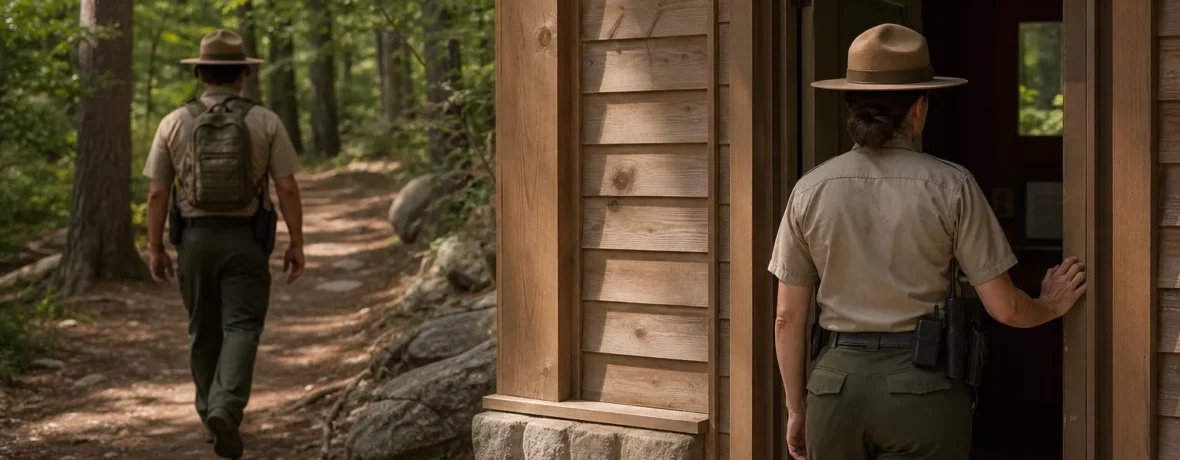
Park ranger vs forest ranger: a park ranger usually protects visitors, resources, and rules inside parks, while a forest ranger usually works across forest lands, roads, trails, timber, fire, permits, and recreation. In the U.S., both jobs vary by agency, but the biggest difference is the land they manage and the mission behind it.
What is the difference between a park ranger vs forest ranger?
The short answer: park rangers focus on parks; forest rangers focus on forests and working public lands.
That sounds tidy. Real life is messier. A park ranger might give a geology talk at 10 a.m., help with a medical call at noon, check a backcountry permit at 2 p.m., and close a trail after rockfall before dinner. A forest ranger might inspect a campground, talk with a grazing permittee, check road damage, support a prescribed burn, and answer questions from hikers staring at a motor vehicle use map like it was written in moon language.
In the federal system, “park ranger” is strongly tied to the National Park Service and other park-managing agencies. “Forest ranger” is often used casually for U.S. Forest Service employees, but inside the agency you will see more specific titles: district ranger, forestry technician, recreation technician, wilderness ranger, fire crew member, law enforcement officer, and forester.
As of November 2026, the National Park Service manages 434 units covering more than 85 million acres. As of November 2026, the U.S. Forest Service manages 154 national forests, 20 national grasslands, and 1 national prairie across 193 million acres. That size difference explains plenty. National forests are bigger, more mixed-use, and full of overlapping activities: hiking, hunting, timber, grazing, climbing, off-highway driving, fire management, and watershed protection.
| Question | Park Ranger | Forest Ranger |
|---|---|---|
| Main setting | National, state, county, or city parks | National forests, state forests, and forest districts |
| Core focus | Visitor safety, interpretation, resource protection, law enforcement, park operations | Forest health, recreation, fire, roads, trails, permits, timber, watershed and land management |
| What hikers notice | Entrance stations, visitor centers, ranger programs, trail patrols, backcountry permits | Ranger districts, dispersed camping rules, fire restrictions, trail crews, road closures |
| Typical public image | Flat hat at a national park overlook | Field staff in a pickup on forest roads and trailheads |
What does a park ranger do?
A park ranger protects the park, helps visitors, and keeps the day from going sideways.
Park ranger work can sit in several lanes. Interpretive rangers teach. They lead walks, explain wildlife behavior, run junior ranger programs, and help visitors understand why a place matters. Protection rangers handle law enforcement, emergency response, search and rescue, traffic, crowd control, and resource protection. Other rangers work in fees, backcountry offices, education, permits, aviation, dispatch, or resource management.
The National Park Service describes visitor and resource protection careers as work that can include preventive law enforcement, incident response, emergency medical services, search and rescue, wildland fire, and aviation in larger or more remote parks. You can read the agency’s own description of NPS visitor and resource protection careers.
For you on trail, a park ranger is often the person who can answer questions like:
- Is this trail open today?
- Do I need a backcountry permit?
- Where are the water sources?
- What should I do if I see a bear, bison, elk, or rattlesnake?
- Can I camp at this site?
- Why is this area closed?
- What is the safest turnaround time for this hike?
Park rangers also deal with the human side of wild places. Lost hikers. Heat illness. Illegal drones. Approaching wildlife. Parking chaos. Trash. A family that underestimated snow at 9,000 feet [2,743 m]. A solo hiker who left the trail without telling anyone. The job can look peaceful from the outside. It is not always peaceful from the inside.
What does a forest ranger do?
A forest ranger manages forest land, recreation, fire concerns, permits, and resource work across large landscapes.
In the U.S. Forest Service world, the term “forest ranger” can mean different things depending on who is talking. A district ranger is a line officer who leads a ranger district and makes land management decisions. A wilderness ranger may patrol trails, check campsites, talk with backpackers, and monitor wilderness impacts. A recreation technician may maintain campgrounds, signs, toilets, and trailheads. A forestry technician may work in fire, timber, silviculture, recreation, wilderness, or research support.
Forest Service land is not managed like a museum behind glass. It is public land with many legal uses. You may see backpackers, mountain bikers, hunters, anglers, ranchers, log trucks, fire crews, volunteer saw teams, and families camped beside a dirt road. That mix is why forest rangers spend so much time on practical land management.
For hikers, forest rangers are the people to ask about:
- Dispersed camping rules
- Seasonal road closures
- Wildfire smoke and fire restrictions
- Trail washouts, blowdowns, and bridge damage
- Wilderness permits where required
- Bear canister or food storage orders in specific forests
- Motorized and nonmotorized trail access
- Maps for complicated forest road systems
A forest ranger may cover far more ground than a park ranger at a single developed park unit. One district can include hundreds of miles of roads, remote trailheads, grazing allotments, timber units, lakes, trail systems, and fire-prone ridges. If you have ever driven 14 miles [23 km] down a washboard road to a trailhead and wondered who keeps that place functioning, this is the world you are in.
Are park rangers and forest rangers law enforcement?
Some are, and some are not.
This is one of the biggest misunderstandings on public land. The uniform does not always mean the same legal authority. Some rangers carry law enforcement authority, wear body armor, make arrests, investigate crimes, and issue citations. Others teach programs, check permits, maintain trails, monitor wildlife, staff visitor centers, or work in fire and resources without being law enforcement officers.
Within the National Park Service, law enforcement rangers go through specific federal law enforcement training. The agency says completion of Ranger-Specific Basic Training and Land Management Police Training is expected to take 18 weeks for NPS law enforcement rangers, as of November 2026.
Forest Service law enforcement is also specialized. The agency has law enforcement officers and special agents, while many recreation or wilderness staff do not have the same authority. Some Forest Service employees may have limited citation authority for specific regulations, but that is not the same as being a full law enforcement officer.
Plain trail translation: if a ranger gives you a safety warning, take it seriously. If a ranger gives you a lawful order during a closure, fire, rescue, wildlife incident, or law enforcement contact, follow it. Arguing at the trailhead is a poor outdoor skill.
Do park rangers and forest rangers work for the same agency?
No, not usually.
Federal park rangers most often work for the National Park Service, which is part of the U.S. Department of the Interior. Federal forest rangers and many forest staff work for the U.S. Forest Service, which is part of the U.S. Department of Agriculture.
State and local governments add more layers. A state park ranger may work for a state parks department. A county park ranger may work for a county parks system. A state forest ranger may work for a state forestry agency. Job titles shift by state, and so does authority.
That is why trail signs matter. A “national park,” “national forest,” “state park,” “state forest,” “wilderness,” “national monument,” and “recreation area” can sit close together on a map but operate under different rules. One road can leave a national park and enter a national forest in minutes. Your dog, campfire, drone, bike, or campsite may be legal on one side and banned or restricted on the other.
Look at the managing agency before you go. Not the nearest town. Not the Instagram caption. The agency.
Which ranger should you ask before a hike?
Ask the ranger tied to the land you will actually hike on.
If your trail starts in a national park, call or visit that park’s visitor center or backcountry office. If your route runs through a national forest, call the local ranger district. If your hike crosses both, contact both. This is common in the West, where a route may begin in a national forest, cross wilderness, and end near a national park boundary.
Use this quick process:
- Find the land manager. Check the official trail page, map, sign, or agency boundary layer.
- Check closures first. Roads, trails, bridges, fire areas, and wildlife zones can close with little warning.
- Ask about permits. Backcountry camping, day hiking, groups, caves, rivers, and overnight parking may have separate rules.
- Ask about current conditions. Snow, heat, smoke, downed trees, water crossings, and washed-out roads change faster than guidebooks.
- Confirm food and fire rules. Bear storage orders and fire restrictions are local and seasonal.
- Get the right map. In national forests, a motor vehicle use map can matter as much as your trail map if you are driving forest roads.
Do not ask a national park ranger to speak for a nearby national forest unless they clearly say they know the current forest conditions. Good rangers will usually point you to the right office. Help them help you by knowing your trailhead name, route, date, party size, and overnight plan.
How do their daily jobs feel different?
Park ranger work often feels visitor-facing; forest ranger work often feels landscape-facing.
That is a broad brush, but it holds up on many hikes. Park rangers frequently work where visitors concentrate: entrances, overlooks, campgrounds, shuttle stops, historic sites, visitor centers, and high-use trails. Forest rangers often work across a wider spread of roads, drainages, trail systems, campsites, timber areas, and fire zones.
A park ranger day might include scheduled talks, crowd questions, permit checks, emergency calls, wildlife jams, and traffic issues. A forest ranger day might include checking dispersed campsites, documenting illegal fire rings, clearing a sign corridor, inspecting a damaged road, talking to hunters, and reporting smoke.
Both jobs can involve long hours outside. Both can include paperwork. Yes, paperwork. Public land runs on field notes, incident reports, permits, environmental compliance, maps, staffing plans, and maintenance logs. The romantic version is all sunsets and radios. The real version includes wet boots, hard conversations, and a computer waiting back at the office.
Who manages trails, campgrounds, and permits?
The managing agency does, and the ranger you meet may only handle one slice of that system.
In a national park, trail crews may work separately from interpretive rangers. Fee staff may not issue backcountry permits. Law enforcement rangers may not be the best people to ask for plant identification. A volunteer at the desk may know the shuttle schedule cold but not the latest climbing closure. Ask the right desk, not just the first uniform.
In a national forest, the local ranger district is often your best starting point. District staff usually know the roads, trailheads, campgrounds, fire restrictions, and wilderness rules for their area. For permits, you may need a district office, a forest website, or a reservation system, depending on the place and season.
Here is the hiker’s cheat sheet:
- National park trail question: park visitor center, backcountry office, or official park website.
- National forest trail question: local ranger district office or official forest website.
- Campground reservation question: the reservation provider or the listed campground manager.
- Dispersed camping question: local forest ranger district.
- Emergency: call 911 when service exists, then contact the managing agency if safe to do so.
How do you become a park ranger or forest ranger?
You build the right mix of education, field experience, fitness, people skills, and agency-specific training.
There is no single magic degree. Park ranger jobs may value natural resources, history, interpretation, education, criminal justice, recreation management, emergency medicine, or public administration, depending on the role. Forest ranger and forestry jobs may value forestry, natural resources, fire science, wildlife biology, recreation management, hydrology, soils, GIS, or range management.
The U.S. Bureau of Labor Statistics groups many related professional roles under conservation scientists and foresters. As of November 2026, BLS says conservation scientists and foresters typically need a bachelor’s degree, and it lists median annual wages from May 2025 as $73,010 for conservation scientists and $76,400 for foresters. See the BLS profile for conservation scientists and foresters for the current federal summary.
Seasonal jobs are common entry points. Many people start as fee staff, trail crew, interpretive interns, campground staff, biological technicians, forestry technicians, fire crew members, or volunteers. Then they stack experience. Chainsaw certification. Wilderness first aid. EMT. GIS. Spanish. Public speaking. Backcountry travel. Conflict de-escalation. Fire qualifications. Search and rescue. The useful skills depend on the job track.
If you want law enforcement, expect a separate path with medical standards, background checks, academy training, and agency requirements. If you want interpretation, learn how to make geology, ecology, history, and safety stick in a tired visitor’s brain in 90 seconds. If you want forest management, get comfortable with maps, policy, field measurements, weather, fire, roads, and competing public demands.
Which job is better for hikers?
Neither is better; they help hikers in different ways.
A park ranger is often your best contact when you are hiking in a national park or other formal park unit with tight visitor management. Think permits, sensitive wildlife zones, shuttle systems, popular trail corridors, historic sites, and well-defined park boundaries.
A forest ranger is often your best contact when your hike involves forest roads, dispersed camping, wilderness access, fire restrictions, seasonal gates, or a trail system spread across a national forest. If the route description says “drive 8 miles [13 km] on Forest Road 317,” you want forest office information, not guesses from a comment thread.
The smartest hikers do not treat rangers like walking search engines. They arrive prepared, ask focused questions, and listen when the answer changes the plan. A ranger saying “that road is still snowed in” is not ruining your trip. They are saving you from spending the afternoon high-centered in slush with no cell service.
What should you ask a ranger before heading out?
Ask questions that change decisions.
Skip vague questions like “Is it good?” Good for whom? A trail runner, a family with kids, a heat-tolerant desert hiker, and a first-time backpacker will give four different answers. Ask for current, specific, useful information.
- Is the full route open?
- Are any roads to the trailhead gated, washed out, or snow-covered?
- Is there reliable water on the route right now?
- Are there active fire restrictions?
- Are bear canisters, food hangs, or hard-sided storage required?
- Are dogs allowed on this trail?
- Do I need a day-use, overnight, parking, wilderness, or group permit?
- What time do storms, heat, tides, or river crossings become a problem?
- Where do hikers usually get off route?
- What is the best backup hike if this plan fails?
That last question is gold. Rangers know the backup hikes. They know the less glamorous trail that drains better after rain, the shaded route on a hot day, and the road that eats low-clearance cars. Use that knowledge.
Related reading
- National Park vs National Forest vs BLM Land
- How to Become a Park Ranger: Education, Steps and Timeline
- What Does a Park Ranger Do? A Day in the Job
- The Park Ranger Hat: History of the Flat Hat
FAQ
Is a forest ranger higher than a park ranger?
No. They are different job families, not ranks on the same ladder. A district ranger in the Forest Service may be a manager, while a park ranger may be seasonal, permanent, interpretive, law enforcement, supervisory, or specialized.
Can a park ranger arrest you?
Yes, if that ranger is a commissioned law enforcement ranger with the authority to do so. Many park rangers are not law enforcement officers, so their authority depends on job type, agency, and jurisdiction.
Can a forest ranger give tickets?
Some can. Forest Service law enforcement officers and certain authorized personnel may issue citations, while other forest staff focus on recreation, trails, fire, timber, or visitor information.
Do park rangers fight wildfires?
Some do. Park agencies and the National Park Service have wildland fire staff, and some rangers have fire qualifications, but not every park ranger is a firefighter.
Who should I call for dispersed camping rules?
Call the local ranger district if you are camping in a national forest. Dispersed camping rules can change by forest, district, road, season, fire restriction, and resource concern.
Are park rangers and forest rangers good sources for trail conditions?
Yes, when you contact the office that manages the land you plan to use. Rangers may not have walked your exact trail that morning, but they often have the best official picture of closures, hazards, permits, and access.