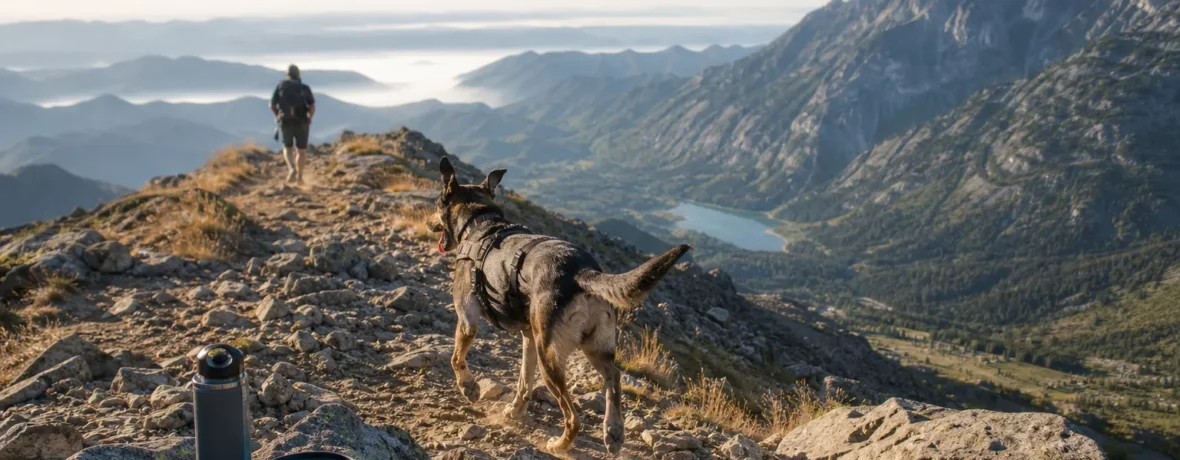
Most healthy adult dogs can hike 5 to 10 miles [8 to 16 km] in a day, while fit trail-seasoned dogs may handle 15 to 20 miles [24 to 32 km]. The real answer to how far can a dog hike depends on age, breed, heat, terrain, paw condition, and training.
How far can a dog hike in a day by age and fitness?
A safe daily range is 1 to 20 miles [1.6 to 32 km], depending on the dog.
That sounds wide because dogs are not one-size-fits-all hikers. A lean, conditioned 3-year-old herding dog on a cool dirt trail is playing a different game than a 10-year-old bulldog on hot granite. Start with the dog in front of you, not the mileage on your map.
| Dog type | Typical day-hike range | Best use |
|---|---|---|
| Puppy under growth maturity | Short walks and easy outings | Practice, trail manners, sniff time |
| Healthy adult beginner | 2 to 5 miles [3.2 to 8 km] | Easy dirt trails, cool weather |
| Fit adult hiker | 5 to 10 miles [8 to 16 km] | Most day hikes |
| Conditioned endurance dog | 10 to 20 miles [16 to 32 km] | Long days, only with training |
Distance is only one number. Elevation gain, sun exposure, humidity, footing, water access, and pack weight can turn a 6-mile [9.7 km] hike into a hard day. If the trail is rocky, sandy, icy, or hot enough to bother your hand on the ground, cut the plan down.
Can a dog hike 10 miles?
Yes, many healthy adult dogs can hike 10 miles [16 km] after training.
Do not make 10 miles the first real hike. Build to it. A dog with strong paws, good leash manners, steady energy, and normal recovery the next day is a better candidate than a weekend-only couch sprinter who explodes for the first mile and wilts by lunch.
For a 10-mile day, choose a route with bailout options. Plan water stops. Keep your dog close enough that you can see changes in gait, breathing, and focus. A dog that starts lagging, seeking shade, lying down, stumbling, or ignoring treats is telling you the day is getting too big.
How far is too far for a dog to hike?
Too far is the point where your dog cannot move comfortably, cool down, or recover normally.
Some dogs will quit early. Others will keep going because you keep going. That second group is risky. High-drive dogs can push past sore paws, heat stress, and fatigue because the trail is exciting and you are still moving.
Turn around early if you see:
- Limping, toe-dragging, or a shortened stride
- Repeated sitting or lying down
- Heavy panting that does not ease during breaks
- Glazed eyes, wobbling, confusion, or weakness
- Refusing water or treats when normally interested
- Cracked, bleeding, or peeled paw pads
- Vomiting, diarrhea, or collapse
Heat changes the math fast. The CDC’s Heat and Pets guidance recommends protecting pets on hot days and checking local HeatRisk conditions. For people on the same hike, the Wilderness Medical Society heat illness guidelines describe heat stroke as a medical emergency marked by high body temperature and central nervous system symptoms such as confusion, seizure, or coma.
What affects how far your dog can hike?
The biggest factors are conditioning, heat, terrain, breed, age, and recovery.
Here is the straight trail breakdown:
- Age: Puppies need short, gentle outings. Seniors may still love trails, but they often need shorter mileage and longer breaks.
- Breed and build: Long-legged working and sporting breeds often handle distance better than short-nosed, heavy-bodied, or very small dogs.
- Weather: Cool, dry air helps. Heat and humidity punish dogs because they mainly cool themselves by panting.
- Terrain: Soft dirt is kind. Sharp talus, lava rock, crusty snow, and hot pavement are not.
- Paws: Tough pads are earned slowly. Booties can help, but only if your dog has practiced in them before the hike.
- Weight: Extra body weight makes climbs, descents, and heat harder.
- Trail rules: Many public lands restrict where dogs can go. In national parks, pets must be restrained on a leash no longer than 6 feet [1.8 m] where allowed, as of November 2026, according to the National Park Service pet guidance.
How do you train a dog for longer hikes?
Build mileage slowly over several weeks.
Your dog needs trail fitness, paw toughness, and calm trail behavior. All three matter. A dog that can run in a yard for 30 minutes is not automatically ready for 8 rocky miles [12.9 km] with stream crossings and 2,000 feet [610 m] of climbing.
- Start with a baseline walk. Pick an easy 1- to 2-mile [1.6 to 3.2 km] route and watch your dog during the walk and the next morning.
- Add distance in small jumps. Increase total mileage by 1 to 2 miles [1.6 to 3.2 km] when your dog finishes strong and recovers well.
- Train on trail surfaces. Mix in dirt, roots, gravel, boardwalks, and gentle climbs before committing to a big mountain day.
- Practice breaks. Teach your dog to drink, eat a small snack, settle, and restart without chaos.
- Test gear early. Harnesses, packs, booties, and cooling vests should be old news by hike day.
- Schedule rest. After a long hike, give your dog an easy day and check paws, nails, shoulders, hips, and attitude.
How much water should a dog carry on a hike?
Carry more than you think your dog will drink.
A practical starting point is 1 quart [0.95 L] for every 3 to 5 miles [4.8 to 8 km] for a medium dog in mild weather, then add more for heat, dry air, climbing, or a larger dog. Do not count on streams. They may be dry, muddy, frozen, contaminated, or off-limits.
Use a collapsible bowl and offer water often. Small, frequent breaks beat waiting until your dog is desperate. If your dog wears a pack, keep it light and balanced, and remove it during hot breaks so heat can escape.
What should you pack for hiking with a dog?
Pack water, food, waste bags, leash control, and first-aid basics.
- Leash, harness, and ID tags
- Extra water and a collapsible bowl
- Dog food or trail snacks
- Waste bags, plus a way to carry them out
- Tick remover or fine-tipped tweezers
- Dog booties or paw wax for rough terrain
- Small towel for mud, cold, or creek crossings
- Basic first-aid kit with bandage material
- Current photo of your dog on your phone
Ticks deserve a hard look after every hike. The CDC says dogs are very susceptible to tick bites and tickborne diseases, and pets can bring ticks into the home; use veterinarian-recommended prevention and check pets daily after outdoor time through the CDC’s tick prevention guidance for pets.
When to see a doctor
Call a veterinarian for your dog, and call a doctor for yourself if symptoms are severe, unusual, or getting worse.
For your dog, contact a veterinarian promptly after a hike if you see collapse, repeated vomiting, trouble breathing, severe weakness, bloody diarrhea, a deep cut, a swollen painful joint, a snakebite, or signs of heat stress that do not quickly improve after stopping and cooling. Do not diagnose on the trail, and do not give human medication unless a veterinarian tells you to.
For you, get medical help if you develop confusion, fainting, chest pain, severe dehydration symptoms, or a spreading rash after a tick bite. Mayo Clinic’s Lyme disease overview lists rash, fever, chills, fatigue, body aches, headache, neck stiffness, and swollen lymph nodes among possible symptoms.
Related reading
- Dog Hiking Gear Checklist
- Best Dog Breeds for Hiking
- How Far Can Kids Hike by Age?
- Best Dog Hiking Gear
FAQ
Can dogs hike 20 miles in a day?
Yes, some conditioned adult dogs can hike 20 miles [32 km] in a day. That distance is for fit dogs with gradual training, cool conditions, durable paws, and a route with reliable water and exit options.
How far can a puppy hike?
A puppy should stick to short, gentle outings rather than long hikes. Ask your veterinarian about safe activity for your puppy’s breed, size, growth stage, and vaccination status before using public trails.
Are small dogs good hiking dogs?
Yes, many small dogs hike well. They may need shorter mileage, help over obstacles, and extra warmth in cold weather, but fitness and trail sense matter more than height.
Should my dog wear a backpack?
A dog can wear a backpack if it is healthy, fully grown, trained, and comfortable with the fit. Keep the load light, balance both sides, and skip the pack in hot weather or on very rough trails.
How do I know my dog is tired on a hike?
A tired dog may lag behind, lie down, pant heavily, stumble, ignore cues, or lose interest in food and water. Stop early when those signs appear; pushing for the summit is not worth a paw injury or heat emergency.