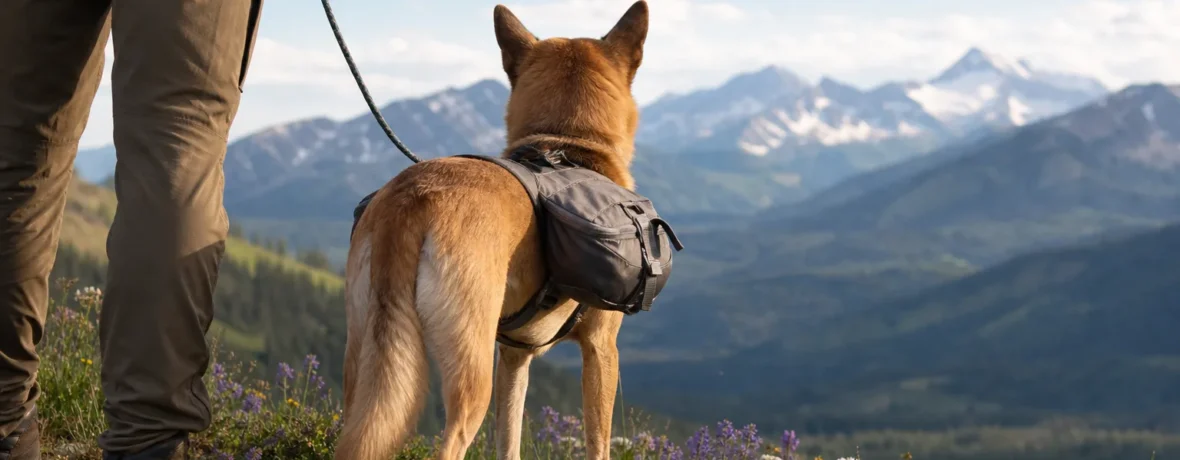
The best dog hiking backpack for most trail days is the Ruffwear Approach Pack: it carries 5–21 L by size, weighs 0.73–1.3 lb [0.33–0.59 kg], rides forward over the shoulders, and has enough structure for water, food, bags, and a bowl without tempting you to overload your dog.
We may earn a commission when you buy through links on this page.
Quick Picks
| Category | Model | Weight | Key feature |
|---|---|---|---|
| Best overall, mid-range | Ruffwear Approach Dog Backpack | 0.73–1.3 lb [0.33–0.59 kg] | Balanced day-hike volume |
| Best multi-day, premium | Ruffwear Palisades Pack | 15 oz–1 lb 11 oz [0.43–0.77 kg] | Removable saddlebags |
| Best rugged value, mid-range | Mountainsmith K9 Dog Pack | 16–22.5 oz [0.45–0.63 kg] | Durable nylon build |
| Best budget | Kurgo Baxter Dog Backpack | 1.1 lb [0.5 kg] | Eight adjustment points |
| Best ultralight, premium | DOGPAK Moab Lite Dog Backpack | Not listed | Water-resistant, low-bulk design |
| Best expedition, premium | Non-stop Dogwear Amundsen Pack | 22.2–50.1 oz [630–1420 g] | 15–55 L capacity |
| Best tactical-style, budget | OneTigris MAMMOTH Dog Pack | 16.58–21.16 oz [470–600 g] | 3 L side pouches on size M/L |
| Best simple carry, budget | AlphaPak Adventure 1-Piece Dog Pack | Not listed | Fast EZ Fit straps |
| Best harness, mid-range | Ruffwear Flagline Harness | Not listed | Lift handle and six adjustments |
| Best boots, premium | Ruffwear Grip Trex Dog Boots | 1.6 oz [45 g] | Vibram outsole |
How we chose
We chose by fit, carry design, materials, specs, verified owner feedback, and expert reviews. This guide is research-based: we compared current product pages, size charts, materials, owner-review patterns on brand pages, and expert dog-gear reviews from sources that publish named testing methods.
For packs, the first cut was stability. A dog pack that swings side to side is worse than no pack. The second cut was fit range. Dogs are not scaled-down humans: a deep-chested pointer, compact cattle dog, and barrel-bodied lab may all weigh 50 lb [23 kg] and still need different geometry. The third cut was restraint. Huge volume looks useful online, then becomes a problem when you fill it because there is space left.
We also gave extra credit to packs with clear weight and capacity specs, replaceable or removable bags, balanced saddle placement, visible trim, and easy cleaning. For supporting gear, we looked for the same thing you should: products that solve trail problems without creating new ones.
What is the best dog hiking backpack?
The Ruffwear Approach is the best dog hiking backpack for most day hikes and light overnights. It has a wide size range, 5–21 L of capacity depending on size, a stable harness-style chassis, and enough volume for the dog’s own water, snacks, waste bags, and a collapsible bowl.
Ruffwear Approach Dog Backpack – Best for most trail days
The Approach suits hikers who want one pack for everyday trail use and short backpacking trips. It is roomy without being huge, structured without feeling clunky, and easier to justify than an expedition pack if most of your outings are single-day hikes.
- Weight: 0.73–1.3 lb [0.33–0.59 kg]
- Capacity: 5, 10, 13, or 21 L by size
- Fit range: 17–42 in [43–107 cm] girth
- Best use: Day hikes, big day hikes, light overnights
Pros
- Good capacity-to-weight balance.
- Weight-forward saddlebags help keep loads over the shoulders.
- Four sizes cover many medium and large dogs.
- Reflective trim and light loop help with low-light visibility.
Cons
- Saddlebags do not detach like the Palisades.
- Still too much pack for tiny dogs or short neighborhood walks.
- Soft items pack better than rigid bottles.
- Fit can be awkward if your dog sits between girth sizes.
Skip it if… you want removable saddlebags for camp or you regularly need expedition-level volume.
Ruffwear Palisades Pack – Best for multi-day backpacking
The Palisades suits dogs that already wear a pack well and need more organization for overnights. Its big win is the modular setup: the saddlebags come off, leaving a standalone harness on your dog for breaks, creek stops, and camp wandering.
- Weight: 15 oz–1 lb 11 oz [0.43–0.77 kg]
- Capacity: 5, 10, 13, or 21 L by size
- Fit range: 17–42 in [43–107 cm] girth
- Best use: Multi-day backpacking
Pros
- Removable saddlebags make breaks much easier.
- Standalone harness has a handle and leash points.
- High-volume design works for food, a bowl, and soft camp items.
- Six adjustment points help dial in fit.
Cons
- Heavier than the Approach.
- Premium build means premium price tier.
- Big capacity can tempt you to pack too much.
- Overkill for short hikes.
Skip it if… your dog is new to packs or you rarely hike beyond half-day loops.
Mountainsmith K9 Dog Pack – Best for rugged value
The Mountainsmith K9 is for dogs that need a tough, traditional saddlebag pack without premium-pack fuss. The official specs list 420d and 630d nylon fabrics, three sizes, and total capacity that scales from 6 L to 18 L across paired panniers.
- Weight: 16, 19, or 22.5 oz [0.45, 0.55, or 0.63 kg]
- Capacity: 6, 10, or 18 L total by size
- Fit guide: Small for 20–50 lb [9–23 kg] dogs; medium for 40–90 lb [18–41 kg] dogs
- Best use: Rugged day hikes and value-focused backpacking
Pros
- Durable fabric package for brushy trails.
- Good volume on the large size.
- Simple design is easy to understand.
- Strong choice when you want mid-range value.
Cons
- Less refined than Ruffwear’s pack chassis.
- Fewer size options than some competitors.
- Pannier balance matters; uneven loads can pull the pack sideways.
- Not the sleekest pick for narrow trails.
Skip it if… you need a tiny-dog fit or removable saddlebags.
Kurgo Baxter Dog Backpack – Best for budget pack users
The Kurgo Baxter suits larger dogs and budget-minded hikers who want a real pack, not a costume. It has two saddlebag compartments, a padded top handle, reflective trim, and eight adjustment points for a closer fit.
- Weight: 1.1 lb [0.5 kg]
- Fit range: Baxter for 30–85 lb [14–39 kg] dogs; Big Baxter for 50–110 lb [23–50 kg] dogs
- Chest range: 27–48 in [69–122 cm] depending on size
- Best use: Budget day hiking
Pros
- Budget-friendly compared with premium trail packs.
- Eight adjustment points help tune the fit.
- Padded handle is useful around logs, cars, and rocky steps.
- Lifetime guarantee against manufacturing defects.
Cons
- Not made for small dogs under 30 lb [14 kg].
- Capacity specs are less clear on the official U.S. product page.
- Rear leash attachment is not ideal for strong pullers.
- Less technical than the Approach or Palisades.
Skip it if… your dog is under 30 lb [14 kg] or you want precise published liter capacity before buying.
DOGPAK Moab Lite Dog Backpack – Best for low-bulk wet-weather hikes
The DOGPAK Moab Lite is for hikers who want a small, weather-resistant pack that behaves more like a harness than a bulky saddle rig. DOGPAK lists waterproof-style construction details including taped seams, sealed zippers, reflective trim, seven adjustment points, and Kevlar-reinforced ROBIC nylon ripstop.
- Weight: Not listed
- Sizes: Small, medium, large
- Fit guide: Small for roughly 20–33 lb [9–15 kg], medium for 33–62 lb [15–28 kg], large for 60 lb [27 kg] and up
- Best use: Wet day hikes, low-bulk carry, visibility
Pros
- Low-profile shape reduces snagging.
- Strong weather-resistance story for rain, dew, and creek splashes.
- Highly reflective detailing stands out near roads and campsites.
- Seven adjustment points help with unusual body shapes.
Cons
- Official page does not list pack weight.
- Lower capacity than big backpacking packs.
- Premium tier for a small-volume pack.
- Not the right pick if your dog needs to carry bulky food bags.
Skip it if… you want maximum liter capacity for a multi-night route.
Non-stop Dogwear Amundsen Pack – Best for big-volume expeditions
The Non-stop Dogwear Amundsen Pack suits experienced, conditioned dogs on long trips where high volume matters. It comes in seven sizes, lists 15–55 L of capacity, and uses aramid-reinforced side bags under a ripstop cover.
- Weight: 22.2–50.1 oz [630–1420 g]
- Capacity: 15–55 L by size
- Sizes: 2XS through 2XL
- Best use: High-volume backpacking and winter-style hauling
Pros
- Largest capacity range in this guide.
- Aramid reinforcement helps with rock and brush abrasion.
- Rolltop-style bags on larger sizes handle bulky gear well.
- Designed to carry heavier items forward over the shoulders.
Cons
- Too large for casual hikes.
- Heavy in bigger sizes before you add gear.
- Can be overloaded fast if you fill the available volume.
- Fit uses width over the back, which may feel less familiar than girth sizing.
Skip it if… you want a simple day pack for water and treats.
OneTigris MAMMOTH Dog Pack – Best for tactical-style storage
The OneTigris MAMMOTH suits larger dogs whose humans want durable fabric, big side pockets, and MOLLE-style organization. OneTigris lists 1000D nylon, breathable mesh lining, UTX-Duraflex buckles, and 3 L side pouches on the medium and large sizes.
- Weight: 16.58 oz [470 g] medium; 21.16 oz [600 g] large
- Capacity: 3 L side pouches on M/L; smaller pouches on size S
- Fit range: 25–36 in [64–91 cm] chest on M/L
- Best use: Budget tactical-style day carry
Pros
- 1000D nylon is tough for the price tier.
- Large pouches swallow bulky trail items.
- Breathable mesh lining helps comfort.
- External bungees and loop panels add organization.
Cons
- Tactical layout can feel bulky on tight singletrack.
- Only M and L appear in the current official size selector.
- Not as refined as premium hiking-specific packs.
- Big pockets make unbalanced loading easy.
Skip it if… your dog has a narrow build or you prefer a sleek, backpacking-first design.
AlphaPak Adventure 1-Piece Dog Pack – Best for simple everyday carry
The AlphaPak Adventure 1-Piece suits hikers who want quick setup and sewn-on saddlebags. AlphaPak lists EZ Fit straps, water-resistant construction, a included water bladder, and four chest-girth sizes from 17–42 in [43–107 cm].
- Weight: Not listed
- Fit range: 17–42 in [43–107 cm] chest girth
- Sizes: Small, medium, large, XL
- Best use: Everyday walks, local trails, simple packing
Pros
- Fast strap system is easy for daily use.
- Broad girth range across four sizes.
- Water bladder included.
- Budget tier compared with many technical packs.
Cons
- Official page does not list weight or liter capacity.
- Sewn-on bags cannot be removed at camp.
- Less proven in expert reviews than older pack lines.
- Not a minimalist ultralight option.
Skip it if… you need published capacity numbers to plan food and water precisely.
Ruffwear Flagline Harness – Best for lift-and-assist hiking
The Ruffwear Flagline is the dog hiking harness to buy when your dog needs help over ledges, into vehicles, or across rough approaches. It has a handle, a load-dispersing chest and belly panel, six adjustment points, three leash attachment points, reflective trim, and a debris-resistant liner.
- Weight: Not listed
- Fit range: 13–42 in [33–107 cm] girth
- Sizes: XXS through L/XL
- Best use: Scrambling, lift assist, pack-free hikes
Pros
- Handle gives controlled assistance on obstacles.
- Six adjustment points improve security.
- Three leash points work for different trail manners.
- Light, low-profile feel compared with pack harnesses.
Cons
- No cargo capacity.
- Not a substitute for carrying an injured dog out.
- Dogs between sizes may need careful fitting.
- Full-body panel can run warm in hot weather.
Skip it if… your main goal is letting your dog carry food, water, and waste bags.
Ruffwear Grip Trex Dog Boots – Best for rocky trails and hot ground
The Ruffwear Grip Trex are the dog hiking boots to try first for abrasive rock, sharp gravel, and rough desert trails. They use breathable mesh uppers, a hook-and-loop closure, reflective trim, and a non-marking Vibram outsole with trail lugs.
- Weight: 1.6 oz [45 g]
- Sizes: Eight paw-width sizes from 1.50–3.25 in [38–83 mm]
- Sold as: Sets of two
- Best use: Paw protection on rough, hot, or sharp terrain
Pros
- Vibram sole gives real trail traction.
- Sold in pairs, helpful when front and rear paws differ.
- Mesh upper breathes better than full rubber.
- Strong expert-review track record for durability.
Cons
- Fit must be precise to avoid rubbing.
- Some dogs need training before they walk normally in boots.
- Can hold moisture longer than thin booties.
- Premium tier for paw wear.
Skip it if… your dog only hikes on soft dirt and has never shown paw irritation.
How much dog hiking gear should your dog carry?
Start lighter than you think. A common pack-maker ceiling is 25% of body weight including the pack, but many dogs should carry less, especially beginners, seniors, puppies, compact breeds, and dogs hiking in heat. Ruffwear publishes a 25% maximum recommendation for its packs, while OneTigris suggests beginners start at 10–12% including the pack.
| Dog condition | Starting load | What to carry first |
|---|---|---|
| New to packs | Empty pack | Nothing; build comfort first |
| Fit adult, short hike | Under 10% body weight | Waste bags, soft bowl, light snacks |
| Conditioned adult, longer hike | 10–20% body weight | Water split evenly, food, small soft items |
| Experienced dog, backpacking | Never over the pack maker’s stated ceiling | Balanced food bags, collapsible bowl, compact layers |
Do not make the dog carry dense items just because they fit. A full water bottle in one pouch and a puffy bowl in the other will twist the pack. Split water, count ounces, and repack after every break.
How do you fit a dog backpack for hiking?
Measure the rib cage first. Most hiking packs size by girth around the widest part of the ribs, not by breed name, age, or guessed weight.
- Use a soft tape around the widest part of your dog’s rib cage.
- Check the brand’s size chart, not a generic chart.
- If the brand says to size down or up between sizes, follow that brand’s advice.
- Put the pack on empty and center it over the back.
- Tighten straps until you can slide two fingers under them without pinching.
- Add equal weight to both sides.
- Walk 10 minutes, then check armpits, chest, elbows, and belly for rubbing.
- Repeat after the first mile [1.6 km] on trail.
A good pack sits forward, close to the shoulders. A bad fit drifts backward, slaps the ribs, blocks the elbows, or makes your dog shorten its stride.
What should you pack in a dog backpack?
Pack soft, light, dog-specific items first. Your dog can carry useful trail gear, but the pack is not a junk drawer.
- Collapsible bowl
- Measured dog food or treats in soft bags
- Waste bags, plus a second odor-resistant bag
- Small microfiber towel
- Dog-safe first-aid basics recommended by your veterinarian
- Boots or spare booties if terrain is rough
- Copy of vaccination records in a waterproof sleeve for trips
- Small LED light or clip-on beacon if the pack has a light loop
You carry sharp tools, heavy water loads, glass, fuel, and anything that could hurt your dog if the pack shifts. Your dog carries dog items. Clean and simple.
Do dogs need boots for hiking?
Dogs need boots when the ground can cut, burn, freeze, or abrade their paws. Bare paws are fine on many soft trails, but granite, desert gravel, crusty snow, talus, and hot pavement can change that fast.
Train boots before the trip. Put them on indoors, reward calm walking, then try short walks before dirt miles. A boot that protects the pad but rubs the dew claw is not a win. Measure each paw while weight-bearing because front paws can be wider than rear paws; Ruffwear’s Grip Trex sizing runs by paw width from 1.50–3.25 in [38–83 mm].
What makes a good dog hiking harness?
A good harness stays secure without blocking the shoulders. For hiking, look for a broad chest panel, multiple adjustment points, a useful handle, reflective trim, and leash points that match your dog’s trail manners.
Skip flimsy fashion harnesses for rocky trails. You want hardware that does not twist under tension and straps that do not saw into the armpits. If your dog slips out of standard harnesses, look at longer body designs with a rear belly strap, like the Flagline.
Are dogs allowed on hiking trails?
Rules depend on the land manager and the exact trail. As of November 2026, the National Park Service pets page says pets are welcomed in some developed areas, on many trails and campgrounds, and in some lodging, but you still need to check the specific park before you go. (nps.gov)
Do the boring check before the drive: leash rules, trail closures, wildlife restrictions, campground rules, and whether pets can ride shuttles. Some national parks allow dogs on paved paths and campgrounds but not backcountry trails. Some national forests are much more flexible. Wilderness areas, wildlife refuges, and state parks can all differ.
How do you keep your dog safe from heat, ticks, and trail problems?
Plan for heat and ticks before you clip on the leash. The CDC heat and pets guidance warns that pets can suffer heat-related illness and should never be left in a parked car, while the CDC tick guidance for pets recommends checking pets daily for ticks and talking with a veterinarian about tick-prevention products. (cdc.gov)
- Start early when the forecast is hot.
- Choose shaded routes when possible.
- Carry more water than your dog normally drinks at home.
- Check paws at breaks, not only after the hike.
- Keep your dog leashed around wildlife, cliffs, horses, and other dogs.
- Do a full tick check after brushy trails.
- Remove the pack during long rests so heat can escape.
When to see a doctor
See a veterinarian urgently if your dog shows severe heat, injury, or illness signs on or after a hike. Cornell’s veterinary guidance says dogs with continued excessive panting and drooling, difficulty breathing, bloody diarrhea, vomiting, weakness, confusion, seizures, or collapse should be taken to a veterinary hospital immediately. Cornell heat safety guidance for dogs (vet.cornell.edu)
For you, contact a healthcare professional if you develop concerning symptoms after a tick bite, animal bite, or heat exposure. Do not guess at medications for yourself or your dog on trail. Call a veterinarian, doctor, poison-control service, or emergency clinic and follow their direction.
Dog hiking backpack comparison table
Here is the clean side-by-side view before you pick.
| Model | Best use | Weight | Main downside |
|---|---|---|---|
| Ruffwear Approach Dog Backpack | Most day hikes | 0.73–1.3 lb [0.33–0.59 kg] | No removable saddlebags |
| Ruffwear Palisades Pack | Multi-day backpacking | 15 oz–1 lb 11 oz [0.43–0.77 kg] | Heavier and pricier |
| Mountainsmith K9 Dog Pack | Rugged value | 16–22.5 oz [0.45–0.63 kg] | Fewer size options |
| Kurgo Baxter Dog Backpack | Budget large-dog carry | 1.1 lb [0.5 kg] | Not for dogs under 30 lb [14 kg] |
| DOGPAK Moab Lite Dog Backpack | Low-bulk wet hikes | Not listed | Lower capacity |
| Non-stop Dogwear Amundsen Pack | Expedition volume | 22.2–50.1 oz [630–1420 g] | Easy to overload |
| OneTigris MAMMOTH Dog Pack | Tactical-style storage | 16.58–21.16 oz [470–600 g] | Bulky shape |
| AlphaPak Adventure 1-Piece Dog Pack | Simple everyday carry | Not listed | No listed liter capacity |
| Ruffwear Flagline Harness | Lift-and-assist hiking | Not listed | No cargo storage |
| Ruffwear Grip Trex Dog Boots | Paw protection | 1.6 oz [45 g] | Fit must be exact |
Related reading
- How to Pack a Hiking Backpack: Weight Zones and a Simple Diagram
- How to Choose a Hiking Backpack: Volume, Torso Length and Fit
- How to Attach a Sleeping Bag to a Backpack
- How to Adjust Backpack Straps for a Comfortable Carry
FAQ
What is the best dog hiking backpack for most dogs?
The Ruffwear Approach is the best pick for most dogs because it balances capacity, weight, and stability. Choose the Palisades instead if you want removable saddlebags for backpacking trips.
How much weight can a dog carry in a hiking backpack?
Many pack makers cap the total load at 25% of body weight, including the pack, but beginners should start far lighter. Ask your veterinarian for your dog’s limit if your dog is young, senior, overweight, recovering, or has joint, heart, breathing, or heat-tolerance concerns.
Can a puppy wear a dog backpack?
A puppy can wear an empty pack for short fit practice only if your veterinarian says it is fine. Do not add load while your dog is still growing.
Are dog backpacks safe?
Dog backpacks are safe when they fit correctly, stay balanced, and carry a conservative load. They become risky when overloaded, used in heat, left on during long rests, or allowed to rub the armpits and belly.
Do dogs need hiking boots?
Dogs need boots on hot ground, sharp rock, abrasive granite, crusty snow, or trails that have already worn their pads. They do not need boots for every soft dirt walk, but carrying a pair can save a trip when paws get tender.
Should a dog wear a harness under a backpack?
Usually, no. A pack already has a harness structure, and stacking gear can create rubbing and pressure points unless the manufacturer says the combination works.
What should my dog carry on a day hike?
Your dog can carry a bowl, waste bags, a small towel, snacks, and evenly split water if the total load stays conservative. You should carry dense, sharp, fragile, or emergency-critical items yourself.