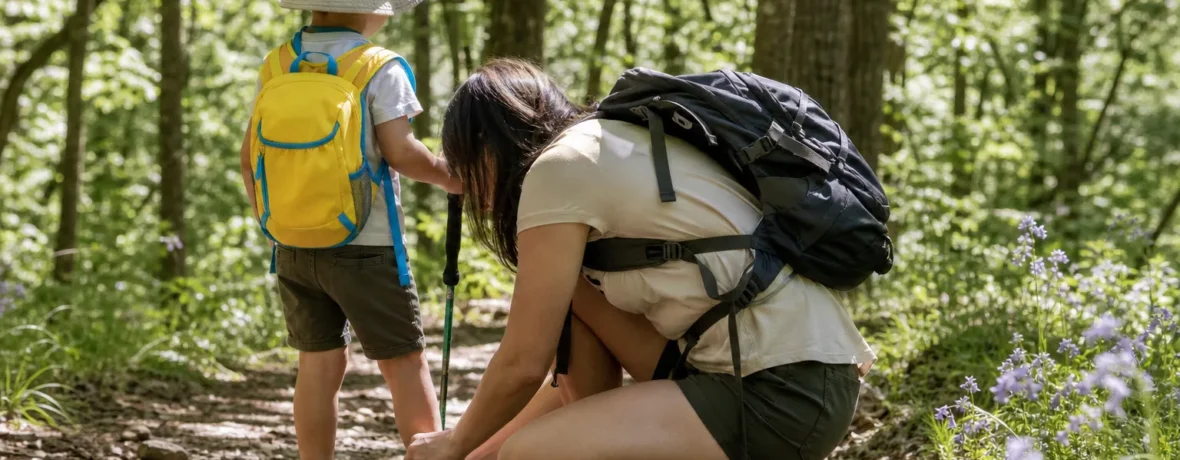
How far can a child hike? Most kids can handle 1 mile [1.6 km] per year of age on easy trails, capped by mood, heat, elevation, and pack weight. Toddlers may do 0.5–2 miles [0.8–3.2 km]; fit teens can do 8–12 miles [12.9–19.3 km] when trained.
How far can a child hike by age?
Use age as a starting line, not a guarantee. A flat forest path, 65°F [18°C] weather, and plenty of snacks can turn a “short” hike into a win; steep rock steps, sun, bugs, and no breaks can wreck the same mileage fast.
| Age | Good first distance | Strong day-hike range | What usually matters most |
|---|---|---|---|
| 2–3 | 0.5–1 mile [0.8–1.6 km] | 1–2 miles [1.6–3.2 km] | Curiosity, naps, carrying options |
| 4–5 | 1–2 miles [1.6–3.2 km] | 2–4 miles [3.2–6.4 km] | Games, snacks, bathroom timing |
| 6–8 | 2–3 miles [3.2–4.8 km] | 3–6 miles [4.8–9.7 km] | Pace, footwear, trail interest |
| 9–12 | 3–5 miles [4.8–8 km] | 5–8 miles [8–12.9 km] | Fitness, elevation gain, buy-in |
| 13–17 | 4–6 miles [6.4–9.7 km] | 8–12 miles [12.9–19.3 km] | Training, heat, pack weight |
The CDC physical activity guidance for children says kids and teens ages 6–17 need at least 60 minutes of moderate-to-vigorous activity daily, while preschool-age children should be active throughout the day. Hiking can fit that pattern, but mileage still needs to match the child in front of you.
What is the 1-mile-per-year-of-age hiking rule?
The 1-mile-per-year rule is a handy ceiling for easy terrain. A 6-year-old might handle 6 miles [9.7 km] on a mellow trail, but that does not mean you should start there.
Treat the rule like a weather forecast. Useful. Not sacred. Cut the distance when the trail has long climbs, loose rock, stream crossings, high altitude, direct sun, snow, or a heavy pack. Add breaks when the route has good kid fuel: bridges, boulders, waterfalls, tide pools, fire towers, frogs, berries, or safe places to throw rocks into water.
A better formula for most families is this: choose the distance your child can finish while still liking hiking at the trailhead. That may be 1 mile [1.6 km] today and 5 miles [8 km] next season. Perfect.
How do you choose the right trail distance for kids?
Pick the trail by time and terrain first, then mileage. Kids feel steepness, heat, and boredom more than map numbers.
- Start with a loop under your child’s known limit. If your child has walked 2 miles [3.2 km] happily, choose 1.5–2 miles [2.4–3.2 km] for the first real hike.
- Check elevation gain. For beginners, keep climbing gentle. A 3-mile [4.8 km] trail with 900 feet [274 m] of gain can feel tougher than a flat 5-mile [8 km] trail.
- Plan a turnaround point. Choose a bridge, overlook, lake edge, or trail junction before you start.
- Set a snack clock. Offer food before the meltdown, not after. Every 45–60 minutes works for many kids.
- Leave extra daylight. Family hiking pace can drop hard when someone starts collecting sticks, crying, or inspecting every beetle.
For younger kids, out-and-back trails are simple but risky: every step out is a step back. Short loops feel more like an adventure and less like a forced march.
How much elevation gain is too much for kids?
For new kid hikers, keep elevation gain under 500 feet [152 m] until you know their climbing legs. Older or active kids may handle 1,000–2,000 feet [305–610 m], but only after easier hikes go well.
Elevation gain changes the whole day. It slows pace, raises effort, increases water needs, and makes descents harder on small legs. A child who cruises 4 flat miles [6.4 km] may struggle on 2 steep miles [3.2 km]. That is normal.
Use these trail signs to trim the plan:
- Your child stops talking on a climb and cannot recover after a break.
- Steps are taller than the child’s shin for long stretches.
- The route has exposed drop-offs and your child is tired or impulsive.
- You are bargaining every 5 minutes before the halfway point.
- The descent will happen in heat, rain, darkness, or icy footing.
How fast do kids hike?
Many families move 0.5–1.5 miles per hour [0.8–2.4 km/h] with young kids, including breaks. Older kids and teens may hike 2–3 miles per hour [3.2–4.8 km/h] on easy trails.
Do not build the day around adult pace. Build it around kid pace plus stops. Children do not hike in a clean line. They sprint, squat, snack, whine, recover, sing, and suddenly fly uphill. That uneven rhythm is part of the deal.
A simple planning method: estimate the adult hiking time, then double it for kids under 8. For ages 9–12, add 50 percent. For teens, use adult time if they are trained and carrying a reasonable load.
What should kids carry on a hike?
Kids should carry light, useful gear, not a punishment pack. Keep it small enough that they can walk normally.
- Water bottle or hydration bladder
- Snack they like and can open themselves
- Rain shell or warm layer, depending on weather
- Whistle attached to the shoulder strap
- Sun hat or warm hat
- Small headlamp for older kids
- Personal medication only if prescribed and managed by the adult plan
For pack weight, stay conservative. Preschoolers do best with nearly nothing. School-age kids can carry a few light items. Teens can carry more, but comfort still wins. If the pack changes posture, rubs shoulders, or causes complaints in the first 15 minutes, lighten it.
How do you keep kids hiking without bribes?
Give them a job, a destination, and frequent tiny wins. Kids often hike farther when the trail feels like a mission instead of exercise.
Try these trail jobs:
- Leader for 10 minutes: They set the pace on safe sections.
- Map checker: They watch for the next junction or landmark.
- Wildlife scout: They look for tracks, feathers, nests, and scat from the trail.
- Snack captain: They call the next planned snack stop.
- Leave No Trace helper: They spot litter to pack out.
Do use treats if they help. Just avoid making every step a transaction. The real goal is ownership: “This is my hike,” not “I am being dragged through trees.”
When to see a doctor
Get medical help fast if your child has red-flag symptoms during or after a hike. Do not try to diagnose on the trail.
Stop hiking and seek urgent help for fainting, confusion, trouble breathing, chest pain, severe headache, repeated vomiting, a major fall, suspected broken bone, or symptoms that worsen despite rest, shade, food, and fluids. Mayo Clinic says severe dehydration needs immediate medical care, especially when a child has very low energy or is not responding normally; see its dehydration treatment guidance.
Heat can turn serious quickly. The Wilderness Medical Society heat illness guidelines support rest in a cool area and fluid replacement for mild heat illness, while heat stroke requires emergency medical care. If your child is hot, confused, staggering, or not acting right, treat it as urgent.
Related reading
- How Far Can a Dog Hike in a Day?
- Las Vegas to Zion: Distance, Drive and Day-Trip Plan
- Glacier to Yellowstone Road Trip: Distance and Route
- Seattle to Olympic National Park: Routes and Ferries
FAQ
Can a 5-year-old hike 5 miles [8 km]?
Some 5-year-olds can, but it is a big day. Start with 2 miles [3.2 km], then build toward 5 miles [8 km] only if your child finishes shorter hikes happy, steady, and willing to go again.
How far can a 7-year-old hike?
A 7-year-old can often hike 3–6 miles [4.8–9.7 km] on easy terrain. Choose the lower end for heat, climbs, new boots, or a child who has not hiked recently.
Can kids hike every day on a vacation?
Yes, if you vary the effort. Mix one longer hike with short nature walks, swim time, visitor centers, picnic stops, and rest days so tired legs do not stack up.
What is too hot for kids to hike?
There is no single safe cutoff because humidity, shade, wind, fitness, and water access all matter. In hot weather, hike early, choose shade, shorten the route, and turn back if your child gets dizzy, unusually tired, nauseated, confused, or stops sweating.
Should I carry my toddler on a hike?
Yes, plan to carry a toddler for part of the route. Even if they walk the first mile [1.6 km], bring a carrier or choose a trail short enough that you can safely get back when their legs, mood, or nap clock runs out.