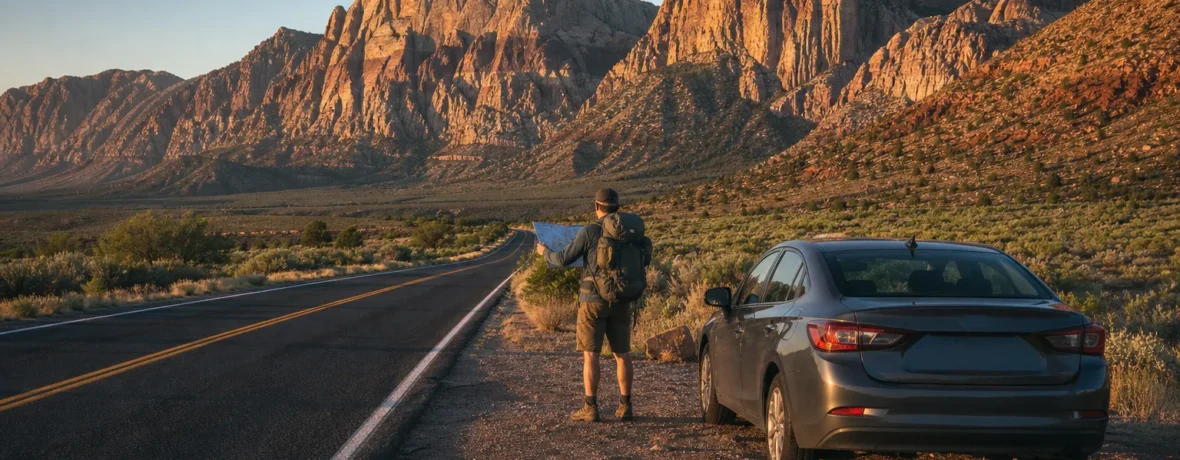
How far is Zion National Park from Las Vegas? From the Las Vegas Strip to Zion Canyon Visitor Center, plan on 163 miles [262 km] and 2 hours 45 minutes to 3 hours without long stops. Yes, it works as a day trip if you leave early and keep the hiking plan tight.
How far is Zion National Park from Las Vegas?
Zion’s main canyon is 158–163 miles [254–262 km] northeast of Las Vegas, depending on your starting point.
The number most hikers care about is the drive to the South Entrance in Springdale, Utah, because that is the gateway to Zion Canyon, the shuttle, Riverside Walk, Emerald Pools, Scout Lookout, Angels Landing, and the Narrows trailhead. If you start on the Strip, use 163 miles [262 km]. If you start closer to downtown Las Vegas, the number lands nearer 158–160 miles [254–257 km].
Do not plan this like a short hop. The drive crosses three states: Nevada, a slice of Arizona, and Utah. You also change time zones. Las Vegas is on Pacific Time. Zion is on Mountain Time. On the way there, your clock jumps forward one hour; on the way back, you get it back. That one hour matters when you are chasing a shuttle, a permit window, or sunset.
Can you visit Zion from Las Vegas in one day?
Yes, Zion is a realistic day trip from Las Vegas if you leave before sunrise.
A clean day-trip plan gives you 6 hours of driving, 1 hour for fuel and food, and 4–6 hours inside the park. That is enough for one main hike, one shorter walk, and a scenic lunch stop. It is not enough for every classic Zion objective. Trying to pack Angels Landing, the Narrows, Canyon Overlook, Emerald Pools, and a slow dinner into one day is how good trips turn ragged.
For a first Zion day from Vegas, think simple: get into the canyon, ride the shuttle if it is running, hike 3–5 miles [5–8 km], eat, look up, and head back before fatigue turns the interstate into a grind.
If you can spare one night in Springdale, do it. You will get quieter morning light, more hiking choices, and less pressure. But if one day is what you have, make it sharp.
What is the best route from Las Vegas to Zion National Park?
The fastest standard route is I-15 north to Utah Exit 16, then UT-9 east through Hurricane, La Verkin, Virgin, Rockville, and Springdale.
From Las Vegas, follow I-15 north past Mesquite, then through the Virgin River Gorge in northwest Arizona. That gorge is the first big scenery hit: steep limestone walls, sweeping curves, and very little room for wandering attention. Stay alert. It is still interstate driving, not a photo pullout.
After you enter Utah, continue past St. George and take Exit 16 toward Hurricane and Zion National Park. UT-9 leads you through the gateway towns to Springdale and the South Entrance. For basic park access, road orientation, and entrance locations, use the National Park Service’s Zion directions and transportation page before you drive.
On a day trip, avoid scenic detours on the way in unless Zion is already familiar to you. Valley of Fire, Snow Canyon, and Kolob Canyons are all strong stops, but each one eats the same daylight you need inside Zion Canyon.
What time should you leave Las Vegas for a Zion day trip?
Leave Las Vegas between 4:30 a.m. and 5:30 a.m. for the best one-day rhythm.
That sounds aggressive. It is. Zion rewards aggressive starts, especially from March through November when shuttle lines, parking, heat, and trail traffic all stack up. Leaving at 7:00 a.m. from the Strip can put you at the visitor center late in the morning after the time change, which is the wrong end of the day for parking and summer hiking.
- Leave Las Vegas at 5:00 a.m. Pacific Time.
- Arrive in Springdale near 9:00 a.m. Mountain Time, allowing for the time change and a short fuel stop.
- Park at the Zion Canyon Visitor Center or in Springdale if park parking is full.
- Enter the park, pay the fee or show your pass, and get on the shuttle if it is running.
- Hike one main trail before lunch.
- Add one easy walk or viewpoint in the afternoon.
- Start driving back by 4:30–5:30 p.m. Mountain Time unless you are staying overnight.
This schedule gives you room for a slow shuttle line, photos, snacks, and the kind of staring-at-cliffs silence that Zion tends to cause.
Do you need a shuttle, reservation, or permit at Zion?
You do not need a reservation to enter Zion, but you may need the shuttle and some hikes require permits.
As of November 2026, Zion charges a $35 private vehicle entrance fee, valid for 1–7 days, according to the park’s official fees and passes page. If you have an America the Beautiful pass, bring it. If you drive into the park, leave, park in Springdale, and walk back in, keep your pass handy.
As of November 2026, the Zion Canyon Shuttle is free, does not require a ticket, and does not require a reservation. During shuttle season, private vehicles are not allowed on Zion Canyon Scenic Drive north of Canyon Junction, so most day hikers reach the main canyon trailheads by shuttle. Check the current Zion Canyon Shuttle System schedule before leaving Vegas because operating dates and times shift by season.
Angels Landing is different. As of November 2026, you need a permit to hike the chained section from Scout Lookout to Angels Landing. Permits are handled by lottery, and the National Park Service explains the process on its Angels Landing permits page. You can hike to Scout Lookout without continuing onto the permitted chains, but do not treat that as an easy consolation prize. It is steep, exposed, and demanding.
Before a long drive from Las Vegas, check the park’s current conditions page for road, trail, weather, flash flood, and closure alerts. Zion changes fast after storms, rockfall, snow, and summer monsoon bursts.
Which hikes fit a Las Vegas to Zion day trip?
The best day-trip hikes are Riverside Walk, Watchman Trail, Lower Emerald Pool, Pa’rus Trail, and Canyon Overlook.
You want trails that deliver canyon scenery without trapping you far from the return drive. For most Vegas day trippers, that means 1–4 miles [1.6–6.4 km] round trip, manageable elevation gain, and simple logistics.
| Hike | Distance | Best for | Day-trip note |
|---|---|---|---|
| Riverside Walk | 2.2 miles [3.5 km] | First-timers, families, canyon walls | Take the shuttle to Temple of Sinawava when shuttles run. |
| Watchman Trail | 3.3 miles [5.3 km] | Views near the visitor center | No deep-canyon shuttle ride required. |
| Lower Emerald Pool | 1.2 miles [1.9 km] | Short hike, classic canyon feel | Good add-on if trail access is open. |
| Pa’rus Trail | 3.5 miles [5.6 km] | Easy walking, bikes, sunset | Paved and starts near the visitor center. |
| Canyon Overlook | 1.0 mile [1.6 km] | Big view, short effort | Parking is limited east of the tunnel. |
If you only choose one, pick Riverside Walk for the deep-canyon experience or Watchman Trail for the easiest logistics from the visitor center. If you are hiking in hot months, choose the earlier trail start over the more ambitious trail. Zion’s cliffs bounce heat back at you. Shade moves. Water disappears fast.
What is the best one-day itinerary from Las Vegas to Zion?
The best plan is one main canyon hike, one short add-on, and a hard turnaround time.
- 5:00 a.m. Pacific Time: Leave Las Vegas with a full tank and breakfast in the car.
- 7:00 a.m. Pacific Time: Quick fuel, restroom, and coffee stop near Mesquite or St. George.
- 9:00 a.m. Mountain Time: Arrive in Springdale or at Zion Canyon Visitor Center.
- 9:30 a.m.: Board the shuttle if it is running, or walk straight to Watchman Trail if parking and shuttle lines are messy.
- 10:15 a.m.–12:15 p.m.: Hike Riverside Walk or Watchman Trail.
- 12:15–1:00 p.m.: Lunch. Keep it simple: shade, water, salty food, shoes off if your feet are swelling.
- 1:00–3:00 p.m.: Add Lower Emerald Pool, Pa’rus Trail, or a visitor center reset depending on heat and energy.
- 3:00–4:00 p.m.: Start moving back toward the car. Do not wait until everyone is cooked.
- 4:30–5:30 p.m. Mountain Time: Leave Zion for Las Vegas.
- 6:30–7:30 p.m. Pacific Time: Arrive back in Las Vegas after the time-zone change, traffic depending.
If the day runs hot, cut the second hike. If shuttle lines are long, hike Watchman and Pa’rus from the visitor center instead of spending precious time waiting. If storms are building, stay out of narrow canyons and river corridors. Zion does not care how long you drove.
What should you pack for a Las Vegas to Zion drive and hike?
Pack for desert driving, canyon hiking, and a tired ride home.
- Water for the drive and the hike; carry more in warm months.
- Salty snacks and a real lunch, not just candy and gas-station coffee.
- Sun hat, sunglasses, and sunscreen.
- Light layers; mornings can feel cool, afternoons can burn.
- Trail shoes with grip for sand, rock, and dusty pavement.
- Printed or offline maps, since cell service can be weak in canyon country.
- Headlamp, even for a day trip.
- Small first-aid kit and any personal medications you already use.
- Park pass, ID, credit card, and Angels Landing permit if you have one.
- Trash bag. Pack out everything.
Skip flimsy flip-flops for hiking. Save them for the car. Zion’s easy trails still have sand, uneven stone, wet patches, and sun-baked surfaces that punish lazy footwear.
When to see a doctor
Get medical help right away for confusion, fainting, persistent vomiting, worsening symptoms, or heat symptoms that last longer than one hour.
Zion can be brutally hot, and a Vegas day trip adds sleep loss plus a long drive. Watch for heat-related warning signs: headache, dizziness, nausea, muscle cramps, weakness, heavy sweating, or cold clammy skin. The CDC’s heat illness guidance says heat stroke can involve confusion, altered mental status, slurred speech, loss of consciousness, and needs immediate emergency care.
Do not diagnose yourself on the trail. Stop activity, move to shade or a cooler place, and get help if symptoms are severe, worsening, or not improving. If someone seems confused, passes out, or cannot safely drink, call 911.
Related reading
- Glacier to Yellowstone Road Trip: Distance and Route
- Seattle to Olympic National Park: Routes and Ferries
- What to Do in Zion National Park: Hikes by Difficulty
- Where to Stay in Zion National Park
FAQ
Is Zion closer to Las Vegas or Salt Lake City?
Zion is closer to Las Vegas. The Las Vegas to Zion drive is 158–163 miles [254–262 km] to the main canyon area, while Salt Lake City is a much longer drive from the north.
What is the closest Zion entrance from Las Vegas?
The South Entrance at Springdale is the closest main entrance for most Las Vegas visitors. It puts you directly by Zion Canyon Visitor Center and the shuttle system.
Can you drive your own car into Zion Canyon?
Only sometimes. During shuttle season, private vehicles cannot drive Zion Canyon Scenic Drive north of Canyon Junction, so you use the shuttle, walk, or bike; in non-shuttle periods, private vehicles may be allowed when parking and conditions permit.
Do you need a reservation to enter Zion National Park?
No, not for standard entry as of November 2026. You still need to pay the entrance fee or show a valid pass, and specific activities such as Angels Landing require permits.
Is Angels Landing a good day trip hike from Las Vegas?
Only if you already have a permit, start very early, and know you are ready for steep exposure. For most first-time day trippers, Riverside Walk, Watchman Trail, or Emerald Pools makes a better Las Vegas-to-Zion plan.
What is the biggest mistake on a Vegas to Zion day trip?
Leaving too late is the classic mistake. A late start collides with the time-zone jump, parking pressure, shuttle lines, heat, and the long drive back to Las Vegas.