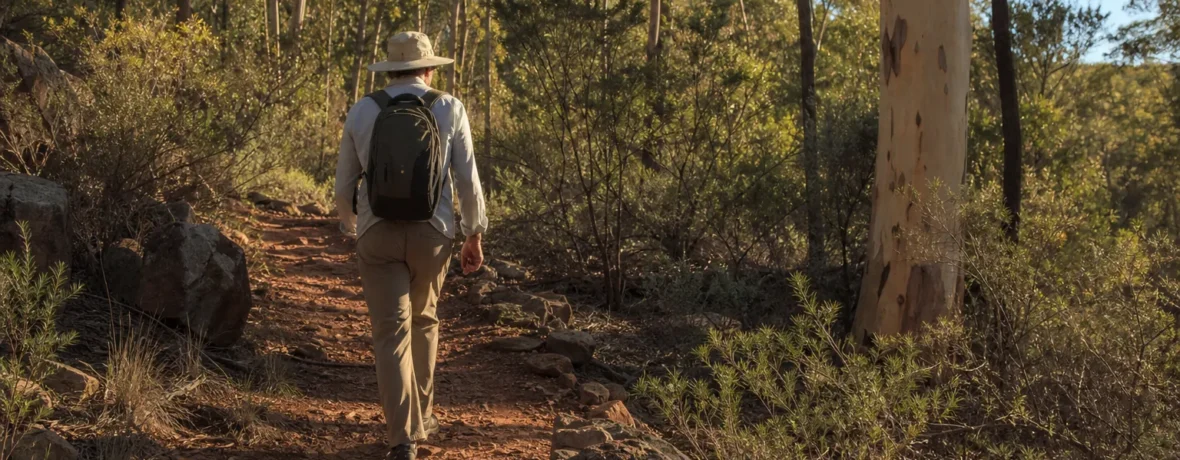
What is bushwalking? Bushwalking is the Australian term for hiking or walking in natural bushland, from short marked walks to rough off-track travel and overnight trips. The word usually signals native vegetation, variable footing, sun, heat, limited services, and a need to plan beyond simply following a path.
Here’s the blunt take: the word people use for hiking matters. Not because “bushwalking” sounds more rugged than “hiking.” Not because “tramping” makes you look worldly. It matters because local language carries local assumptions: terrain, access, weather, etiquette, rescue culture, and the level of self-reliance expected from you.
Call every walk a hike if you want. You’ll be understood in many places. But if you listen to the local word, you get free trail intelligence before your boots hit dirt.
What is bushwalking, really?
Bushwalking is walking through natural bush or wild country, most commonly in Australia.
That can mean a signed 2-mile [3.2 km] loop through eucalyptus forest, a full-day route across rocky ridges, or a multi-day walk where you carry shelter, food, water treatment, and a map. In Australian usage, “bush” does not mean a shrub beside the driveway. It means natural country: forest, scrub, heath, desert margins, rainforest, coastal tracks, and national park backcountry.
Official Australian park agencies use “hiking,” “walking,” and “bushwalking” side by side. Parks Victoria describes its parks as places to “hike, walk or bushwalk,” from short trails to multi-day trips, and points walkers to grading systems, maps, closures, and weather checks before setting out: Parks Victoria hiking and bushwalking guidance.
My position: when you see “bushwalking,” raise your planning standard one notch. Expect less hand-holding than a city greenway. Expect heat, exposure, uneven ground, sudden storms, fire risk, snakes in season, and long gaps between services. You may still be on a fine, popular track. Good. Pack like the country can change its mind.
What is tramping in New Zealand?
Tramping is New Zealand’s word for hiking, especially walking in backcountry or mountain terrain.
The New Zealand Department of Conservation says hiking is commonly known there as tramping, and it classifies tracks into six walking and tramping categories. That official language is useful because it tells you what sort of experience the route expects: easy walking, formed tracks, rougher tramping tracks, or marked routes where navigation skills matter. See the DOC walking and tramping track categories.
In practice, tramping often carries a stronger backcountry flavor than the American word “hiking.” A tramp may involve huts, river crossings, alpine passes, wet boots, changeable weather, and steep travel that gains 3,000 feet [914 m] before lunch. It may also be a mellow half-day track near a town. The word alone does not tell you the grade. The local track category does.
So don’t hear “tramping” and assume romance. Hear “check the route notes.” New Zealand terrain can compress several climates into one day. A blue-sky valley start can become wind, cold rain, and low visibility higher up. The right response is not fear. It is preparation.
What do people mean by hillwalking in the UK and Ireland?
Hillwalking means walking in hilly or mountainous country, often on open land.
In Scotland, Wales, Northern England, and Ireland, “hillwalking” can describe anything from a grassy ridge walk to a long day over exposed mountains. The word may sound gentle to an American ear. Do not be fooled. Hill country can bring bog, wind, mist, rock, snow, and pathless sections where a phone map alone is thin comfort.
Mountaineering Scotland treats hillwalking as an activity that benefits from practical skills like route choice, navigation, weather judgment, and suitable kit; its beginner guidance is a smart starting point: Mountaineering Scotland hillwalking advice.
The key distinction is that hillwalking sits between lowland walking and technical mountaineering. You usually are not climbing with ropes. You may still need to make mountain decisions. If winter conditions enter the picture, the line can move fast.
Is bushwalking the same as hiking?
Yes, but not perfectly.
“Hiking” is the big umbrella term, especially in the United States and Canada. Bushwalking fits under that umbrella, but it adds regional color and useful context. Same with tramping and hillwalking. They all describe traveling on foot outdoors, usually for recreation, but each word points to a different outdoor culture.
| Term | Common region | What it usually suggests | Planning cue |
|---|---|---|---|
| Hiking | United States, Canada | Trails from local parks to wilderness routes | Check distance, gain, permits, weather, water |
| Bushwalking | Australia | Native bushland, heat, scrub, rougher tracks | Check fire danger, water, closures, track grade |
| Tramping | New Zealand | Backcountry tracks, huts, rivers, alpine weather | Check DOC category, hut bookings, river levels |
| Hillwalking | UK, Ireland | Open hills, moorland, ridges, mountain weather | Carry map, compass, layers, and a bad-weather plan |
The mistake is treating these words as travel brochure synonyms. They are not. They are small warnings wrapped in local slang.
How should you prepare for a bushwalk, tramp, or hillwalk?
Prepare for the place, not the label.
A 5-mile [8 km] bushwalk in hot, dry country can demand more water and caution than a 10-mile [16 km] forest hike with streams. A 7-mile [11 km] hillwalk in cloud can become a navigation problem. A 12-mile [19 km] tramp with a river crossing can become a no-go after heavy rain.
- Translate the local term. Ask what the word implies where you are: formed trail, marked route, off-track travel, huts, private land, fire risk, tides, river crossings, or winter gear.
- Read the official route page. Use park agency information first. Social posts are useful for mood; official pages are better for closures, alerts, track categories, and safety notices.
- Match the grade to your group. Fitness is only one piece. Add experience, weather, daylight, navigation skill, and how far you will be from help.
- Pack for delay. A simple day kit should handle an unplanned stop, a missed turn, or weather that arrives early.
- Leave a plan. Tell someone your route, trailhead, turnaround time, and when to call for help.
What should you pack for hiking under these different names?
Pack the same core safety items, then adjust for local hazards.
The base kit does not change much across countries. Food, water, insulation, rain protection, first aid, navigation, light, sun protection, and emergency communication belong in your pack for any serious walk. Leave No Trace also gives a useful ethics baseline for any outdoor trip, including planning ahead, traveling on durable surfaces, disposing of waste properly, and respecting wildlife: National Park Service Leave No Trace Seven Principles.
- For bushwalking: sun hat, sunscreen, extra water capacity, long sleeves, gaiters if scrub is thick, and current fire or closure checks.
- For tramping: rain shell, warm layers, map, headlamp, hut or campsite plan, water treatment, and caution around rivers.
- For hillwalking: waterproofs, warm hat and gloves, paper map, compass, whistle, headlamp, and a route you can shorten in poor visibility.
- For any longer day: carry enough food for the planned walk plus a reserve, not just a snack you hope will do.
Do not let the cutest word make the trip sound smaller. “Walk” can still mean exposure. “Hill” can still mean weather. “Bush” can still mean no water. “Tramp” can still mean a full-value mountain day.
Why local hiking words make you a better traveler
Using local words makes you pay attention.
That is the whole argument. Outdoor language is not trivia for gear nerds. It is a map of local expectations. In the U.S., a “hike” might be a maintained trail in a national park, a 20-mile [32 km] wilderness route, or a paved path with a waterfall at the end. In Australia, “bushwalking” tells you the bush itself is part of the experience. In New Zealand, “tramping” hints at a backcountry tradition built around tracks, huts, and self-reliance. In Scotland, “hillwalking” tells you that hills are not minor simply because they are not called mountains.
Respect the word, and you’ll ask better questions:
- Is the track marked the whole way?
- Will I need to cross water?
- Is the route safe after rain?
- Is there reliable drinking water?
- What happens if cloud drops and I lose the view?
- Are there seasonal closures, fire restrictions, or access limits?
That is not overthinking. That is competent walking.
Related reading
- Type 2 Fun: Why Hard Hikes Feel Good Later
- The Seven Summits Explained
- What Is Geocaching?
- What Is Hiking, Really? A Definition Worth Arguing About
FAQ
Is bushwalking only an Australian word?
Mostly, yes. Bushwalking is most strongly associated with Australia, though people elsewhere may understand it if they know Australian outdoor language. In the U.S., most people would simply say hiking.
Is tramping different from backpacking?
Sometimes. Tramping can mean a day hike or a multi-day backcountry trip in New Zealand, while backpacking in the U.S. usually means an overnight trip carrying camping gear. If huts are involved, a tramp may not require a tent.
Is hillwalking the same as mountaineering?
No. Hillwalking usually means walking in hills or mountains without technical climbing gear. In winter or severe weather, a hillwalk can still require mountaineering-level judgment and equipment.
Can beginners go bushwalking?
Yes, beginners can bushwalk on easy, marked routes that match their fitness and experience. Start short, check official park information, carry water and sun protection, and turn around before the walk stops being fun.
What word should Americans use overseas?
Use the local word when you can. Say bushwalking in Australia, tramping in New Zealand, and hillwalking in Scotland or Ireland; you will sound more informed, and you will be prompted to plan for the local terrain.