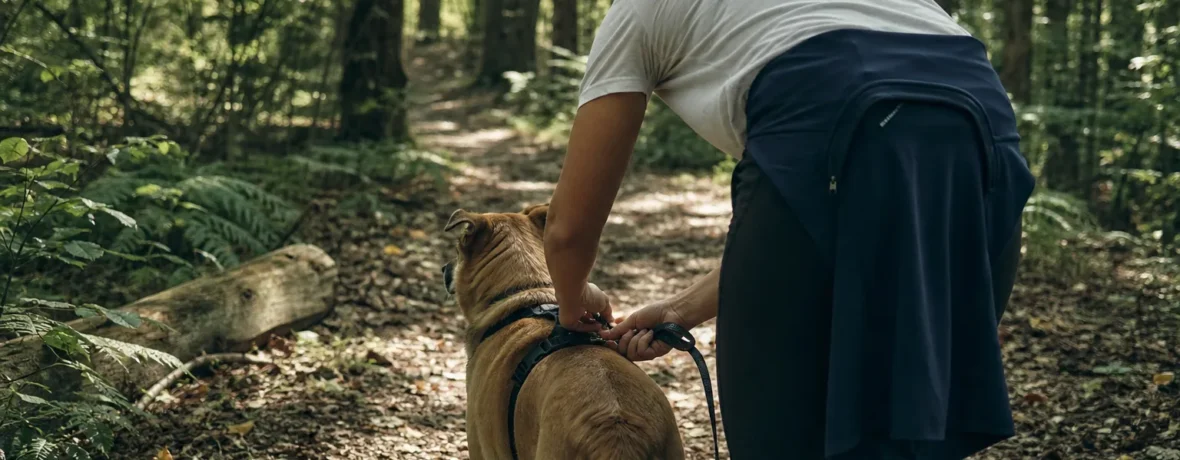
Hiking with dogs is allowed on many U.S. trails, but only when the trail permits pets, your dog can handle the distance, and you follow leash, waste, wildlife, and safety rules. Plan for one rest stop every 30-45 minutes, carry extra water, and turn back before your dog struggles.
Can you take dogs on hiking trails?
Yes, you can take dogs on many hiking trails, but not all of them.
Before you load the car, check the land manager’s page for that exact trail. National parks, national forests, BLM land, state parks, city preserves, beaches, and wildlife refuges all set their own pet rules. A trail that allows dogs in the parking area may ban them beyond the trailhead. A trail that allows dogs in October may close to pets during nesting season, lambing season, or winter wildlife closures.
The National Park Service pet guidance says most national parks allow pets in developed areas, but many restrict pets from backcountry trails and sensitive habitat. As of November 2026, the NPS B.A.R.K. principles are still the cleanest rule set to remember: bag waste, always leash, respect wildlife, and know where you can go.
BLM-managed land is often more flexible. The Bureau of Land Management hiking guidance says dogs are welcome on most BLM-managed trails, but you still need to check the local trail page or field office for leash rules. That last part matters. “Public land” does not mean “anything goes.”
Use this quick filter before any dog hike:
- Trail page says pets allowed: Go to the next check.
- Trail page says no pets: Leave the dog at home. No debate.
- Rules are unclear: Call the ranger station, park office, or land manager.
- Trail has ladders, metal grates, exposed scrambling, deep snow, or hot slickrock: Pick a different route.
- Your dog is reactive, injured, overheated, under-trained, or not fully vaccinated: Skip the hike and train first.
What are the basic dog hiking rules?
The basic dog hiking rules are simple: leash where required, keep control everywhere, pack out waste, yield early, and protect wildlife.
Rules vary by agency and location, but the pattern is steady across the U.S. Parks want your dog under control. Other hikers want space. Wildlife needs to be left alone. Nobody wants to step over a plastic poop bag glowing beside the trail like a bad decision.
| Land type | What to check before you go | Common pet rule pattern |
|---|---|---|
| National parks | Specific park pet page and trail page | Pets often limited to roads, campgrounds, paved paths, and developed areas; many trails prohibit pets. |
| BLM land | Local field office or recreation site page | Dogs are welcome on most trails, but leash rules differ by site. |
| State parks | State park pet policy and individual park notices | Leashes are commonly required; swimming beaches, buildings, and sensitive areas may be off-limits. |
| City and county trails | Trailhead signs and municipal code | Leash, waste, seasonal closure, and voice-control rules can change from one preserve to the next. |
As of November 2026, many NPS sites that allow pets require a leash no longer than 6 feet [1.8 m] and require pet waste to be bagged and carried to a trash can; check the NPS visiting with pets page and the specific park page before relying on that rule for your destination.
Here is the trail version of being a good human with a dog:
- Keep your dog close enough that you can stop contact before it happens.
- Step downhill and off the trail when hikers, runners, horses, or other dogs pass.
- Ask before letting your dog greet anyone.
- Never let your dog chase deer, marmots, squirrels, birds, livestock, or reptiles.
- Pack out filled waste bags all the way to a trash can.
- Do not tie a dog to a tree, signpost, picnic table, or trail marker and walk away.
- Use a real leash, not a long retractable line on crowded or narrow trails.
What gear do you need for hiking with dogs?
You need a leash, collar or harness, water, bowl, waste bags, ID, first-aid basics, and weather-appropriate protection.
Skip the cute gear until the safety gear is handled. Your dog does not need a tiny expedition cosplay kit for a 2-mile [3.2 km] forest loop. Your dog does need water, control, identification, and a way home if something goes wrong.
Pack this for every hike:
- Leash: A fixed 4-6 foot [1.2-1.8 m] leash gives better control than a retractable leash.
- Collar with ID: Include your phone number on the tag.
- Harness: Useful for steep trails, nervous dogs, and dogs that pull.
- Water: Carry more than you think you need; do not rely on creeks.
- Collapsible bowl: Easier than pouring water into your hand.
- Waste bags: Bring extras in case one tears.
- Tick remover or fine-tipped tweezers: Check your dog and yourself after the hike.
- First-aid kit: Add gauze, wrap, antiseptic wipes, and a spare bandana.
- Towel: For mud, creek crossings, cold paws, and your car seats.
- Light: Clip-on dog light or reflective strip for dusk starts and late finishes.
For rough ground, snow, salt, desert rock, or frozen trail, consider dog boots. Test them at home first. A dog discovering boots at the trailhead may walk like a confused crab for 10 minutes, then refuse to move at all.
A dog pack can work for fit adult dogs, but keep it light and balanced. Let your dog get used to the empty pack on short walks before adding weight. Watch for rubbing behind the front legs and under the belly. If the pack shifts on every switchback, it is the wrong fit.
How far can a dog hike?
A dog can hike only as far as its fitness, paws, age, breed, health, training, and the day’s conditions allow.
There is no universal mileage number. A trail-hardened cattle dog and a short-nosed senior bulldog are not signing up for the same outing. Distance is only one piece. Elevation gain, surface, heat, humidity, water access, crowds, and descent all change the load.
Use this progression if your dog is new to trails:
- Start with 1-2 miles [1.6-3.2 km] on easy terrain with a bail-out point.
- Add distance slowly after your dog finishes hikes with normal energy, appetite, gait, and paws.
- Introduce elevation after flat miles feel routine.
- Practice trail manners around hikers, dogs, runners, bikes, and horses.
- Check paws after every hike for worn pads, cuts, cactus spines, ice balls, or redness.
- Plan the turn-around point before the dog looks tired.
Puppies need extra caution. Their bones, joints, and attention span are still developing. Keep puppy hikes short, soft, positive, and easy. For long mileage, steep descents, pack weight, or running, talk with your veterinarian first.
Senior dogs need the same respect. They may still want to go, and that want can outrun their joints. Choose shorter loops, softer surfaces, cooler temperatures, and more breaks.
How much water should you bring when hiking with a dog?
Bring enough water for you and your dog, plus a reserve for heat, delays, and dry trail conditions.
Do not assume a stream will be flowing. Do not assume the lake is safe. Natural water can carry pathogens, algae, agricultural runoff, or sediment that upsets your dog’s stomach. If you would not drink it untreated, do not make your dog rely on it.
Offer small drinks often instead of waiting until your dog is panting hard. On warm days, stop in shade every 30-45 minutes and watch the dog, not your watch. Heavy panting that does not settle, glassy eyes, stumbling, weakness, vomiting, or collapse means the hike is over and the dog needs urgent cooling and veterinary help.
For your own heat safety, the Wilderness Medical Society heat illness guidelines recommend reducing heat strain, using shade and cooling measures, and treating mild to moderate heat illness with oral fluids when the person can drink safely. For your dog, follow your veterinarian’s advice and act early. Dogs do not sweat like humans. They dump heat mostly through panting, and that system can fall behind fast.
Heat planning is not only an air-temperature issue. Ground temperature matters. Dark asphalt, slickrock, sand, and metal bridges can burn paws. Press the back of your hand to the surface for 7 seconds. If you pull away, your dog should not walk on it.
How do you handle leash etiquette around other hikers and dogs?
Give space first, then ask.
That is the whole etiquette code. Your dog may be friendly. The other dog may be injured, elderly, anxious, training, working, or recovering from surgery. The other hiker may be afraid of dogs. Nobody on a trail owes your dog a greeting.
Use this passing routine:
- Shorten the leash before the pass, not during the pass.
- Move to the downhill side when possible.
- Put your dog on the outside, away from the passing person or dog.
- Ask, “Can we pass?” or “Do you want space?”
- Keep moving unless both handlers agree to a greeting.
- Reward your dog after the pass, not while it is lunging.
Retractable leashes cause trouble on trails because the thin cord can wrap around legs, bikes, trekking poles, brush, or another dog. On narrow trails, use a fixed leash. Save long lines for open areas where they are legal and uncrowded.
If your dog barks, lunges, freezes, or spins at every passing dog, choose wider trails at quiet times and build skills before trying crowded weekend routes. Training on boring sidewalks pays off in the backcountry.
What should you do with dog poop on the trail?
Pick it up, carry it out, and put it in a trash can.
Leaving a bag beside the trail “for the way back” is how trails become plastic-bag museums. People forget. Ravens, coyotes, rodents, and weather scatter bags. Other hikers get to stare at your dog’s leftovers for miles.
Dog waste is not the same as wild animal scat. Dogs eat processed food, may carry parasites, and concentrate waste on popular trails. That is why land managers ask you to pack it out.
Make it painless:
- Clip a hard-sided waste carrier to your pack.
- Double-bag on hot days.
- Bring more bags than one dog “usually” needs.
- Pick up waste even if it lands off-trail.
- Never toss bags into pit toilets unless the site specifically allows it.
If you hate carrying dog poop, choose trails with trash cans near the route. That is honest planning.
How do you keep your dog safe around wildlife?
Keep your dog leashed or close enough to control instantly.
Wildlife encounters turn bad when dogs chase, corner, bark at, or surprise animals. A loose dog can bring an angry animal straight back to you. That is not a wilderness badge. That is a preventable mess.
Give wildlife a huge buffer. If you see deer, elk, moose, bison, bear, bighorn sheep, mountain goats, coyotes, foxes, snakes, nesting birds, or livestock, shorten the leash and leave the area calmly. Do not stop for a photo shoot with your dog in the foreground.
Rattlesnake country needs special care. Stay out of tall grass when you can, keep your dog out of rock piles and brushy edges, and avoid letting dogs sniff blindly under logs or ledges. If a snakebite happens, move away from the snake, limit movement, and get veterinary emergency care.
In grazing areas, leash up before you reach cattle, sheep, goats, or working dogs. Livestock guardian dogs are not pets waiting for a playdate. Give them room, keep your dog quiet, and move through without drama.
How do you check your dog after a hike?
Do a nose-to-tail check before the ride home.
Most trail problems are easier to fix early. A tiny cactus spine can become a limping dog by dinner. A tick hidden behind an ear can stay attached for hours. A rub mark from a harness can open on the next hike.
Post-hike checklist:
- Run your hands over the head, ears, neck, armpits, belly, tail, and between toes.
- Check paws for cuts, torn nails, burrs, ice, foxtails, thorns, and raw pads.
- Look under the collar and harness for rubbing.
- Brush out burrs before they tighten.
- Offer water and a calm rest period.
- Watch for limping, unusual fatigue, coughing, vomiting, diarrhea, or behavior changes later that day.
The CDC guidance on preventing ticks on pets recommends checking pets for ticks after they have been outdoors and talking with a veterinarian about tickborne diseases in your area. For humans, the CDC also says to remove an attached tick as soon as possible with tweezers and to seek medical care if rash or fever develops after a tick bite.
When to see a doctor
See a doctor after a bite, concerning tick symptoms, heat illness signs, or any injury that is more than a simple scrape.
This section is for you, the human on the hike. For your dog, call a veterinarian or emergency vet. Do not use human medical advice as pet medical advice.
Seek medical care if a dog, wild animal, or unknown animal bites or scratches you, especially if the skin is broken. The CDC animal safety guidance says animal bites and licks can lead to bacterial infection, and rabies can spread through bites or scratches from infected mammals. Wash the wound with soap and water, then get medical guidance.
After a tick bite, the CDC tick bite guidance says to remove the tick promptly and see a doctor if rash or fever develops within several days to weeks. The Mayo Clinic tick bite first-aid page also recommends medical care for spreading rash, flu-like symptoms, infection signs, or trouble removing the tick completely.
Call emergency services for severe heat symptoms in a person: confusion, fainting, seizures, inability to drink, severe weakness, or altered mental status. Move to shade, start cooling, and get help. Do not try to “push through” heat illness on a trail.
How do you know if your dog should stay home?
Your dog should stay home when the trail, weather, rules, or your dog’s condition make the hike unsafe.
That is not failure. That is good judgment. Some days are human-only days. Some routes are not dog routes. Your dog does not understand permits, talus fields, cryptobiotic soil, desert heat, icy ladders, hunting seasons, or cliff exposure. You do.
Leave your dog home if:
- The trail bans pets.
- The forecast is hot, smoky, icy, or stormy.
- The route has long exposed sections with no shade.
- The trail surface can burn, slice, or freeze paws.
- Your dog is limping, coughing, vomiting, recovering, or unusually tired.
- Your dog cannot pass people, dogs, horses, or bikes calmly.
- You cannot carry your dog out if it gets hurt on a remote route.
A safe dog hike is not measured by mileage. It is measured by coming home with the dog sound, calm, hydrated, and ready to nap instead of needing help.
Related reading
- Are Dogs Allowed in National Parks?
- Can Dogs Get Altitude Sickness?
- Can Dogs Get Poison Ivy?
- How Do Dogs Get Giardia on Hikes?
FAQ
Is hiking good for dogs?
Yes, hiking can be good for dogs when the trail, distance, weather, and terrain match the dog. Start short, build fitness gradually, and ask your veterinarian before long or strenuous hikes if your dog is young, senior, short-nosed, overweight, or has a medical condition.
Should dogs be on leash while hiking?
Yes, dogs should be leashed wherever rules require it and controlled everywhere else. Even on off-leash legal trails, leash your dog around other hikers, dogs, horses, wildlife, trailheads, parking lots, and blind corners.
Can dogs drink from streams while hiking?
They can, but it is safer to carry clean water for them. Streams, lakes, and puddles can contain pathogens, algae, sediment, or runoff that may make a dog sick.
What should a dog carry in a hiking pack?
A dog pack can carry light, soft items such as waste bags, a small bowl, or a light layer if the dog is fit and the pack fits well. Keep weight conservative, balance both sides, and stop using the pack if you see rubbing, fatigue, gait changes, or reluctance.
What is the best leash length for hiking with a dog?
A fixed 4-6 foot [1.2-1.8 m] leash is the most practical choice for most trails. It gives enough room to walk naturally while keeping your dog close for passing hikers, dogs, horses, bikes, and wildlife.
What do you do if an off-leash dog runs up to your dog?
Create space and speak clearly to the other handler: “Please leash your dog.” Keep your dog close, avoid wrapping the leash around your hand, and move away calmly instead of forcing a nose-to-nose meeting.