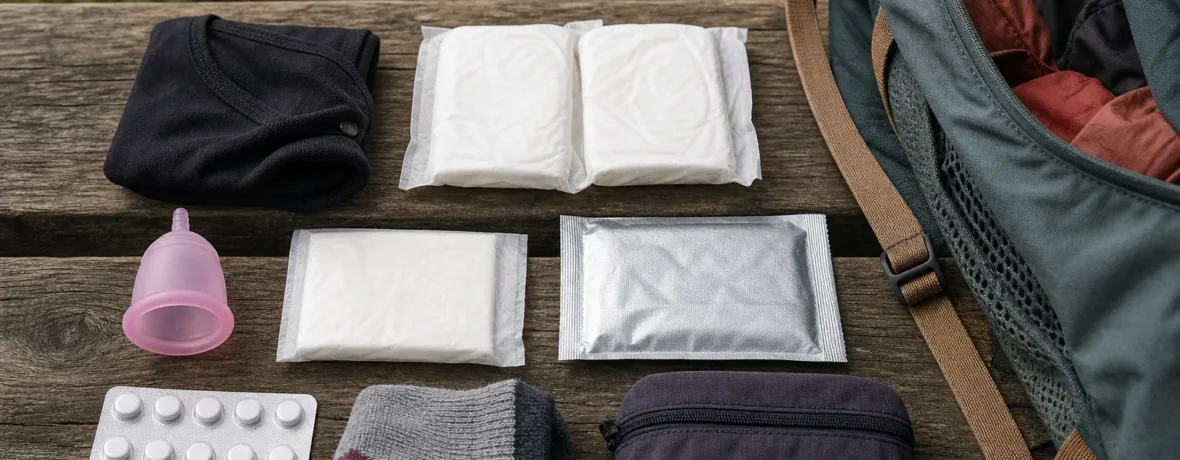
If you’re hiking on your period, pack your usual menstrual product plus one backup, a sealable waste bag, hand sanitizer, wipes or water, extra underwear, pain relief you already tolerate, and a dark liner or period underwear for leaks. For hikes over 4 hours, carry enough supplies for one full product change.
Can you go hiking on your period?
Yes, you can hike on your period if your symptoms are manageable and you pack for bleeding, hygiene, pain, and waste.
Menstruation is a normal body process, and the NIH’s Eunice Kennedy Shriver National Institute of Child Health and Human Development describes it as the shedding of blood and tissue from the uterine lining during the menstrual cycle. On trail, the issue usually is not the period itself. It is logistics.
You need a way to collect blood, keep your hands clean, prevent leaks, reduce chafing, and carry out used products. That is it. No drama.
If your cramps flatten you, your flow is heavier than usual, you feel dizzy, or you are soaking products faster than you can safely manage, shorten the hike or stay home. The mountain will still be there next weekend.
What should you pack when hiking on your period?
Pack a period kit small enough to grab fast and tough enough to keep clean items clean and dirty items sealed.
Use a pouch, zip bag, or small dry bag that lives near the top of your pack. Do not bury it under your puffy, snacks, and rain shell. When you need it, you want it now.
- Your preferred menstrual product: pads, tampons, cup, disc, or period underwear.
- One backup product beyond what you expect to use.
- A sealable waste bag for used pads, tampons, liners, wipes, and wrappers.
- A second clean bag for unused products.
- Hand sanitizer.
- Unscented wipes or a small bottle of water for rinsing hands and skin.
- Toilet paper or a pee cloth, depending on your system.
- Extra underwear in a small zip bag.
- A dark liner, thin pad, or period underwear for leak backup.
- Any pain relief you already use safely at home, packed in its original container or clearly labeled.
- A trowel or WAG bag if your route lacks toilets.
For a day hike under 4 hours, your kit can be tiny. For a full-day hike, pack for at least one change. For a backpacking trip, count your heaviest-flow day first, then add extras for delays, rain, altitude changes, or the classic surprise period that shows up 2 days early.
Are pads, tampons, cups, or discs better for hiking?
The best product is the one you can use cleanly, quickly, and confidently with cold hands, no sink, and a sloping patch of dirt.
The FDA’s menstrual product guidance groups common options into products that absorb flow outside the body, such as pads and period underwear, and products used inside the vagina, such as tampons, cups, and discs. Each has trail tradeoffs.
| Product | Best for | Trail drawbacks | Pack-out needs |
|---|---|---|---|
| Pads | Easy changes, no insertion, lighter-flow day hikes | Can bunch, chafe, hold sweat, and feel bulky | Pack out used pads and wrappers |
| Tampons | Swimming, high-output hiking, minimal bulk | Need clean hands; must be changed on schedule | Pack out used tampons, applicators, and wrappers |
| Menstrual cup | Long days, backpacking, reducing trash | Takes practice; messy if you are new to it | Pack out wipes; bury menstrual fluid only where human waste burial is allowed |
| Menstrual disc | Long wear for experienced users | Can be tricky to place and remove cleanly outdoors | Pack out wipes and any disposable disc |
| Period underwear | Leak backup, camp wear, light flow | Hard to rinse and dry on wet trips | Carry used pairs in a sealed bag |
If you want to switch products for hiking, test the new setup at home for a full cycle first. Then test it on a short local trail. A 12-mile [19 km] ridge walk is a bad classroom for learning how to break a cup seal.
Tampon users should follow the timing on the product label. The Office on Women’s Health says a tampon should not be worn for more than 8 hours because of toxic shock syndrome risk. On trail, set an alarm if you tend to lose track of time.
How do you change period products on trail?
Change products the same way you would at home, with extra attention to clean hands and waste control.
Pick privacy first. Step off the trail where allowed, but do not trample fragile plants or camp on a viewpoint just because the scenery is good. If you are also using the bathroom, follow the local land manager’s human-waste rules.
- Move 200 feet [61 m] from water, campsites, and trails if you need to pee or dig a cathole.
- Set your pack down where it will not roll downhill.
- Sanitize your hands before touching a tampon, cup, disc, or your skin.
- Put clean supplies within reach before removing the used product.
- Change the product while keeping wrappers, applicators, and wipes under control.
- Put used items straight into your waste bag.
- Sanitize again before touching snacks, trekking poles, your phone, or your water bottle.
Wind is the sneaky problem. Lightweight wrappers and wipes fly fast. Open only what you need, keep a knee or rock on the waste bag, and do not leave anything loose on duff, sand, snow, or granite.
How do you pack out period waste while hiking?
Pack out every used pad, tampon, liner, wipe, wrapper, applicator, and piece of period trash.
As of November 2026, the National Park Service advises hikers to carry a poop kit with hand sanitizer, toilet paper, a bag for packing out toilet paper and hygiene products, a trowel, and a WAG bag when needed; its cathole guidance uses 200 feet [61 m] from water, campsites, and trails and a hole 6 to 8 inches [15 to 20 cm] deep for human waste where catholes are allowed. Read the NPS Leave No Trace waste guidance before you go, then check the page for your specific park, forest, or wilderness area.
A good period waste bag is simple:
- Use a quart-size zip bag or odor-resistant bag.
- Line it with an opaque dog-waste bag, foil pouch, or duct tape for privacy.
- Add a small square of paper towel if you want extra absorption.
- Keep it in an outer pack pocket, not beside your lunch.
- Empty it only into a proper trash receptacle after the hike.
Do not bury pads or tampons. Do not burn them. Do not toss them in a pit toilet unless the site says that is allowed. Most plastic-backed products, applicators, wipes, and wrappers do not belong in the ground or in backcountry toilets.
How do you prevent leaks and chafing while hiking on your period?
Prevent leaks with redundancy, and prevent chafing by reducing bulk, moisture, and friction.
Trail movement is repetitive: hip belt, stride, sweat, dust, rain, more stride. A pad that feels fine at breakfast can become sandpaper by lunch. If pads usually irritate you, try a thinner pad with snug underwear, period underwear as backup, or an internal product you already know how to use.
- Wear breathable, snug underwear that holds products in place.
- Skip cotton underwear for long or wet hikes; it stays damp.
- Carry one spare pair of underwear in a dry bag.
- Use dark hiking bottoms on heavy-flow days.
- Change damp underwear at camp before you sleep.
- Use anti-chafe balm on thighs and skin folds, but keep it away from internal products.
- Do not use scented wipes, deodorant sprays, or fragranced products on vulvar skin.
If you leak, handle it fast and keep walking. Rinse skin with clean water, change underwear if needed, seal the dirty pair in a bag, and use your backup product. One leak does not end the hike unless you are cold, soaked, in pain, or out of supplies.
What helps period cramps while hiking?
For mild cramps, slow your pace, hydrate, eat salty food if you are sweating, use warmth at breaks, and take only pain relief you already know is safe for you.
Mayo Clinic lists menstrual cramp symptoms that can include lower-abdominal pain, pain radiating to the lower back and thighs, nausea, loose stools, headache, and dizziness. It also says cramps often peak 24 hours after bleeding starts and ease within 2 to 3 days for many people. See Mayo Clinic’s menstrual cramps guide for medical background and red flags.
On trail, keep the fixes practical:
- Start slower than your usual pace for the first mile [1.6 km].
- Loosen your hip belt for a few minutes if pressure worsens cramps.
- Take shorter steps on steep climbs.
- Use a small adhesive heat patch only if your skin tolerates it and you can check for irritation.
- Pack snacks you can eat even if you feel queasy.
- Avoid trying a new medication, supplement, or herbal product for the first time on trail.
If cramps are severe enough that you cannot walk normally, turn around. Toughing it out is not a badge of honor. It is how small problems become rescue problems.
Can bears smell period blood?
Menstruation has not been shown to be linked to known bear attacks, but you should still use unscented products and pack out all used items.
As of November 2026, Yellowstone National Park says there is no statistical evidence that known bear attacks have been related to menstruation, while recommending unscented or lightly scented menstrual products and packing out used items rather than burying or burning them. Read the park’s Yellowstone safety guidance if you are traveling in bear country.
Treat used menstrual products like other scented trash. Store them according to the local food-storage rules: bear canister, bear locker, hang, hard-sided vehicle, or other required system. Follow the land manager, not social media lore.
When to see a doctor
See a doctor if period pain disrupts your life every month, gets worse over time, starts as severe cramping after age 25, or comes with fever, unusual discharge, fainting, or bleeding that feels unsafe for you.
Do not use a hiking article to diagnose pelvic pain. Cramps can be primary menstrual cramps, but pain can also be connected to conditions that need care. Mayo Clinic specifically recommends medical care when cramps disrupt life monthly, symptoms progressively worsen, or severe cramps start after age 25.
Get urgent medical help if you use tampons, cups, or discs and develop sudden high fever, vomiting, diarrhea, rash, dizziness, faintness, or confusion during your period. Those symptoms can have several causes, and toxic shock syndrome is rare, but it is serious. Remove the internal product and seek medical care right away.
If you want to delay or suppress your period for a long expedition, talk with a clinician months ahead of time. The Wilderness Medical Society discusses menstrual management as part of expedition planning, especially when altitude, schedule disruption, illness, or long travel could complicate your usual routine.
How do you pack for a backpacking trip on your period?
For backpacking, multiply your day-hike kit by the number of bleeding days, then add backup supplies for one extra day.
Backpacking adds three problems: storage, privacy, and cleanup without a sink. Keep clean supplies in one bag and used supplies in another. At night, store used products where local rules say scented items go. In bear country, that usually means with food and trash in approved storage.
For reusable products, plan the rinse. A menstrual cup or disc can reduce trash, but it still requires clean hands. Bring enough water to rinse hands before and after. If water is scarce, tampons or pads may be cleaner for you, even if they create more trash. Choose the system you can execute well on day three, not the one that looks sleek in your living room.
For period underwear, pack one clean pair for daytime, one dry pair for sleeping, and a sealed bag for used pairs. Do not count on wet underwear drying overnight inside a tent. In humid forests and cold alpine camps, it may still be damp at breakfast.
What should you keep in a tiny emergency period kit?
Keep a mini kit in every hiking pack, even when your period is not due.
Cycles do not care what your calendar app says. Stress, travel, illness, and hard efforts can shift timing. A tiny kit weighs little and saves the day for you or someone else.
- One tampon or pad.
- One liner.
- Two unscented wipes.
- One pair of nitrile gloves if you like extra hand protection.
- One small zip bag for waste.
- Two pain-relief tablets you already tolerate, stored safely and labeled.
- One spare underwear pair for longer hikes.
Refresh the kit every season. Heat, pack compression, and random crumbs can wreck packaging. If a wrapper is torn, replace it.
Related reading
- A Walk in the Woods: Bill Bryson's AT Story vs Reality
- Kids' Hiking Boots: How to Size and When to Buy
- Mountain Porters: The People Who Carry Expeditions
- Teaching Leave No Trace to Kids
FAQ
Is hiking on your period bad for you?
No, hiking on your period is not bad for you if your symptoms are manageable. Stop or turn around if you feel faint, have severe pain, bleed much more than usual, or cannot stay clean and comfortable.
Can I wear a menstrual cup while hiking?
Yes, you can wear a menstrual cup while hiking if you already know how to insert, remove, empty, and clean it. Practice at home first, because trail conditions make learning messier.
How many tampons should I bring on a hike?
Bring the number you normally use for that time window, plus one extra. For a full-day hike, many hikers pack enough for one scheduled change and one backup, then adjust for heavy-flow days.
Do I have to pack out used tampons and pads?
Yes, pack out used tampons, pads, liners, applicators, wrappers, and wipes. Put them in a sealed bag and throw them away after the hike in a proper trash receptacle.
What if I get my period unexpectedly on trail?
Use your emergency kit, shorten the hike if needed, and protect your clothing with a liner, pad, tampon, or folded clean cloth until you can get proper supplies. If you have no safe way to manage bleeding or hygiene, head back.
Can I swim or cross water while on my period?
Yes, you can swim or cross water while on your period if you use an internal product such as a tampon, cup, or disc and change or clean it on schedule. Do not rinse bloody products directly in lakes, streams, or rivers; step well away from water sources and pack out waste.