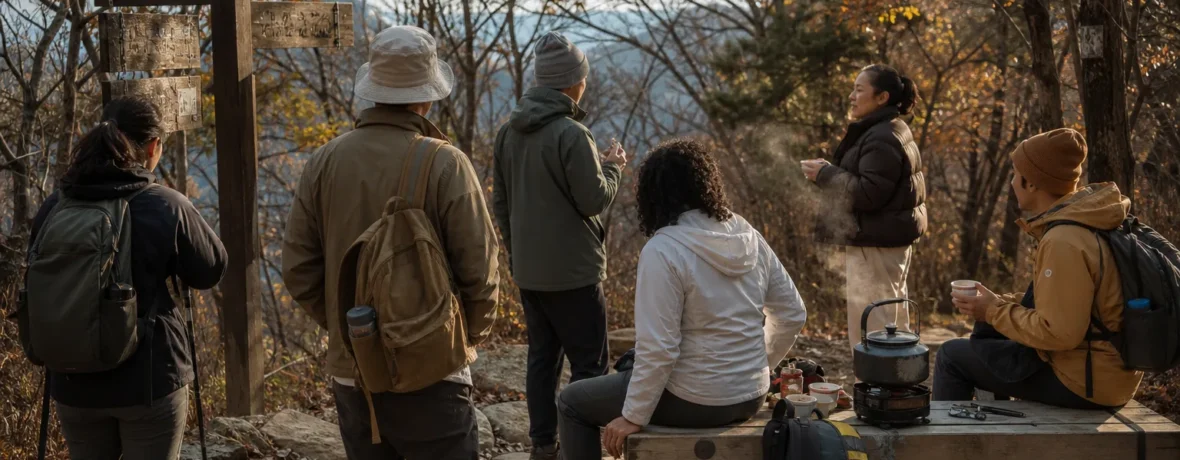
Hiking culture is the shared trail behavior that tells you who yields, where you may walk, how loudly you talk, and what respect looks like outside. There is no single global version: learn 5 patterns—access, pace, gear, hospitality, and stewardship—and you can hike respectfully in most countries.
What does hiking culture mean around the world?
Hiking culture means the local code for moving through land on foot.
That code can be legal, like public access rules. It can be social, like greeting every passing hiker. It can be spiritual, like treating a mountain path as a pilgrimage route rather than a workout lane. The mistake is assuming your home trail habits travel well.
Here is the straight position: good hikers are not the ones with the newest pack or the fastest summit time. Good hikers read the room. Or the valley. Or the village at the trailhead. They adapt.
On a crowded US national park trail, that may mean staying on the hardened tread, packing the Leave No Trace 7 Principles into every decision, and stepping aside before you block a switchback. In Scotland, it may mean understanding that broad access comes with broad responsibility. In Japan, it may mean walking a historic route with the humility you would bring to a shrine gate.
Why is hiking culture different from country to country?
It differs because land is owned, protected, farmed, worshiped, and shared in different ways.
That sounds obvious until you are standing at a gate wondering if “private” means “keep out” or “close it behind you.” In some places, walking across working land is normal when done respectfully. In others, leaving a signed trail can damage fragile habitat, violate property rights, or put you in real danger.
| Place | What shapes the trail culture | What you should do |
|---|---|---|
| United States | Public lands, permits, wilderness ethics, heavy visitation | Check official land-manager rules, stay on trail, carry the essentials |
| Scotland | Responsible access rights across much land and inland water | Act responsibly, avoid disturbing homes, crops, livestock, and wildlife |
| Switzerland | Highly organized trail networks and sign systems | Respect route grades, timing signs, weather, and alpine exposure |
| Japan | Pilgrimage routes, mountain spirituality, village etiquette | Keep noise down, respect shrines, and treat routes as cultural places |
Switzerland shows how infrastructure can become culture. The Swiss federal portal describes a network of 40,389 miles [65,000 km] of walking, mountain, and alpine trails, with signs and maps that make hiking feel orderly without making mountains harmless. That system tells you something: preparation and precision are part of the walk there. See the Swiss government’s overview, On the Trail: Hiking in Switzerland.
How do trail rules and access rights change hiking culture?
Access rules teach hikers what freedom is supposed to look like.
As of November 2026, Scotland’s Outdoor Access Code says people can enjoy the outdoors on most land and inland water if they act responsibly. It also recognizes responsible lightweight camping in small numbers for 2 or 3 nights in one place. That creates a different mindset than a place where every trailhead begins with a permit board. Read the official Scottish Outdoor Access Code before you assume “right to roam” means “do whatever you like.” It does not.
In the United States, trail culture often runs through agencies: National Park Service, Forest Service, Bureau of Land Management, state parks, tribal lands, county preserves. One canyon may need a permit. The next ridge may not. One area may allow dogs. Another may ban them to protect wildlife or drinking water. A burn scar may be closed while the map app still shows a line.
That is not red tape for its own sake. It is how crowded landscapes survive. The more people love a place, the less “I didn’t know” works as an excuse.
What trail etiquette should you follow in any country?
Follow the strictest local rule and the kindest local custom.
If you only remember one sentence, make it that one. Trail etiquette is not a personality test. It is a friction reducer. It keeps hikers, locals, animals, and land managers from paying for your blind spots.
- Read official information first. Check the land manager, tourism board, park office, or hut operator before trusting social media.
- Learn the access norm. Find out if gates, farms, shrines, private forests, beaches, and grazing land are open to walkers.
- Match the local volume. If everyone is quiet, be quiet. Your speaker is not a passport.
- Yield early. Uphill hikers, livestock, porters, horse riders, and narrow-trail traffic all deserve room before the awkward moment.
- Handle waste like an adult. Pack out trash. Know toilet rules before you need them.
- Spend locally when routes pass through villages. Buy food, pay hut fees, use official shuttles, and do not treat residents as scenery.
- Change plans without drama. Weather, closures, sacred events, fire risk, and rescue capacity matter more than your itinerary.
Is hiking a sport, a pilgrimage, or a social activity?
It can be all 3, but the local meaning should set your tone.
In parts of the US, hiking leans athletic: mileage, elevation gain, fastest known times, summit lists, ultralight kits. That can be fun. It can also turn every trail into a leaderboard, which is a small way to miss a big place.
On Japan’s Kumano Kodo, the framing is different. Official tourism sources describe the routes as historic pilgrimage paths tied to sacred sites, local communities, and gratitude toward nature. That does not mean you cannot sweat. It means the sweat is not the whole story. The official Wakayama guidance on Kumano Kodo rules and etiquette makes clear that walkers are entering cultural heritage, not just a scenic corridor.
In hut cultures across the Alps, hiking may be social in a way that feels strange to hikers used to solitude. You may share tables, bunks, drying rooms, and weather talk with strangers in four languages. Your manners matter because the hut is part of the trail.
What gear habits say about hiking culture?
Gear habits reveal what a hiking community fears, values, and rewards.
A desert hiker talks about water capacity. A Scottish hillwalker talks about wind, rain, and bog. A Swiss hiker respects footwear and route markings because a “trail” may tilt into terrain where a slip carries consequences. A US thru-hiker may care deeply about pack weight because 20 miles [32 km] feels different on day 90 than day 1.
The danger is turning your gear culture into moral superiority. Heavy boots are not foolish everywhere. Umbrellas are not silly everywhere. Trail runners are not magic everywhere. A cotton shirt may be harmless on a short lowland stroll and reckless above treeline in cold rain.
For US national parks, the National Park Service tells hikers to plan ahead, know the trail, and carry the 10 essentials through its Hike Smart guidance. That advice travels well because it is built around judgment, not brand names.
- Carry the safety basics for the worst reasonable conditions, not the best forecast.
- Use local maps and signs, not just a phone track.
- Ask what locals carry and why.
- Choose gear that fits the route, season, and rescue reality.
How can you be a respectful hiker abroad?
Do less assuming and more observing.
Start before the trailhead. Learn a few local phrases: hello, thank you, excuse me, is this the path, may I pass. Read signs even if you need translation. If a custom feels inefficient, resist the urge to “fix” it. You are a guest moving through someone else’s backyard, workplace, watershed, or sacred ground.
The best global hiking culture is not bland sameness. It is not every trail becoming a US-style park path with identical signs, identical posts, and identical rules. The beauty is difference. Yellow Swiss signs. Scottish access responsibility. Japanese pilgrimage manners. American wilderness ethics. New Zealand care for place and community. Each one teaches a useful habit.
Here is the argument: the future of hiking depends less on getting more people outside and more on getting more people outside with better manners. Crowding is not solved by vibes. Trail damage is not solved by hashtags. Local resentment is not solved by telling residents they should be grateful for tourism.
Walk softly, yes. But also walk intelligently. Learn the local code, carry what the route demands, pay where payment supports the trail, and leave room for people whose relationship with that place is older and deeper than your trip.
Related reading
- Type 2 Fun: Why Hard Hikes Feel Good Later
- The Seven Summits Explained
- What Is Geocaching?
- What Is Hiking, Really? A Definition Worth Arguing About
FAQ
What is hiking culture?
Hiking culture is the shared set of trail habits, ethics, rules, and expectations in a place. It covers access, greetings, waste, safety, gear, pace, camping, and respect for local communities.
Which country has the best hiking culture?
No country has the single best hiking culture. Switzerland excels at trail infrastructure, Scotland at responsible access, Japan at cultural reverence, and the US at large-scale public-land hiking ethics.
Do hikers greet each other everywhere?
No, greetings vary by place and crowd level. On quiet rural or mountain trails, a greeting is common; on packed urban trails, a nod or simple pass may be enough.
Is wild camping accepted around the world?
No, wild camping rules vary sharply by country, region, landowner, and protected area. Check official local guidance every time, because access rights in one place do not transfer to another.
How do I avoid being a rude tourist on a trail?
Read official trail information, keep noise low, respect signs, control your group, and spend money in local communities when appropriate. If locals are doing something differently, watch first and copy the respectful pattern.
Does Leave No Trace apply outside the United States?
Yes, the ideas travel well, but local rules still come first. Use Leave No Trace as a baseline, then add the specific access laws, cultural customs, and safety practices of the place you are hiking.