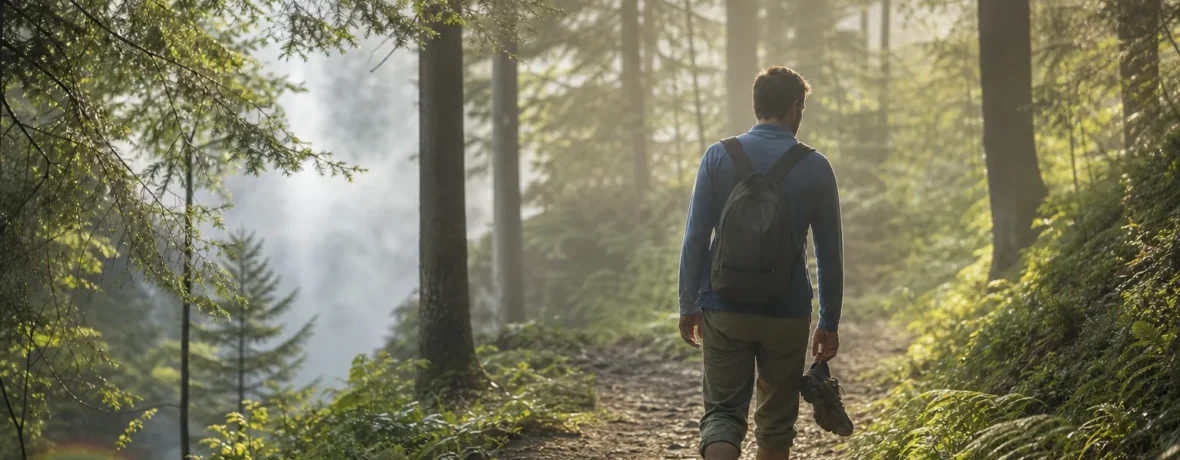
Hiking works as meditation if you treat the walk as practice, not performance. For 10-30 minutes, slow your pace, match steps to breath, notice one sense at a time, and return attention whenever it wanders. You still hike safely, but the goal shifts from miles to presence.
What does hiking as meditation mean?
It means using the trail as your attention practice.
The position here is simple: a hike does not become meditation just because trees are nearby. Plenty of hikers spend 6 miles [9.7 km] replaying work drama, checking pace, judging their legs, and bargaining with the next uphill. That is exercise in a pretty place. Good exercise, sure. Not meditation.
For a hike to work as meditation, you need an anchor. In seated meditation, that anchor is often the breath. On trail, it can be your footfall, breath, sound, body sensation, or the visual rhythm of the path. Your job is not to empty your mind. Your job is to notice when the mind runs off, then come back. Again. And again. That is the whole practice.
This is why hiking can be a strong doorway for restless people. Sitting still can feel like being trapped inside a buzzing machine. Walking gives the body a job. The mind has less room to spin when your boots are solving roots, rocks, mud, grade, and balance in real time.
How do you practice mindful hiking on the trail?
Start with 10 minutes and one point of attention.
Do not try to make the entire day sacred. That is how people turn a simple tool into another performance. Pick one stretch of trail: the first 10 minutes after the trailhead, a flat section near water, or the final half-mile [0.8 km] back to the car. Then practice like this:
- Set an intention before you move. Try: “For the next 10 minutes, I am walking to pay attention.” That is enough.
- Slow your pace by one notch. You do not need to creep. Walk at a pace where you can breathe through your nose for several steps or speak in short sentences.
- Choose one anchor. Use footfalls, breath, birdsong, the swing of your arms, or the feel of your pack straps.
- Name distractions without drama. “Planning.” “Worry.” “Memory.” “Judging.” Then return to the anchor.
- Use the terrain. On climbs, count four steps in and four steps out. On descents, soften your knees and feel each foot land.
- Close the practice. Stop for 20 seconds. Look around. Notice one sound, one color, and one body sensation before hiking on.
That is the whole recipe. Simple. Not easy. Your attention will bolt like a spooked deer. Let it. Bring it back without scolding yourself.
Can hiking replace sitting meditation?
No, but it can stand on its own as a serious practice.
Sitting meditation trains stillness. Walking meditation trains attention while moving through the real world. Hiking adds weather, grade, effort, navigation, and discomfort. That makes it messier. It also makes it useful.
The National Center for Complementary and Integrative Health says mindfulness and meditation practices have been studied for stress, anxiety, depression symptoms, pain, and other conditions, while the strength of evidence varies by condition. Read their plain-language review of meditation and mindfulness effectiveness and safety.
The case for hiking is not that it is magically better than sitting. The case is that many people will actually do it. A 30-minute walk on a dirt path can count toward your weekly movement and train attention at the same time. The CDC recommends adults get 150 minutes of moderate-intensity aerobic activity each week, plus muscle-strengthening activity on 2 days; brisk walking can count when it raises your heart rate and breathing. See the CDC’s adult physical activity guidance.
| Approach | Main goal | Best use |
|---|---|---|
| Regular hike | Reach a viewpoint, finish miles, enjoy the outdoors | Fitness, fun, scenery, social time |
| Fitness hike | Build endurance, speed, strength, or climbing ability | Training days and bigger objectives |
| Meditative hike | Train attention through breath, senses, and movement | Stress reset, focus practice, calmer trail time |
What should you focus on while walking?
Focus on something steady enough to return to.
The breath is the cleanest anchor because it travels with you. But on trail, the breath changes with grade, altitude, heat, and effort. So give yourself options.
- Footfalls: Feel heel, midfoot, toe. Then the other side. Repeat.
- Breath rhythm: Try three steps in, three steps out on easy ground; shorten the count on climbs.
- Sound: Listen for the farthest sound, then the nearest sound, then your own breath.
- Vision: Keep a soft gaze 6-10 feet [1.8-3 m] ahead, wide enough to stay safe.
- Body scan: Notice jaw, shoulders, hands, belly, hips, knees, feet.
Do not stare at one leaf and trip over a rock. Trail awareness comes first. The practice is not to disappear from your surroundings. The practice is to enter them more fully.
How long should a meditative hike be?
Ten minutes is enough to begin.
A 2-hour silent hike sounds noble until your phone buzzes, your stomach growls, and your brain starts composing emails. Start smaller. Ten minutes builds the habit. Twenty minutes deepens it. Thirty minutes can shift the mood of an entire day.
If you like structure, use this 30-minute format:
- Minutes 0-5: Walk normally and let your body warm up.
- Minutes 5-15: Use footfalls as your anchor.
- Minutes 15-25: Open to sounds, smells, light, air, and temperature.
- Minutes 25-30: Walk with no special target. Notice what is already here.
Longer is not always better. Better is better. If you can give 12 honest minutes to the trail without turning the practice into another achievement badge, that beats 2 distracted hours.
What gear helps without turning it into another project?
Use the gear that keeps you safe and lets you forget the gear.
You do not need a special cushion, incense, linen pants, or a new identity. You need the same basics any sensible hiker carries, scaled to the trail and conditions.
- Comfortable shoes or boots with enough traction for the surface
- Water and snacks for the route length, heat, and your body
- Sun protection, insulation, and rain protection when conditions call for them
- A map, downloaded route, or navigation tool you know how to use
- A small first-aid kit
- A watch or timer if you want a defined practice window
Leave one thing behind when you can: constant audio. Music and podcasts are not evil. They are also not the same as listening to the trail. If silence feels harsh, try 10 minutes without earbuds before you press play.
When to see a doctor
Get medical help when symptoms, injury, heat, or mental health concerns make hiking unsafe.
Meditation is not a substitute for medical care. Mayo Clinic says meditation may help with stress and can be practiced while walking, but it does not replace treatment; for some people, meditation may worsen symptoms linked to certain mental health conditions. See Mayo Clinic’s overview of meditation and stress.
Talk with a health care professional before increasing hiking intensity if you have a chronic condition, have been inactive, are recovering from injury, or have concerns after symptoms on trail. Call 911 for chest pain or discomfort, shortness of breath, faintness, cold sweat, nausea, or pain in the jaw, neck, back, arm, or shoulder, following the CDC’s heart attack symptom guidance.
Heat deserves respect. The Wilderness Medical Society describes heat stroke as severe heat illness with a core temperature above 104°F [40°C] and central nervous system problems such as altered mental status, seizure, or coma. Its 2024 heat illness guideline also warns that heat exhaustion can progress if untreated. If someone is confused, collapses, has a seizure, or cannot care for themselves in heat, treat it as an emergency.
Related reading
- Bear Spray vs Pepper Spray: What's the Difference?
- Hiking as a Couple: Tips for Sharing the Trail
- Hiking as a Family: Kids’ Boots, Realistic Distances and Keeping It Fun
- Type 2 Fun: Why Hard Hikes Feel Good Later
FAQ
Is hiking as meditation the same as walking meditation?
Not exactly. Walking meditation is often done on flat ground in a slow, repeated pattern, while trail practice includes uneven terrain, navigation, weather, and effort.
Do I need to hike alone to meditate?
No. Solo hiking can make attention easier, but a quiet partner works too. Agree on a 10- to 20-minute silent section, then talk before or after it.
Can I use trekking poles during a meditative hike?
Yes. Poles can become the anchor: plant, step, plant, step. Keep the rhythm soft enough that you still hear your breath and the trail around you.
What if my mind never gets quiet?
That is normal. The win is noticing the wandering and returning to the trail. A busy mind can still practice well.
Should I use a meditation app while hiking?
Use one only if it helps you begin. After a few sessions, try hiking without prompts so the trail itself becomes the teacher: breath, steps, wind, grade, and ground.