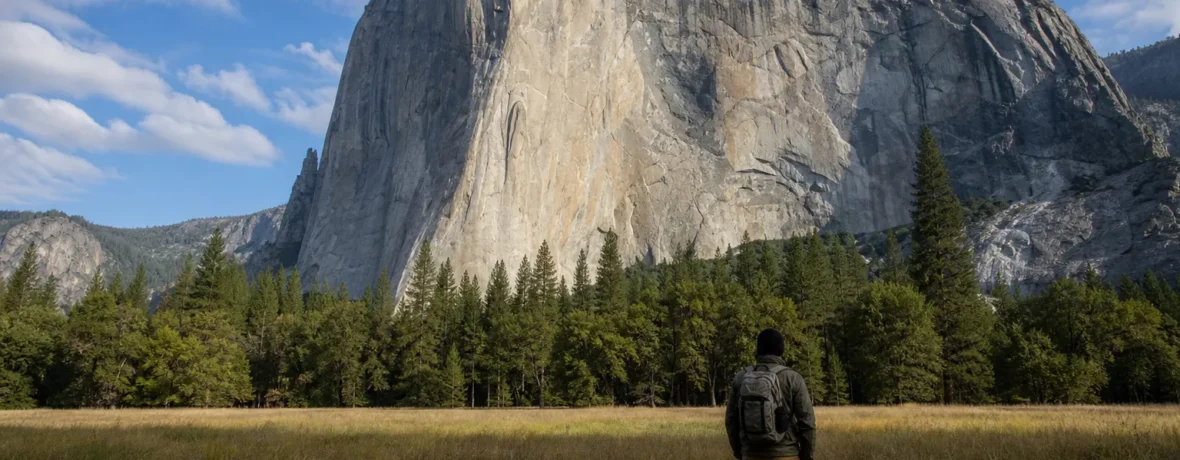
Yes, you can hike El Capitan by taking the back-side trail from Yosemite Valley, most often via the Yosemite Falls Trail and north-rim route. Plan for a strenuous full day: 15–17 miles [24–27 km] round trip, more than 4,500 feet [1,372 m] of gain, and 8–12 hours on trail.
Can you hike El Capitan without climbing?
Yes. The hiking route reaches El Capitan from behind, not up the wall. You do not need ropes, climbing gear, or big-wall skills if you stay on the hiking trail.
That surprises people because El Capitan’s famous face is nearly vertical. From the Valley floor, it looks impossible. But the summit is connected to Yosemite’s north rim by forested terrain, slabs, and maintained trail sections. You climb out of Yosemite Valley, pass the top of Yosemite Falls area, then travel west across the rim toward El Capitan.
This is still a serious hike. It is long, steep, hot in summer, icy in winter, and easy to underestimate after the Yosemite Falls climb has already taken a bite out of your legs.
What is the back-side trail to El Capitan?
The back-side trail is the north-rim hiking approach that reaches El Capitan from above and behind. The most common version starts near Camp 4 on the Yosemite Falls Trail, then continues west toward Eagle Peak and El Capitan.
Yosemite National Park lists Eagle Peak from the Yosemite Falls Trailhead as 12.6 miles [20.2 km] round trip with 3,770 feet [1,150 m] of gain, and notes that hikers continue in the direction of El Capitan from there on the north rim; see the park’s Yosemite Valley trails guide. The full El Capitan summit hike adds more mileage beyond the Eagle Peak junction.
| Route | Best for | What you get |
|---|---|---|
| Yosemite Falls Trail from the Valley | Strong day hikers who want the classic climb | Huge elevation gain, Yosemite Falls views, north-rim travel, El Capitan summit |
| Tamarack Creek / Tioga Road approach | Backpackers or hikers starting from the high country when the road is open | Longer forest travel with less brutal climbing from the Valley floor |
| Old Big Oak Flat Road area | Experienced route planners | Alternative access, less straightforward logistics, careful map work required |
How hard is the El Capitan hike?
It is very hard as a day hike. The grade, distance, sun exposure, and total time make it a step above casual Yosemite sightseeing.
The first major challenge is the Yosemite Falls Trail. NPS describes it as steep and strenuous; the route to the top of Yosemite Fall alone is 7.2 miles [11.6 km] round trip with 2,700 feet [823 m] of elevation gain. You can check the official Yosemite Falls Trail page before building your plan.
Then comes the mental part. Once you reach the rim, El Capitan is still not right there. You still need to roll west through forest, junctions, granite, and rolling trail. Save energy for the return. The descent down Yosemite Falls can feel rougher than the climb, especially on hot afternoons when your feet are tired and the stone steps start punching back.
How do you hike to the top of El Capitan from Yosemite Valley?
Start early and follow the north-rim route carefully. A pre-dawn start is normal for fit hikers doing El Capitan as a day trip.
- Start at the Yosemite Falls Trailhead near Camp 4. Fill water before you leave the Valley. Do not count on easy water later in the season.
- Climb the Yosemite Falls Trail. You pass Columbia Rock, keep grinding upward, and eventually reach the rim near the top of Yosemite Falls.
- Follow signs toward El Capitan. From the rim, go west rather than east toward Yosemite Point or North Dome.
- Consider Eagle Peak if time allows. Eagle Peak is a worthy side trip, but it adds effort. If the day is slipping away, stay focused on El Capitan.
- Continue to the El Capitan summit area. The top is broad, wooded, and less dramatic than the cliff face looks from below. The magic is knowing what drops away beyond the rim.
- Turn around early enough. Do not let summit fever push you into a dark, exhausted descent without water, layers, and a headlamp.
Do you need a permit to hike El Capitan?
For a day hike, no wilderness permit is required unless your plan includes Half Dome. For an overnight trip, yes, you need a Yosemite wilderness permit year-round.
As of November 2026, NPS states that wilderness permits are required for backpacking, overnight climbing, or any overnight stay in the Yosemite Wilderness, but not for normal day hikes except Half Dome when permits apply. Check the official Yosemite wilderness permits page before planning an overnight route.
You still need to enter Yosemite legally. As of November 2026, the standard Yosemite entrance fee is $35 per private vehicle for seven consecutive days, and NPS says no reservation is required to enter Yosemite in 2026. Confirm current pricing and entry rules on the official Yosemite fees and passes page.
When is the best time to hike El Capitan?
Late spring through fall is the normal window, with the cleanest conditions usually after major snow has melted and before winter storms return.
Spring gives you stronger waterfall flow, but lingering snow and wet crossings can complicate travel on the rim. Summer gives longer daylight, but the Yosemite Falls climb can bake. Fall often brings cooler hiking weather, shorter days, and lower water availability.
Winter is a different animal. As of November 2026, NPS warns that Yosemite trails can close for rockfall, snow, ice, or fire hazards, and that open trails may still be snowy and difficult to follow from November through May or June. Check Yosemite current conditions close to your hike date, not a month before.
What should you pack for the El Capitan hike?
Pack like you are committing to a long mountain day. Because you are.
- Topo map or offline GPS map, plus a backup battery
- Headlamp, even if you plan to finish before dark
- 3–4 liters of water capacity, more in heat
- Water filter or treatment if you plan to refill from natural sources
- Salty food and real calories, not just bars you are already sick of
- Sun hoodie or hat, sunglasses, and sunscreen
- Light insulating layer and rain shell
- First-aid kit and blister care
- Trekking poles for the long descent
- Microspikes when ice is possible
Food storage rules matter even on day hikes. Keep food within arm’s reach while eating or resting, and never leave a pack unattended. For overnight trips, Yosemite requires approved bear-resistant storage; see the park’s food storage and bear canister guidance.
Is the El Capitan summit viewpoint scary or exposed?
The hiking route itself is not a cliff climb, but the summit area demands respect. Stay well back from edges, especially on slick granite or in wind.
Many hikers expect a neat summit sign and a clean railing. That is not what El Capitan gives you. The top is a natural granite-and-forest rim, and the most dangerous places are the ones where curiosity pulls you toward the drop. Get your photos from safe ground. No photo is worth a slip.
Is hiking El Capitan worth it?
Yes, if you want a demanding Yosemite hike with a huge sense of place. No, if you mainly want the best classic view into Yosemite Valley for the least effort.
The summit of El Capitan is meaningful because of where you are standing, not because it gives the single cleanest Valley panorama. Eagle Peak and Yosemite Point can feel more scenic to some hikers. El Capitan feels more legendary. Different reward.
Related reading
- How Long Is the Appalachian Trail? Miles, States and Time
- How to Plan a Camping Trip
- Where Does the Appalachian Trail Start and End?
- How to Start Camping: A Beginner's Guide
FAQ
Can beginners hike El Capitan?
Most beginners should not make El Capitan their first big Yosemite hike. Build up with shorter steep trails first, then try El Capitan when 15 miles [24 km] and a full-day climb feel realistic.
How long does it take to hike El Capitan?
Plan for 8–12 hours from Yosemite Valley. Strong, efficient hikers may move faster, but breaks, heat, route-finding, and the descent can stretch the day.
Can you camp on top of El Capitan?
You can only camp overnight in Yosemite Wilderness with the proper wilderness permit and legal food storage. Do not assume the summit itself is a free-for-all campsite; plan your exact itinerary through NPS permit rules.
Is the El Capitan hike the same as climbing El Capitan?
No. Hiking El Capitan uses trails to reach the top from the back side. Climbing El Capitan means ascending the vertical granite wall by technical climbing routes.
Do you need a Half Dome permit for El Capitan?
No. A Half Dome permit is not needed for a standard El Capitan hike. You only need a Half Dome permit if your itinerary includes Half Dome when the cables are up.
Where does the El Capitan hike start?
The classic day-hike version starts at the Yosemite Falls Trailhead near Camp 4 in Yosemite Valley. From there, you climb to the rim and head west toward El Capitan.