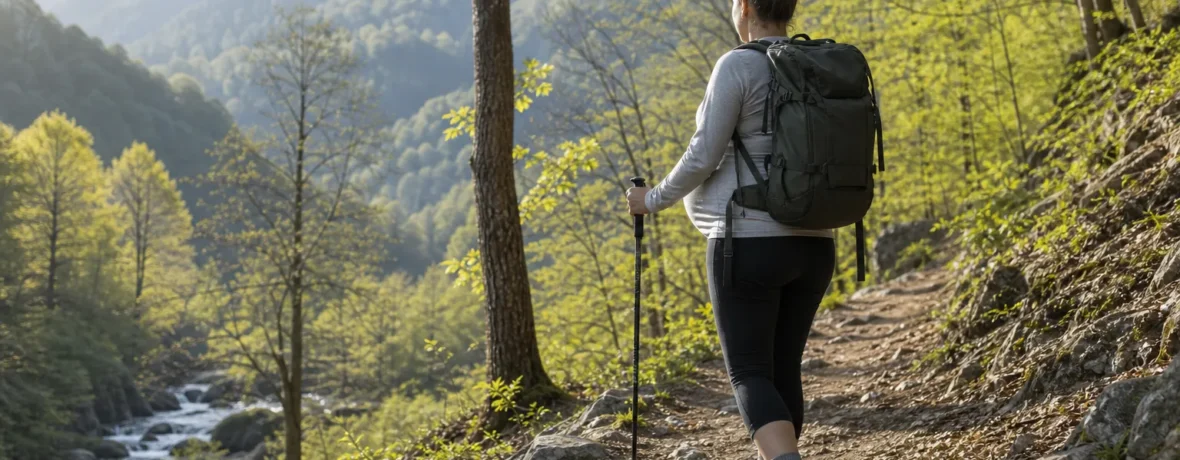
Hiking while pregnant is usually safe for a healthy, uncomplicated pregnancy if you keep the pace moderate, avoid overheating, choose stable trails, and stop for warning symptoms. Aim for conversational effort, shorter loops, more snacks and water, and doctor approval for high altitude, bleeding, contractions, dizziness, or any pregnancy complication.
Is hiking safe during pregnancy?
Yes, for many pregnancies.
If your pregnancy is healthy and your clinician has not restricted exercise, trail walking can fit well into the weekly movement target recommended by the CDC. As of November 2026, the CDC guidance for pregnant and postpartum women recommends at least 150 minutes of moderate-intensity aerobic activity each week. That can be 30 minutes on 5 days, one mellow weekend hike plus shorter walks, or whatever pattern your body tolerates.
The key word is moderate. You should be able to talk in full sentences without gasping. If you are huffing too hard to answer a simple question, back off. Slow down. Stop in shade. Turn around early. The summit will not care.
Hiking also has trail-specific risks that a treadmill does not: loose rock, mud, water crossings, heat, lightning, altitude, ticks, remoteness, and the long walk back to the car. During pregnancy, the smart move is not to quit the outdoors. It is to trim the margin for error.
Hiking while pregnant: what changes by trimester?
Each trimester changes the plan.
Your route, pace, pack weight, and bailout options should shift as your body shifts. A trail that felt breezy before pregnancy may feel clunky at 10 weeks, smooth at 20 weeks, and awkward at 34 weeks. That is normal trail math.
| Trimester | Common trail issue | Best hiking style | Smart adjustment |
|---|---|---|---|
| First: weeks 1-13 | Nausea, fatigue, smell sensitivity, frequent bathroom stops | Short loops, familiar parks, easy exits | Start later if mornings are rough; carry bland snacks and extra fluids |
| Second: weeks 14-27 | More energy for some hikers, changing balance, round ligament discomfort | Moderate day hikes on stable tread | Use trekking poles and avoid trails where a slip has consequences |
| Third: week 28 to birth | Shorter stride, pelvic pressure, swelling, slower recovery | Local trails, smooth grades, frequent breaks | Stay close to the trailhead and hike with a partner |
First trimester: can you hike when you feel wiped out?
Yes, if symptoms are mild and you feel steady.
The first trimester can be sneaky hard. You may not look pregnant, but your energy can fall off a cliff. Pick trails where you can be back at the car quickly. A 1-mile [1.6 km] nature loop may beat a 7-mile [11.3 km] ridge walk, even if your pre-pregnancy self would have laughed at that sentence.
Keep snacks easy to eat: crackers, pretzels, dried fruit, nut butter packets, cheese, trail mix, or whatever your stomach accepts. If nausea hits, stop before you get shaky. If vomiting, dizziness, or dehydration becomes a pattern, skip the hike and call your clinician.
Second trimester: is this the best time for trails?
Often, yes.
Many hikers feel their strongest in the second trimester. Nausea may ease, energy may return, and the belly is not yet doing full third-trimester physics. This is the window when mellow scenic hikes can feel fantastic.
Still, do not confuse “better” with “bulletproof.” Your center of gravity is changing. Joints may feel looser. Downhill steps can feel less precise. Use trekking poles before you think you need them. Choose switchbacks over steep gullies. Save scrambly routes, exposed ledges, and sketchy creek crossings for another season.
Third trimester: should you stay on easy trails?
Usually, yes.
Late pregnancy rewards boring routes. That sounds dull until you are 2 miles [3.2 km] from the car with pelvic pressure, swollen feet, and a bladder with the storage capacity of a thimble. Choose wide trails, gentle grades, and short loops where you can stop without drama.
Third-trimester hikes are not failed hikes because they are short. They are successful if you get fresh air, move well, stay safe, and return with energy left. Leave the “push through” mindset at home.
How hard can you hike while pregnant?
Use the talk test.
Moderate effort means you can speak in full sentences. You are working, but you are not straining. The NIH/NIDDK pregnancy activity tips also favor moderate activities that are less likely to cause injury, such as walking, and recommend avoiding brisk outdoor exercise in very hot weather.
If you were hiking regularly before pregnancy, you may be able to keep hiking with scaled-down goals. If you were not active before pregnancy, start with flat walks first. Try 10 to 20 minutes on even ground, then add time gradually if you feel good afterward.
Here is a simple trail effort scale:
- Green light: you can talk, your footing feels solid, symptoms are mild or absent, and you recover well after breaks.
- Yellow light: you need more stops than expected, feel overheated, feel lightheaded on climbs, or notice pelvic pressure. Slow down or turn around.
- Red light: bleeding, fluid leakage, chest pain, faintness, painful regular contractions, severe headache, calf swelling or pain, or shortness of breath before exertion. Stop and get medical help.
How do you plan a safer pregnant hike?
Plan the exit first.
The best pregnancy hikes have options. You want shade, water access if available, cell service if possible, bathrooms near the start, and a route that does not force you to finish a long loop when you already know you are done.
- Ask your prenatal clinician about your plan. Mention distance, elevation gain, altitude, heat, remoteness, and whether you will be alone.
- Pick a familiar trail. Pregnancy is not the ideal time to test a faint route with poor signage and surprise scrambling.
- Cut your normal distance. Start with less than you think you can do. Add only if you still feel good near the end.
- Check the weather close to departure. Heat, smoke, thunderstorms, and icy footing all change the risk fast.
- Use an out-and-back or short loop. Big point-to-point days leave fewer choices.
- Tell someone your route and return time. Share the trailhead, route name, and who is with you.
- Turn around early. If your body sends a clear “no,” listen the first time.
What should you pack for hiking during pregnancy?
Pack for comfort and a fast turnaround.
You do not need to carry the whole nursery. You do need enough to prevent small annoyances from becoming long, miserable walks.
- Water, plus a plan to drink before you feel thirsty
- Salty and carb-rich snacks you can tolerate
- Electrolyte drink or mix if your clinician says it fits your needs
- Trekking poles for balance, especially on descents
- Comfortable shoes with room for swelling
- Moisture-wicking layers and a sun hat
- Rain shell or wind layer
- Small first-aid kit
- Phone, map, and offline navigation
- Headlamp, even on short hikes
- Bathroom kit: toilet paper, hand sanitizer, waste bag, and trowel where appropriate
- Pregnancy-safe insect repellent and sunscreen approved by your clinician
- Medical info card with emergency contact and your prenatal provider’s number
Keep the pack light. If you are hiking with someone else, hand off shared gear. No prize is given for carrying the stove, water filter, group snacks, and everyone’s emotional baggage.
How do heat, altitude, and remote trails change the risk?
They shrink your safety margin.
Heat hits harder in pregnancy. Your body is already working at a higher baseline, and overheating can make a mild hike feel ugly fast. Start early, choose shade, avoid exposed climbs in hot weather, and cancel when the forecast looks punishing. The Mayo Clinic guidance on exercise during pregnancy lists dizziness, headache, chest pain, increased shortness of breath before exercise, vaginal bleeding, painful contractions, fluid leakage, calf pain or swelling, and balance-affecting weakness as reasons to stop and contact a health care provider.
Altitude deserves extra caution. As of November 2026, the CDC Yellow Book high-altitude travel guidance says high-altitude travel during pregnancy warrants confirmation of good maternal health and a low-risk pregnancy, and notes that clinicians may advise pregnant travelers not to sleep above 10,000 ft [3,050 m]. The same CDC page summarizes Wilderness Medical Society altitude illness guidance recommending gradual ascent for travelers sleeping high, including avoiding a one-day jump to a sleeping altitude of 9,000 ft [2,750 m] or higher.
Remote terrain adds another layer. If a trail has no cell service, no shade, steep loose descents, or a long evacuation, ask yourself one blunt question: would this still be a good plan if you had to stop right now? If not, choose a different trail.
When to see a doctor
Call your clinician for any warning sign.
Do not try to diagnose trail symptoms on your own. Stop hiking, sit or lie in a safe place, cool down if needed, and contact medical help if something feels wrong.
Get medical advice before hiking if you have been told you have a high-risk pregnancy, placenta problems, preeclampsia or high blood pressure concerns, severe anemia, heart or lung disease, preterm labor risk, ruptured membranes, significant bleeding, or restrictions on exercise. Also ask first if you are carrying multiples or planning high-altitude travel.
Stop hiking and seek care for:
- Vaginal bleeding
- Fluid leaking or gushing from the vagina
- Chest pain
- Fainting, dizziness, or feeling like you may pass out
- Shortness of breath before exertion or trouble breathing that does not settle
- Severe or persistent headache
- Regular painful contractions
- Severe abdominal or pelvic pain
- Calf pain or swelling
- Muscle weakness that affects balance
- Baby’s movement slowing or stopping later in pregnancy
If symptoms are severe, you cannot reach your clinician, or you feel unsafe, use emergency services. Trail stubbornness is not toughness. Getting help early is the strong move.
What trails should you avoid while pregnant?
Avoid fall-heavy terrain.
Skip routes with exposure, loose talus, steep snow, slick logs, ladders, ropes, boulder hopping, unbridged swift water, and narrow ledges. Also avoid trails where heat, smoke, icy tread, hunting closures, or poor visibility make basic movement harder.
Good pregnancy trails tend to have:
- Even footing
- Gentle to moderate grades
- Shade or cooler temperatures
- Bathrooms near the trailhead
- Cell service or steady foot traffic
- Benches, rocks, or safe places to rest
- Easy turnaround points
If a guidebook calls a trail “airy,” “exposed,” “hands required,” or “not for the faint of heart,” believe it. Future you can come back.
Related reading
- How to Prevent Tick Bites While Hiking
- Why Hands Swell While Hiking
- How to Protect Against Insects While Hiking: Ticks, Mosquitoes and More
- How to Avoid Getting Lost While Hiking
FAQ
Quick answers.
Can hiking cause miscarriage?
Normal moderate exercise is not known to cause miscarriage in a healthy pregnancy. If you have bleeding, cramping, a history of pregnancy loss, or any high-risk condition, ask your prenatal clinician before hiking.
Can I hike in the first trimester?
Yes, if you feel well and your clinician has not restricted activity. Keep routes short, carry snacks, and turn around for dizziness, heavy nausea, bleeding, or pain.
Can I hike at high altitude while pregnant?
Sometimes, but get medical clearance first. Be extra cautious with sleeping altitude, rapid ascent, remote terrain, and symptoms that could be confused with normal pregnancy fatigue or nausea.
Is backpacking safe during pregnancy?
It depends on your pregnancy, pack weight, route, altitude, weather, and distance from help. Many hikers should choose car-camping plus day hikes instead, especially later in pregnancy.
Should I hike alone while pregnant?
Short, familiar, busy trails may be reasonable for some hikers, but a partner is safer. For remote trails, hot weather, altitude, third trimester, or any medical concern, do not go solo.
When should I stop hiking during pregnancy?
Stop when symptoms, balance, heat, fatigue, or your clinician’s advice says to stop. The right cutoff is not a certain week; it is the point where the hike no longer feels safe, steady, and easily reversible.