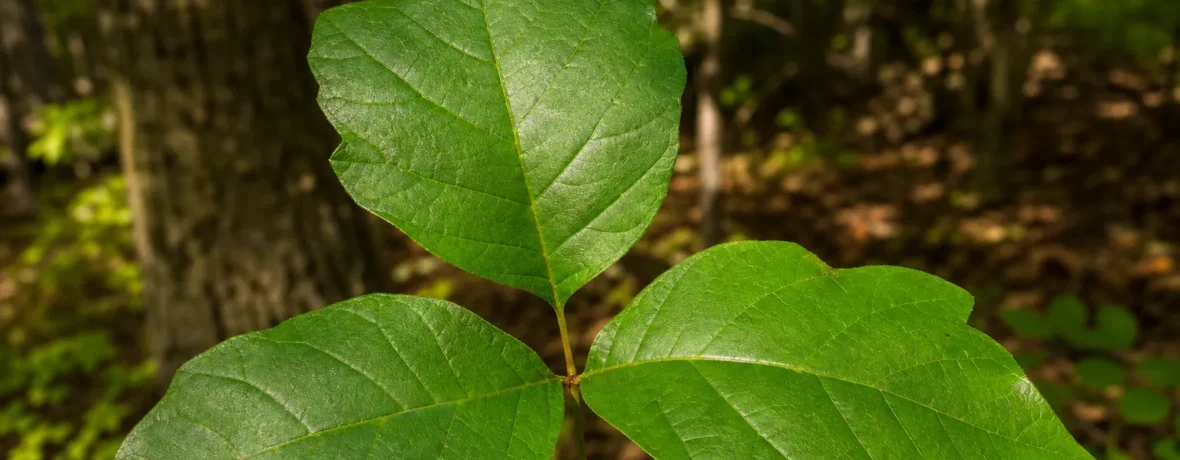
What does poison ivy look like? Poison ivy has compound leaves with 3 leaflets, often with a longer-stalked middle leaflet, no thorns, and sometimes a hairy-looking climbing vine. Leaves can be shiny or dull, smooth or toothed, green in summer, reddish in spring, and red, orange, or yellow in fall.
What does poison ivy look like on the trail?
Poison ivy usually shows up as three leaflets on one leaf, growing from a vine, shrub, or low groundcover.
The old line “leaves of three, let it be” is useful, but it is not enough by itself. Poison ivy is a shapeshifter. One plant can have neat oval leaflets while another has jagged, mitten-shaped edges. The surface may look glossy after rain or dull in dry shade. The size also varies, from small trail-edge sprouts to big, leafy vines climbing a tree.
For a stronger ID, look for the whole pattern:
- Three leaflets: one center leaflet and two side leaflets.
- Longer center stalk: the middle leaflet usually sits on a longer little stem than the side leaflets.
- Alternate leaves: leaf groups usually step back and forth along the stem rather than sitting directly opposite each other.
- No thorns: poison ivy does not have prickles like blackberry or raspberry canes.
- Hairy vine: older climbing vines can look fuzzy because of aerial rootlets gripping bark.
- Pale berries: mature plants can produce small whitish or cream-colored berries in clusters.
The Penn State Extension guide to poison ivy identification describes poison ivy as having three leaflets, variable leaf shape, and hairy aerial roots when it grows as a vine.
How to identify poison ivy before you brush against it?
Use a 5-step check: count the leaflets, check the center stalk, scan for thorns, look at the vine, and compare nearby plants.
- Count leaflets, not “leaves.” Poison ivy has 3 leaflets that make up one compound leaf.
- Look for the longer middle leaflet. The center leaflet often reaches out on a longer stalk, like a pointer finger.
- Check the edges. Smooth, toothed, wavy, or lobed edges can all be poison ivy, so do not rely on edge shape alone.
- Look for a hairy climbing stem. A thick, fuzzy vine on a tree trunk is a serious warning sign.
- Back up if you are unsure. Do not grab it for a closer look. Take a photo from a safe distance and compare it later.
That is the field method for how to identify poison ivy without playing leaf roulette. If your brain says “maybe,” treat it as a yes.
Does poison ivy always have leaves of three?
Poison ivy almost always has three leaflets, but “three leaves” alone does not prove the plant is poison ivy.
Many harmless or less irritating plants can mimic the pattern when young. Boxelder seedlings, young Virginia creeper, wild strawberry, and some blackberry or raspberry leaves can fool fast-moving hikers. That is why the full combination matters: three leaflets, longer center stalk, alternate arrangement, no thorns, and possibly a hairy vine.
Also, poison ivy can be dangerous in winter. Bare vines and stems still contain urushiol, the oily substance that triggers the rash. The NIH MedlinePlus page on poison ivy, oak, and sumac says the sap is found in the roots, stems, leaves, and fruit of these plants.
What plants look like poison ivy?
Several common trail plants look like poison ivy, especially when they are young.
| Plant | How it can fool you | Best clue | Trail advice |
|---|---|---|---|
| Virginia creeper | Young growth may show 3 leaflets | Mature leaves usually have 5 leaflets from one point | Still avoid grabbing; it can irritate some skin |
| Boxelder seedling | Can have 3 leaflets like poison ivy | Leaves often grow opposite each other on the stem | Check arrangement before judging |
| Blackberry or raspberry | Some leaves appear in groups of 3 | Canes usually have thorns or prickles | No thorns? Be more suspicious |
| Wild strawberry | Has 3 leaflets close to the ground | Small plant with toothed leaflets and runners | Do not use it as a handhold |
The cleanest split is often this: Virginia creeper tends toward five leaflets, blackberry has thorns, and boxelder often shows opposite leaves. Poison ivy keeps coming back to that three-leaflet, no-thorn, alternate-stem pattern.
What color is poison ivy in spring, summer, and fall?
Poison ivy changes color through the seasons, so green is not the only warning color.
- Spring: new leaves may look red, bronze, or shiny.
- Summer: leaves are usually green, either glossy or matte.
- Fall: foliage can turn yellow, orange, red, or deep crimson.
- Winter: leaves may be gone, but vines and stems can still carry urushiol.
Do not let pretty fall color talk you into touching it. A red three-leaflet vine along a trail edge deserves the same respect as a green one in July.
Where does poison ivy grow?
Poison ivy grows in many parts of the United States, especially along edges, disturbed ground, woods, fields, fences, and trails.
You are most likely to brush it where the tread narrows and plants lean into the corridor. Watch for it near trailheads, creek banks, old stone walls, campsites, and sunny forest edges. It can sprawl low across the ground, climb a tree, or form a woody shrub, so do not search for one single shape.
The CDC/NIOSH poisonous plants guidance identifies poison ivy, poison oak, and poison sumac as plants that release urushiol when damaged or burned. That oil can transfer from plants to skin, clothing, boots, tools, and pets.
What should you do if you touch poison ivy?
Wash your skin and gear as soon as you can.
Urushiol is oily. Your goal is to remove it before more of it binds to skin or spreads to your pack straps, trekking poles, dog leash, or car seat. Move calmly and clean up without scrubbing your skin raw.
- Rinse exposed skin with cool running water.
- Use soap or a poison-plant wash if available.
- Clean under fingernails.
- Bag contaminated clothing until it can be washed.
- Wash boots, tools, trekking poles, and pet fur that may have touched the plant.
- Never burn poison ivy; smoke can carry irritating particles.
The FDA guidance on poison ivy and poisonous plants says the rash happens where urushiol touches skin and is not spread across your body by scratching once the oil is gone.
When to see a doctor
See a doctor if the rash is widespread, severe, infected-looking, near sensitive areas, or lasts more than a few weeks.
This article can help you recognize the plant and reduce exposure, but it cannot diagnose a rash. Poison ivy reactions can look like red patches, swelling, intense itching, bumps, blisters, or streaks where the plant dragged across skin. Symptoms may appear hours to days after exposure.
Get medical help fast if you have trouble breathing or swallowing, especially after smoke exposure. Contact a clinician if the rash involves your face, eyes, mouth, or genitals; covers a large area; shows signs of infection; or keeps you from sleeping. The Mayo Clinic poison ivy rash guidance says medical treatment may be needed when a rash spreads widely, persists longer than a few weeks, or becomes infected.
Related reading
- What Does a Poison Ivy Rash Look Like?
- What Does Poison Sumac Look Like?
- What Does a Tick Bite Look Like? Photos and Warning Signs
- How Long Does Poison Ivy Last?
FAQ
Is poison ivy contagious?
No, the rash itself is not contagious. You can spread urushiol oil from skin, clothes, boots, tools, or pets if it has not been washed off.
Can poison ivy have red leaves?
Yes, poison ivy can have red leaves, especially in spring and fall. Do not judge by color alone; count the leaflets and look for the full plant pattern.
Does poison ivy grow as a vine or a bush?
It can grow as both. Poison ivy may crawl as groundcover, stand as a shrub, or climb trees and posts as a woody vine with hairy-looking aerial roots.
What is the easiest poison ivy lookalike to confuse with it?
Virginia creeper is one of the easiest lookalikes to confuse with poison ivy. Mature Virginia creeper usually has 5 leaflets, while poison ivy usually has 3.
Can you get poison ivy rash in winter?
Yes, you can react to poison ivy in winter. Leafless vines, stems, roots, and berries can still contain urushiol, so avoid touching bare “hairy” vines on trees.
Should you use a plant ID app for poison ivy?
Yes, but do not trust it as your only check. Use the app from a safe distance, then compare leaflet count, center stalk length, vine texture, thorns, and leaf arrangement before you decide it is safe.