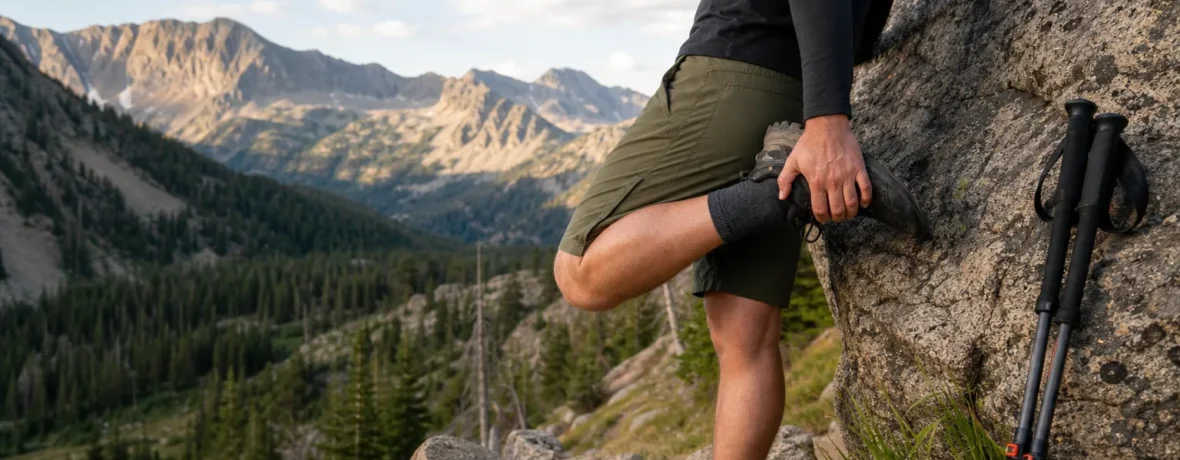
IT band syndrome is outer-knee pain caused by irritation where the iliotibial band moves near the knee, and downhill hiking can trigger it within minutes on steep descents. Stop pushing through sharp pain, shorten your stride, use poles, reduce downhill load, and get medical care if pain worsens or lasts several weeks.
Can hiking downhill cause it band syndrome?
Yes, downhill hiking can trigger it band syndrome, especially on long, steep, repetitive descents.
The iliotibial band is a thick strip of connective tissue running from the outside of your hip to just below the outside of your knee. MedlinePlus explains iliotibial band syndrome as irritation from rubbing near the outside of the hip or knee, and downhill movement can make symptoms worse.
Why downhill? Your knee bends and straightens over and over while your quads brake your body weight. Add a loaded pack, tired hips, loose dirt, big rock steps, and a long descent, and the outside of your knee can get cranky fast. The pain often starts as a hot spot, then turns into a sharp, stabbing, or burning feeling that makes every downhill step feel personal.
Why does my outside knee hurt going downhill?
Outer knee pain on descents often comes from irritated tissue around the iliotibial band, but it is not the only possible cause.
With classic IT band trouble, the pain usually sits on the outside of the knee, sometimes a finger-width or two above the joint line. It may feel fine on flat ground, then bark as soon as the trail tilts down. That pattern fits what hikers describe all the time: “Uphill was fine. Downhill wrecked me.”
Still, outer knee pain can also come from a meniscus injury, ligament sprain, patellofemoral pain, arthritis, tendon irritation, or referred pain from the hip. Mayo Clinic’s knee pain guide lists iliotibial band tightness as one possible cause of knee pain, not the only one. Treat the pattern seriously, but do not self-label every outside-knee ache as IT band syndrome.
| Clue | More like IT band irritation | Needs extra caution |
|---|---|---|
| Pain location | Outside of knee or outer thigh | Deep joint pain, major swelling, deformity |
| Trail pattern | Worse downhill, better with rest | Pain after a fall, twist, pop, or direct blow |
| Movement | Sharp during repeated bending | Knee locks, buckles, or cannot bear weight |
What should you do on trail when IT band pain starts?
Back off immediately and change how you descend.
Pushing through sharp lateral knee pain is how a minor flare turns into a miserable limp back to the car. Your first job is to calm the irritation and stop feeding it with the same movement pattern.
- Shorten your stride. Take small, quick steps instead of long braking steps.
- Use trekking poles. Plant both poles slightly ahead on steep sections to share load through your arms and trunk.
- Zigzag when safe. A gentle traverse can reduce the constant straight-down braking force.
- Loosen your pace. Rushing downhill pounds the knee harder and gives tired hips less control.
- Take pack weight off if possible. Shift shared gear, eat food weight, or dump unnecessary water only where refill is certain and safe.
- Stop before your gait changes badly. Limping can irritate your hip, ankle, or the other knee.
If pain fades after a short rest, continue conservatively. If it returns hard after a few minutes, make the smart call: shorten the route, skip the summit add-on, or turn around before the descent becomes a rescue problem.
How do you treat IT band syndrome after a hike?
Rest from the painful trigger, reduce irritation, then rebuild hip and leg control.
MedlinePlus recommends rest from painful activities, ice wrapped in cloth, and a gradual return to activity for IT band syndrome; it also notes that a physical therapist may work on hip and core strength, stretching, and form changes. The American Academy of Orthopaedic Surgeons also describes nonsurgical care as the usual path, commonly including rest, ice, and physical therapy.
For hikers, the key word is “trigger.” You may be able to walk flat neighborhood routes while steep descents still light up the knee. Keep the motion that does not hurt. Pause the motion that does.
- For the first few days: avoid steep downhill hiking, stairs for workouts, running descents, and heavy pack training if they reproduce pain.
- For symptom control: use cold packs wrapped in cloth after activity; do not put ice directly on skin.
- For training: choose flat walks, easy cycling, swimming, or gentle mobility if pain-free.
- For footwear: check worn-out shoes, poor traction, and unstable midsoles that let your knee collapse inward.
Avoid the trap of smashing the outside of your thigh with a foam roller and calling it rehab. Rolling may feel satisfying, but the hiking fix usually comes from better load management and stronger control at the hip, glutes, trunk, and foot.
What exercises help IT band syndrome for hikers?
Hip and glute strengthening usually matter more than aggressive IT band stretching.
Your IT band is tough connective tissue, not a shoelace you can simply yank longer. The muscles around it, especially the gluteus medius and other hip stabilizers, help control where your knee tracks when you step down. Weak or tired hips can let the knee dive inward, making descents uglier.
Use these as general exercise ideas, not a diagnosis or personalized prescription. Stop any move that increases sharp pain.
- Side-lying leg raises: slow lifts for outer-hip strength.
- Clamshells: controlled hip rotation without rolling your pelvis backward.
- Step-downs: small step height first, knee tracking over the middle toes.
- Single-leg balance: add pack weight only after pain-free control.
- Glute bridges: build hip extension without pounding the knee.
- Lateral band walks: short steps, level hips, no rushing.
Build slowly. Two or three quality sessions per week beats a heroic daily routine that leaves you sore and irritated. If you cannot do a low step-down without knee pain or knee wobble, your body is telling you the trail descent is not ready yet.
How can you prevent IT band pain on downhill hikes?
Train descents gradually instead of saving all downhill stress for one big mountain day.
Many hikers train by walking flat miles, then wonder why a 3,000-foot [914 m] descent crushes their knees. Flat fitness helps your heart. It does not fully prepare your legs for eccentric braking, loose footing, and thousands of downward steps.
- Progress elevation loss. Add downhill volume in small steps across weeks, not all at once.
- Practice with your real pack. A 25 lb [11 kg] pack changes your braking and balance.
- Use poles before pain starts. Do not wait until your knee is already yelling.
- Keep steps quiet. Loud downhill foot slaps usually mean heavy braking.
- Strength train year-round. Hips, glutes, calves, and quads all share the work.
- Plan descents honestly. The summit is only halfway if the car is below you.
On steep trails, think “soft knees, short steps, steady rhythm.” If you are leaning back hard, heel-braking every step, and landing with straight legs, your knees are paying the bill.
When to see a doctor
See a clinician if pain is severe, persistent, worsening, or linked to injury.
Get urgent medical care if you cannot bear weight, cannot bend or straighten the knee, see major swelling or deformity, have fever with redness and warmth, or heard a pop with sudden pain. Mayo Clinic’s knee pain symptom guidance flags several of these as reasons to seek emergency medical care.
Make a non-urgent appointment if outer knee pain keeps returning on hikes, does not improve after a few weeks of backing off, or changes your walking pattern. MedlinePlus says a provider may examine your knee, move your leg through positions, and use imaging such as X-ray, ultrasound, or MRI if needed. Do not chase injections, braces, or internet exercises before someone checks whether the problem is actually IT band syndrome.
Related reading
- Lyme Disease Symptoms After a Hike
- Hantavirus and Camping: Cabins, Shelters and Risk
- Electrolytes for Hikers: What They Are and How Much You Need
- What Does Poison Ivy Look Like? Leaves of Three and Lookalikes
FAQ
Can I hike with IT band syndrome?
Yes, but only if the hike does not reproduce sharp or worsening pain. Flat, short walks may be fine while steep descents are not; let symptoms guide the day, not your ego.
Does IT band syndrome go away on its own?
Sometimes it calms down with rest from the trigger and a gradual return. If you go right back to long downhill hikes without changing strength, pacing, or load, it often comes back.
Is stretching enough for IT band syndrome?
No, stretching alone is usually not enough for hikers. Most people need load reduction, hip and glute strengthening, better downhill technique, and a careful return to descents.
Are trekking poles good for IT band pain?
Yes, trekking poles can help by sharing some downhill load and improving balance. They work best when used early, with short steps, instead of as a last-ditch crutch after pain has already spiked.
What does IT band syndrome feel like?
It often feels like burning, aching, or sharp pain on the outside of the knee that worsens with repeated bending, especially downhill. Pain may ease with rest, then return when the descent starts again.
Should I use pain medicine and keep hiking?
No, do not use pain medicine to mask worsening knee pain so you can keep descending hard. Talk with a healthcare professional before using medicines if you have medical conditions, take other medications, or the pain keeps returning.