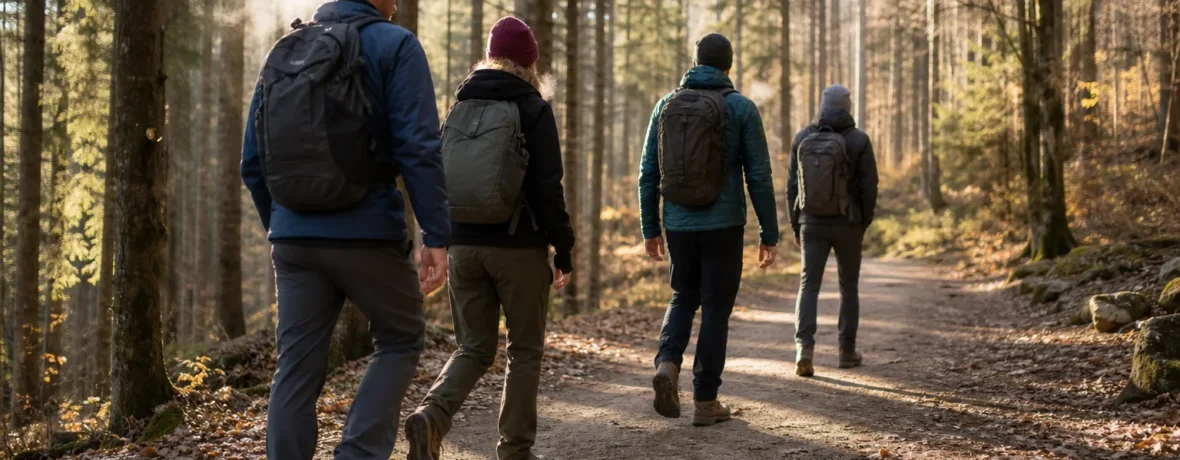
What is a good hiking pace? For most day hikers, 2 to 3 mph [3.2 to 4.8 km/h] on easy to moderate trails is solid. Steep climbs, rough footing, heat, altitude, and a loaded pack can drop that to 1 to 2 mph [1.6 to 3.2 km/h].
What is a good hiking pace for a day hike?
A good hiking pace is the speed you can hold while breathing steadily and still making safe choices.
On a smooth trail with mild grades, many hikers settle into 2.5 mph [4 km/h]. That means a 6-mile [9.7 km] hike takes 2 hours 24 minutes before snack stops, photos, layers, water filtering, and route-finding. Add those breaks and the same hike can easily fill 3 to 4 hours.
Do not chase someone else’s pace. A fast hiker who misses blazes, skips water, and burns their legs in the first hour is not moving well. The best pace keeps your group together, your footing clean, and your energy steady for the walk back.
What is the average hiking speed on different trails?
The average hiking speed changes sharply with grade, surface, pack weight, and weather.
| Trail type | Typical pace | What it feels like |
|---|---|---|
| Flat, smooth path | 3 mph [4.8 km/h] | Brisk walk, easy footing |
| Rolling forest trail | 2 to 2.5 mph [3.2 to 4 km/h] | Steady effort, short climbs |
| Steep mountain trail | 1 to 2 mph [1.6 to 3.2 km/h] | Heavy breathing, frequent grade changes |
| Loose rock, snow, mud, or bushy trail | 0.5 to 1.5 mph [0.8 to 2.4 km/h] | Slow feet, careful balance |
These numbers are planning ranges, not a scoreboard. A trail with 3,000 ft [914 m] of gain in 4 miles [6.4 km] will not move like a rail trail. A sandy desert wash will not move like packed dirt. Wet roots can turn a “quick” descent into the slowest mile of the day.
How do you calculate hiking time with Naismith’s Rule?
Naismith’s Rule estimates hiking time by adding distance time and climb time.
The classic version is simple: allow 1 hour for every 3 miles [4.8 km] forward, plus 1 extra hour for every 2,000 ft [610 m] of ascent. The U.S. Forest Service describes this formula in research on travel rates and terrain modeling: Naismith’s Rule allows one hour per three miles plus one hour per 2,000 feet of ascent.
- Measure the trail distance in miles.
- Divide distance by 3.
- Find the total elevation gain in feet.
- Divide elevation gain by 2,000.
- Add both numbers for moving time in hours.
- Add break time separately.
Example: a 9-mile [14.5 km] hike with 2,000 ft [610 m] of gain.
Distance: 9 ÷ 3 = 3 hours. Climb: 2,000 ÷ 2,000 = 1 hour. Naismith estimate: 4 hours of moving time. If you plan three 10-minute breaks and one 20-minute lunch, your trailhead-to-trailhead time becomes 4 hours 50 minutes.
Does Naismith’s Rule work for downhill hiking?
Naismith’s Rule handles climbing better than descending.
Gentle downhill can be faster than flat hiking. Steep downhill can be slower, especially with tired legs or a heavy pack. Your knees, ankles, and toes take the bill. If the route drops over talus, wet slabs, roots, or loose gravel, keep the pace conservative.
A practical adjustment: treat easy downhill as neutral, treat rough downhill as uphill, and add time when the descent is steep enough that you shorten your stride. If your toes are jamming the front of your shoes, your pace is no longer the main problem. Stop, tighten your heel lock, and slow down.
What slows down your hiking pace the most?
The biggest pace killers are steep grade, bad footing, heat, altitude, heavy packs, and group management.
- Elevation gain: Climbing 1,000 ft [305 m] changes the day more than adding 1 flat mile [1.6 km].
- Trail surface: Rock hops, mud, snow, sand, and roots force shorter steps.
- Pack weight: Extra food, water, camera gear, and overnight equipment cut speed.
- Heat: Hot conditions demand more water breaks and lower effort.
- Altitude: Higher elevations can make an easy pace feel hard. The CDC says travelers with medical conditions should consult a clinician before high-altitude travel, and altitude illness can develop after ascent to high elevations; read the CDC guidance on high-altitude travel and altitude illness.
- Group size: Five hikers rarely move like one hiker. Shoe fixes, layers, snacks, and bathroom stops stack up.
How can you find your own hiking pace?
Track a few hikes and use your real numbers.
Pick a trail you know, then record distance, elevation gain, moving time, and total time. Do not use one perfect-weather hike as your master number. Use three to five hikes with different terrain. Patterns show up fast.
- Choose a route between 3 and 6 miles [4.8 and 9.7 km].
- Start at a pace that lets you speak in full sentences.
- Check your time at each mile marker or map point.
- Write down moving time and stopped time separately.
- Repeat on a steeper trail.
- Use the slower number when planning new terrain.
The talk test is useful here. The CDC says moderate-intensity activity lets you talk but not sing, while vigorous activity makes talking harder; see the CDC guide to measuring physical activity intensity. For long hikes, most people do better below redline effort. Save the gas for the last climb, not the first one.
How do you hike faster without burning out?
Move smoother before you try to move faster.
- Take shorter steps on climbs instead of lunging.
- Keep snack and water stops planned, not random.
- Use trekking poles on steep or loose terrain if they help your balance.
- Pack less weight when the route allows it.
- Start slightly slower than you want to finish.
- Practice climbing, not just flat walking.
Fast hiking is not frantic hiking. The efficient hiker looks boring from the outside: steady cadence, quiet breathing, clean foot placement, few long stops. That is the goal. Less drama. More miles.
When to see a doctor
See a doctor if shortness of breath, chest pain, dizziness, fainting, or unusual fatigue shows up outside normal hard exertion.
Hiking should make you breathe harder. It should not make you feel like something is wrong. Mayo Clinic says shortness of breath that cannot be explained by rigorous exertion or exercise needs prompt evaluation, and emergency care is needed when shortness of breath comes with chest pain lasting more than a few minutes; see Mayo Clinic guidance on shortness of breath.
If you are planning high-altitude hiking and have heart, lung, blood, or sleep-related conditions, talk with a clinician before the trip. On trail, stop ascending if you develop concerning altitude symptoms such as headache with nausea, dizziness, unusual fatigue, or worsening breathlessness. Do not diagnose yourself from a pace chart.
Related reading
- What Is a Good Walking Pace?
- Is Jump Rope Good Cardio?
- Is the StairMaster Good Cardio for Hiking Fitness?
- Is Rowing Good Cardio?
FAQ
Is 2 mph a good hiking pace?
Yes, 2 mph [3.2 km/h] is a good hiking pace on many real trails. It is especially reasonable with hills, roots, rocks, heat, or a day pack.
How long should a 5-mile hike take?
A 5-mile [8 km] hike usually takes 1 hour 40 minutes to 2 hours 30 minutes of moving time on moderate terrain. Add breaks, photos, and navigation time, and plan for 2.5 to 4 hours total.
What pace is too slow for hiking?
A pace is too slow only if it creates a safety problem, such as finishing after dark without lights or running out of water. For planning, use your slowest realistic speed, then add a buffer.
Do hiking poles make you faster?
Sometimes. Hiking poles can improve rhythm and balance on climbs, descents, stream crossings, and loose ground, but they will not fix poor fitness or an overloaded pack.
Should beginners use Naismith’s Rule?
Yes, beginners can use Naismith’s Rule as a starting estimate. Add extra time for breaks, rough trail, heat, snow, altitude, and any group member who is new to hiking.