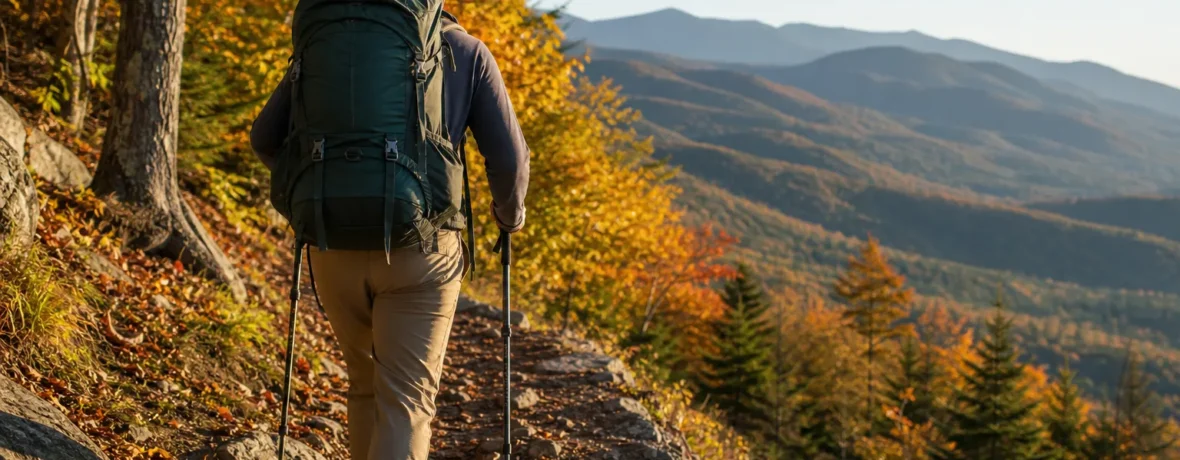
Give yourself 8 weeks, hike 3 days a week, strength train 2 days, and build your pack from 10 lb [4.5 kg] to trip weight. Add hills early, practice descents, and keep the heaviest pack day 6–8 days before departure.
How to train for backpacking with a loaded pack?
Train by carrying weight often, but not heavy every day.
A backpacking pack changes everything. Your stride shortens. Your calves work harder on climbs. Your quads take a beating on descents. Your shoulders, hips, and core have to stabilize the load for hours, not minutes. The goal is not to prove toughness on one monster training hike. The goal is to arrive at the trailhead with legs, lungs, feet, and joints that already know the job.
Use this simple weekly structure:
- 3 walking or hiking days: one easy walk, one hill or stair session, one longer loaded hike.
- 2 strength days: legs, hips, calves, core, and upper back.
- 1 mobility or easy recovery day: light walking, stretching, or gentle cycling.
- 1 full rest day: no heroic chores, no “quick” weighted stair workout.
The CDC physical activity guidelines for adults recommend weekly aerobic activity plus muscle-strengthening work on 2 days. Backpacking training fits that pattern well: you need endurance to move for hours and strength to handle load, uneven ground, and repeated downhill braking.
How heavy should your training pack be?
Start lighter than your ego wants.
For the first loaded sessions, use 10–15 lb [4.5–6.8 kg] if you are new to backpacking or returning after a break. If you already hike weekly, start with 20 lb [9.1 kg]. Add 5 lb [2.3 kg] at a time only when your feet, knees, hips, and back feel normal the next day.
Your final long training hike should use the same weight you expect to carry on the trip, including water. Do not make the first day of your trip the first day your body feels that load.
| Trip pack weight | Starting training weight | Final training target |
|---|---|---|
| 20 lb [9.1 kg] | 10 lb [4.5 kg] | 20 lb [9.1 kg] |
| 30 lb [13.6 kg] | 15 lb [6.8 kg] | 30 lb [13.6 kg] |
| 40 lb [18.1 kg] | 20 lb [9.1 kg] | 35–40 lb [15.9–18.1 kg] |
Pack the weight like a real trip. Heavy items should sit close to your spine and centered between your shoulder blades and hips. A sloppy pack filled with loose dumbbells or shifting water jugs teaches your body to fight a bad load. Use your actual backpack, actual shoes, and actual trekking poles if you plan to use them.
How to train for a backpacking trip in 8 weeks?
Build distance, weight, and elevation one layer at a time.
An 8-week plan works for a weekend or moderate multi-day trip if you already walk without pain. If you are starting from the couch, give yourself 12–16 weeks. If your route has high altitude, long water carries, snow travel, desert heat, or 4,000 ft [1,219 m] climbing days, stretch the plan and train more specifically.
- Weeks 1–2: Build the habit. Walk 3 times weekly. Make one walk 60–90 minutes with 10–15 lb [4.5–6.8 kg]. Add one strength day if two feels like too much at first.
- Weeks 3–4: Add hills. Keep 3 weekly walks. Make one a hill, stair, or treadmill incline session. Your long hike should reach 2–3 hours with 15–25 lb [6.8–11.3 kg].
- Weeks 5–6: Train the long day. Hike 3–5 hours once per week. Carry 70–85 percent of your expected trip weight. Practice eating, drinking, adjusting layers, and managing hot spots.
- Week 7: Peak. Do your longest loaded hike 6–8 days before departure. Use trip weight, similar shoes, and similar terrain. Stop while you still have clean form.
- Week 8: Taper. Cut volume by half. Keep walking, keep mobility, and keep one short pack session. No last-minute sufferfest.
A good taper feels too easy. That is the point. You are not getting fitter in the final 48 hours before a trip. You are either staying sharp or making yourself sore.
What exercises help most for backpacking?
Train legs, hips, calves, core, and upper back.
Backpacking strength is not bodybuilding. You need controlled steps, steady hips, durable ankles, and a torso that does not fold under weight. Use loads you can control. Clean reps beat sloppy heavy reps every time.
- Step-ups: Use an 8–16 in [20–41 cm] box or bench. Drive through the whole foot. Step down slowly.
- Split squats: Build single-leg strength for climbs, descents, and uneven trail.
- Romanian deadlifts: Train hamstrings and glutes for climbing power and hip stability.
- Calf raises: Do straight-knee and bent-knee versions. Your lower legs work all day in stiff terrain.
- Side planks: Train lateral core strength so the pack does not yank you around.
- Rows: Strengthen upper back muscles that help support shoulder straps and posture.
- Farmer carries: Walk with weight in both hands to train grip, bracing, and loaded posture.
Do 2–4 sets of 6–12 reps for strength exercises. For carries, use 30–60 seconds per set. Rest enough that your next set looks solid. The NIH muscle-strengthening checklist supports training major muscle groups at least 2 days each week, which matches the sweet spot for most backpackers.
How do you train for hills and descents?
Climb for your lungs, descend for your legs.
Most hikers train uphill and forget the downhill. Then the trip starts fine, the summit feels great, and the descent cooks the quads. Downhill hiking creates repeated braking forces. A loaded pack magnifies them.
Add one hill-focused workout each week:
- Hill repeats: Walk uphill 3–5 minutes, descend under control, repeat 4–8 times.
- Stairs: Climb steadily for 20–40 minutes. Walk down slowly. Hold the rail only for balance.
- Treadmill incline: Use 8–15 percent incline for 30–45 minutes when you lack hills.
- Downhill practice: Find a safe grade and focus on short steps, soft knees, and quiet feet.
Keep your torso tall on climbs. On descents, avoid leaning back hard. That turns your knees into brakes. Shorten your stride and let trekking poles share some load if you use them.
How far should your longest training hike be?
Your longest training hike should mimic your hardest trip day, not exceed it.
If your first trip day is 8 mi [12.9 km] with 2,000 ft [610 m] of gain, a 6–8 mi [9.7–12.9 km] training hike with hills and full pack weight is useful. You do not need to duplicate every mile of a 4-day route before you leave. You need enough practice that the first day does not shock your body.
Use time on feet as much as mileage. A rocky 5 mi [8 km] trail with 1,500 ft [457 m] of gain can train you better than a flat 10 mi [16.1 km] path. Match the terrain whenever possible: sand for desert routes, stairs for canyon trips, roots and rocks for mountain trails.
What should you practice before the trip besides fitness?
Practice the systems that fail when you are tired.
Training hikes are not just workouts. They are rehearsals. Every long loaded hike should answer practical questions before the real trip asks them loudly.
- Footwear: Wear the socks and shoes you plan to use. Treat hot spots immediately.
- Pack fit: Adjust hip belt, shoulder straps, load lifters, and sternum strap while moving.
- Fuel: Eat trail food during training, not mystery snacks on day one.
- Water: Practice carrying the amount your route demands and drinking steadily.
- Poles: If you bring them, train with them on climbs and descents.
- Layering: Test rain gear, sun layers, and insulation during real movement.
- Recovery: Notice what hurts the next day. Feet and joints are honest reviewers.
Blisters can derail a strong hiker fast. Mayo Clinic’s blister first aid guidance recommends acting early on hot spots, using well-fitting shoes, choosing moisture-wicking socks, and changing into dry socks when needed.
When to see a doctor
See a clinician before training if pain, medical history, or altitude risk raises red flags.
This guide is training advice, not a diagnosis. Talk with a doctor, physical therapist, or qualified medical professional before starting loaded-pack training if you have chest pain, unexplained shortness of breath, fainting, a recent injury, a heart or lung condition, uncontrolled asthma, diabetes complications, or joint pain that changes how you walk.
Get medical care promptly if knee pain follows a forceful injury, swelling is significant, you cannot bear weight, the joint looks deformed, or you have fever with redness and swelling. Mayo Clinic’s knee pain guidance lists several symptoms that call for medical evaluation.
Heat and altitude deserve respect. The CDC lists confusion, slurred speech, loss of consciousness, and very high body temperature among heat-stroke warning signs that require emergency action; review the CDC’s heat-related illness signs before training in hot weather. For high routes, the CDC’s high-altitude travel guidance recommends gradual acclimatization and medical planning for travelers with relevant health conditions.
How do you know your backpacking training is working?
You are ready when loaded hiking feels repeatable.
The best sign is not speed. It is how you feel the next morning. If you can hike with your trip-weight pack, climb and descend similar terrain, eat normally afterward, sleep well, and walk comfortably the next day, your training is doing its job.
Use this readiness checklist 1 week before departure:
- You completed one loaded hike within 80–100 percent of trip pack weight.
- You walked at least 3 hours on terrain similar to your route.
- Your shoes and socks caused no untreated hot spots.
- You tested your pack fit with full water.
- You practiced eating and drinking during movement.
- You can climb stairs or hills without knee, hip, or back pain changing your gait.
- You have a plan for heat, cold, altitude, water, and bailout points.
If two or more items fail, adjust the trip. Shorten the first day. Lower pack weight. Add a rest day. Pick a route with less elevation. Smart changes beat stubborn suffering.
What mistakes should you avoid when training with a loaded pack?
The big mistake is doing too much, too late.
Backpacking punishes panic training. A huge pack hike 3 days before the trip only adds soreness and blisters. Start early and progress steadily.
- Do not run with a backpacking pack. It adds impact and trains a movement you will not use on trail.
- Do not add weight and distance in the same week every time. Increase one stress first, then the other.
- Do not ignore downhill pain. Descents reveal weak spots before climbs do.
- Do not train only on pavement. Trails require ankle and hip control that sidewalks barely touch.
- Do not skip rest days. Adaptation happens between workouts.
- Do not change shoes right before departure. New footwear belongs in training, not at the trailhead.
Related reading
- How to Train for a Long-Distance Hike
- How to Train for High-Altitude Hiking at Sea Level
- How to Train for Kilimanjaro
- How to Train for the Everest Base Camp Trek
FAQ
Can I train for backpacking without hiking trails nearby?
Yes, you can train with stairs, treadmill incline, sidewalks, gym strength work, and loaded walks. Use parks, parking garages, stadium stairs, or repeated neighborhood hills to build climbing and descending practice.
How many days per week should I train for backpacking?
Train 4–5 days per week for most trips. A solid week includes 3 walking or hiking days, 2 strength sessions, and at least 1 full rest day.
Should I train with the same backpack I will use on the trip?
Yes, use your actual backpack as early as possible. Pack fit, hip belt placement, shoulder pressure, and load balance all need practice under real weight.
Is walking enough to prepare for backpacking?
Walking is the base, but it is not enough for every route. Add hills, loaded hikes, strength training, and downhill practice if your trip includes elevation gain, rough footing, or multi-day mileage.
When should I stop hard training before a backpacking trip?
Stop hard training 6–8 days before departure. During the final week, keep moving with short walks, light mobility, and one easy pack session, but avoid new exercises and long loaded hikes.
What if my knees hurt during loaded-pack training?
Stop the session if pain changes your stride or worsens as you continue. Reduce pack weight, shorten descents, work on strength, and see a medical professional if pain persists, swelling appears, or you cannot bear weight normally.